Cancer diagnoses could reach record high in 2024. Here's how alcohol increases risk.

Minerva Studio // Shutterstock

Originally published on northwell.edu, part of the BLOX Digital Content Exchange.

Every day this year, almost 5,500 Americans, on average, will get the news that they have some form of cancer.
That's as the risk of dying from cancer has declined over the last three decades, a trend the American Cancer Society attributes to lower rates of cigarette smoking, early detection, and advancements in cancer treatment.
But the organization is also warning that 2024 could be a record year for common cancer diagnoses in Americans—a third of which are known to be heavily influenced by alcohol habits.
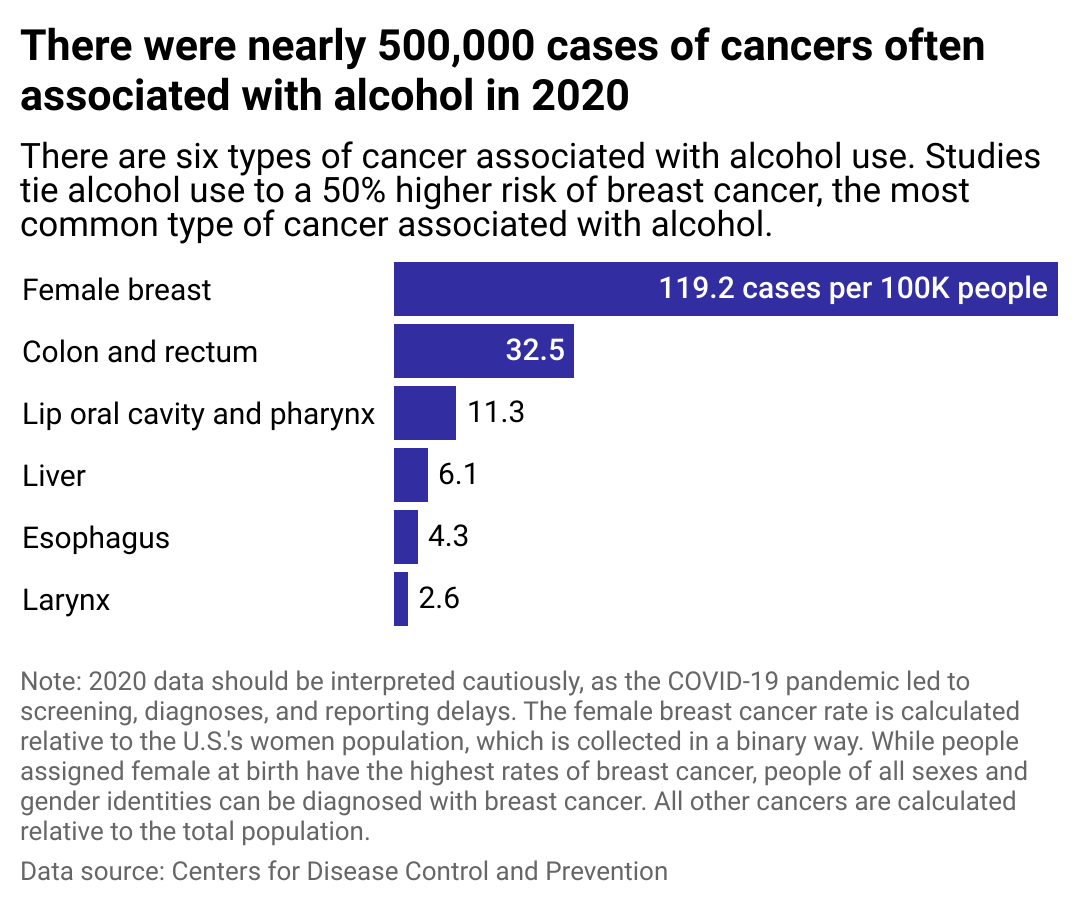
To break down the rates of alcohol-associated cancers, Northwell Health partnered with Stacker to visualize the latest available data from the Centers for Disease Control and Prevention.
In 2020, there were over 450,000 new cancer cases associated with alcohol consumption, according to the CDC.
Health experts advise there is no safe amount of alcohol for humans to consume. Still, the more a person incorporates alcohol into their lifestyle, the more the risks of developing related cancers grow. As alcohol intake increases, so, too, does the risk of cancer. Studies have found that daily drinking can increase rates of breast cancer by 50% and colorectal cancer by 40%.
These unfortunate cancer diagnosis trends are emerging in a world still trying to get its footing after the COVID-19 pandemic, which drove an uptick in risky alcohol use, among other unhealthy habits. Overall, few Americans are aware of the consequences of regularly drinking alcoholic beverages.

Public service campaigns in the late 1900s were successful in educating many Americans about the potential for smoking cigarettes to cause cancer, but alcohol is also a carcinogenic substance.
Most Americans will use alcohol at some point in their lives. However, less than a third know that alcoholic beverages such as wine, beer, and liquors can raise the risk of developing cancer, according to a nationally representative survey of Americans published in 2023. One in 10 Americans surveyed believed consuming wine decreases the risk of cancer; however, the opposite is true of all forms of alcohol.
When alcohol enters the body, it's broken down into the chemical acetaldehyde. Acetaldehyde attacks DNA cells, which regulate cell growth, and cells can grow out of control, forming cancerous tumors, according to the CDC.
The American Cancer Society notes that the COVID-19 pandemic may have also contributed to delayed diagnoses, but the report notes that it will take many years to parse out those effects.
Story editing by Ashleigh Graf. Copy editing by Paris Close. Photo selection by Clarese Moller.
This story originally appeared on Northwell Health and was produced and distributed in partnership with Stacker Studio.
Originally published on northwell.edu, part of the BLOX Digital Content Exchange.
Please disable your ad blocker, whitelist our site, or purchase a subscription


Sorry, an error occurred.
Already Subscribed!
Cancel anytime
Thank you .
Your account has been registered, and you are now logged in.
Check your email for details.
Submitting this form below will send a message to your email with a link to change your password.
An email message containing instructions on how to reset your password has been sent to the email address listed on your account.
No promotional rates found.
Secure & Encrypted
Thank you.
Your gift purchase was successful! Your purchase was successful, and you are now logged in.
| Rate: | |
| Begins: | |
| Transaction ID: |
A receipt was sent to your email.
(0) comments
Welcome to the discussion.
Log In
Keep it Clean. Please avoid obscene, vulgar, lewd, racist or sexually-oriented language.
PLEASE TURN OFF YOUR CAPS LOCK.
Don't Threaten. Threats of harming another person will not be tolerated.
Be Truthful. Don't knowingly lie about anyone or anything.
Be Nice. No racism, sexism or any sort of -ism that is degrading to another person.
Be Proactive. Use the 'Report' link on each comment to let us know of abusive posts.
Share with Us. We'd love to hear eyewitness accounts, the history behind an article.