As AI workloads become increasingly demanding, data centers are facing a critical memory-wall challenge – the growing gap between processor performance and the speed at which data can be accessed from memory. Credo Technology Group Holding Ltd.CRDO is addressing this bottleneck by developing a new open interconnect standard within the Open Compute Project (OCP). It has established the OCP Open Chiplet Economy (OCE) Lightweight Serial Interconnect (LSI) Workstream, aimed at developing efficient interconnect solutions for AI infrastructure. As part of the initiative, Credo plans to contribute its OmniConnect lightweight AXI framer specification to OCP.
HBM has become a key component of modern AI systems, but its high cost, limited availability and density constraints are creating challenges as AI infrastructure scales. Credo believes a lightweight serial interconnect could offer a more flexible way to connect compute and memory resources. By enabling memory disaggregation and chip-to-chip communication, the technology could allow AI system designers to build more modular architectures. According to Credo, these composable designs could deliver up to 25 times greater memory density and 5% higher bandwidth than HBM4 in certain configurations.
The OCP LSI initiative is designed to support an open, interoperable ecosystem where compute, memory and other resources can be combined more efficiently. This could allow data-center operators and AI developers to tailor systems to specific workloads rather than relying on fixed architectures. Credo's OmniConnect technology uses an AXI-over-VSR (Very Short Reach) SerDes bus, supporting both die-to-die connectivity and scale-up networking. The approach can connect multiple compute engines through external chiplets, potentially enabling new modular and near-package architectures for AI inference.
Credo’s OCP initiative not only strengthens its position in chiplet-based AI infrastructure but also expands opportunities for OmniConnect. The move supports the industry shift toward open, modular and scalable AI architectures that address memory and interconnect bottlenecks.
Navigating CRDO’s Competitive Battlefield
Astera Labs ALAB is benefiting from rising demand for high-speed connectivity as AI infrastructure shifts toward larger rack-scale systems. ALAB’s second-quarter revenues surged 104.4% to $392.4 million, led by broad-based demand across AI fabrics and signal-conditioning products, driving the upside, while PCIe 6 offerings generated more than half of quarterly revenues. Management cited expanding design activity across customers and product categories as AI infrastructure deployments require greater connectivity bandwidth and more complex switching architectures. In July, it expanded its Taurus portfolio with the industry’s first OCP-standard footprint-compatible 3.2T Smart Retimers and Smart Redrivers, designed for 200G-per-lane Ethernet, UALink and ESUN connectivity in AI infrastructure.
Marvell TechnologyMRVL is benefiting from AI-led demand across the data center end market, with custom silicon, interconnect, switching and optics driving record revenues and a higher multi-year outlook. Marvell’s custom silicon strategy continues to benefit from hyperscaler demand for differentiated XPU and XPU-attach solutions. MRVL now expects custom revenues to grow more than 20% year over year in fiscal 2027 and to more than double in fiscal 2028, driven by multiple program ramp-ups. Recently, MRVL unveiled AI memory innovations spanning server storage, rack-scale CXL memory and pod-level optical shared memory, enabling hyperscalers to scale memory independently from compute and improve AI infrastructure efficiency.
CRDO’s Price Performance, Valuation and Estimates
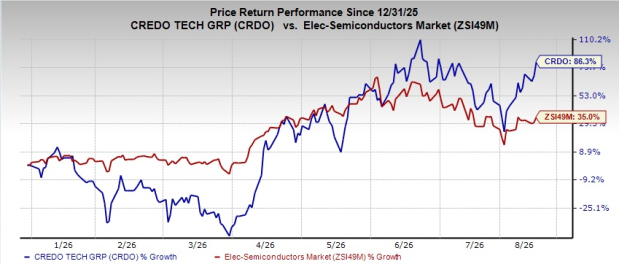
Shares of CRDO have gained 86.3% year to date compared with the Electronics-Semiconductors industry’s growth of 35%.
Image Source: Zacks Investment Research
In terms of the forward 12-month price/sales ratio, CRDO is trading at 18.75, higher than the Electronics-Semiconductors industry’s multiple of 5.41.
Image Source: Zacks Investment Research
The Zacks Consensus Estimate for CRDO earnings for fiscal 2027 has been marginally revised upwards over the past 60 days.
Zacks' Research Chief Names "Stock Most Likely to Double"
Our team of experts has just released the 5 stocks with the greatest probability of gaining +100% or more in the coming months. Of those 5, Director of Research Sheraz Mian highlights the one stock set to climb highest.
This top pick is a little-known satellite-based communications firm. Space is projected to become a trillion dollar industry, and this company's customer base is growing fast. Analysts have forecasted a major revenue breakout in 2025. Of course, all our elite picks aren't winners but this one could far surpass earlier Zacks' Stocks Set to Double like Hims & Hers Health, which shot up +209%.
Want the latest recommendations from Zacks Investment Research? Today, you can download 7 Best Stocks for the Next 30 Days. Click to get this free report
Keep it Clean. Please avoid obscene, vulgar, lewd,
racist or sexually-oriented language. PLEASE TURN OFF YOUR CAPS LOCK. Don't Threaten. Threats of harming another
person will not be tolerated. Be Truthful. Don't knowingly lie about anyone
or anything. Be Nice. No racism, sexism or any sort of -ism
that is degrading to another person. Be Proactive. Use the 'Report' link on
each comment to let us know of abusive posts. Share with Us. We'd love to hear eyewitness
accounts, the history behind an article.



(0) comments
Welcome to the discussion.
Log In
Keep it Clean. Please avoid obscene, vulgar, lewd, racist or sexually-oriented language.
PLEASE TURN OFF YOUR CAPS LOCK.
Don't Threaten. Threats of harming another person will not be tolerated.
Be Truthful. Don't knowingly lie about anyone or anything.
Be Nice. No racism, sexism or any sort of -ism that is degrading to another person.
Be Proactive. Use the 'Report' link on each comment to let us know of abusive posts.
Share with Us. We'd love to hear eyewitness accounts, the history behind an article.