
Amid the proliferation of artificial intelligence (AI), investors are focusing on companies that provide the infrastructure behind it. This is creating strong market opportunities for companies specializing in high-speed connectivity solutions essential to AI data centers.
Credo Technology Group Holding Ltd. CRDO and Astera Labs ALAB are prominent pure-play beneficiaries of this trend. Both players bring their unique strengths to the table, making it an intriguing comparison for investors.
Now the question arises: which stock makes a better investment pick at present? Let us dive into the fundamentals, valuations, growth outlook and risks for each company.
The Case for CRDO
CRDO’s focus on high-performance, energy-efficient connectivity solutions gives it strategic relevance as hyperscalers and cloud service providers overhaul their network architectures. Fiscal 2026 was a breakout year, with revenues surpassing $1.3 billion, more than tripling year over year. Non-GAAP net income increased more than fivefold.
AECs sit at the core of its growth narrative, playing an increasingly critical role in AI-driven networking deployments. According to Credo, the adoption of zero-flap AECs is accelerating because they deliver up to 1,000x higher reliability while consuming less power compared with optical alternatives. These advantages are particularly valuable in large XPU clusters, where network failures can disrupt operations and lead to high costs. Beyond the traditional hyperscalers, Credo is also seeing increasing demand from emerging Neocloud providers.
In addition to AEC, CRDO is now focusing on the optical business. The company expects mid-single-digit sequential growth in the first half of fiscal 2027, followed by a stronger second-half acceleration buoyed by its optical portfolio. Management projects more than $600 million in optical revenues, with ZeroFlap optics, silicon photonics PICs and optical DSPs each contributing more than $100 million. This is expected to support more than 80% year-over-year revenue growth for the full year.
The acquisition of DustPhotonics strengthens Credo’s high-speed optical connectivity portfolio with silicon photonics PIC technology. The deal adds advanced technology, including 800G and 1.6T solutions, and brings a roadmap to 3.2T solutions and beyond.
Credo Technology Group Holding Ltd. Revenue (TTM)

Credo Technology Group Holding Ltd. revenue-ttm | Credo Technology Group Holding Ltd. Quote
As revenues scale, Credo is beginning to show signs of operating leverage. For fiscal 2027, gross margins are projected to stay in line with fiscal 2026 levels, while non-GAAP net margins are expected to remain around 50%, even as the company continues to invest in R&D.
However, no investment case is without risks. Macroeconomic uncertainties and exposure to the AI investment cycle amid increasing market competition remain concerns. On the last earnings call, Credo noted ongoing tightness in the supply chain. While the company has taken steps to secure capacity, disruptions could still affect its ability to meet demand.
The Case for ALAB
Strong business momentum for ALAB is underpinned by the expanding role in delivering comprehensive connectivity infrastructure at the rack scale. The company is benefiting from increased spending on AI and cloud infrastructure by hyperscalers. On the last earnings call, management highlighted several industry forecasts that point to hyperscaler AI and cloud infrastructure spending in 2027 reaching into the $1 trillion range as sovereign AI, inference workloads and enterprise adoption expand rapidly.
The company recently reported second-quarter 2026 results, wherein revenues surged 104% year over year to $392.4 million and increased 27% sequentially. Broad-based strength, particularly for its AI fabric and signal-conditioning portfolios, acted as catalysts. PCIe 6 products (across AI fabric and signal conditioning portfolio) accounted for more than half of total revenues, up from roughly one-third in the prior quarter.
Scorpio AI Fabric Switch portfolio is a key catalyst for ALAB. The high-radix Scorpio X-Series has entered volume production and is expected to ramp significantly in the second half. Scorpio is expected to become ALAB’s largest product family in the third quarter, one quarter earlier than previously anticipated. At present, the company is shipping multiple Scorpio X configurations for scale-up applications to its initial customers and expects to ship to more customers by year-end.
Management estimates the merchant scale-up switching TAM at $20 billion and expects the content opportunity for Scorpio X alone to eventually exceed $1,000 per XPU in future generations of AI platforms.

Beyond Scorpio, Astera has multiple growth engines. Aries is benefiting from retimers and gearboxes adoption across scale-up and scale-out networks in AI and general-purpose platforms. Taurus is benefiting from the transition toward 800G connectivity. The recently expanded 200-gig-per-lane retimers and redrivers are expected to double the addressable opportunity for Taurus to more than $4 billion by 2030. Meanwhile, renewed CXL momentum has resulted in a new Leo design win at a U.S. hyperscaler, with standard and custom Leo memory controllers expected to ship in volume to two U.S. hyperscalers in 2027.
Strong growth is translating into operating leverage as well. Second-quarter non-GAAP operating margin expanded 290 basis points sequentially to 39.1%. For the third quarter, ALAB expects revenues of $540-$560 million, implying roughly 40% sequential growth at the midpoint, while non-GAAP operating margin is projected to reach approximately 43%, expanding 400 bps sequentially.
However, Astera’s increasing investment across PCIe 7, UALink, optical connectivity and custom silicon, while a necessity, might prove a drag on margins if revenue growth falters as costs are incurred ahead of several expected revenue ramps. Operating expenses rose to $135.8 million, and the company expects further increases in the range of $156 million to $160 million in the third quarter of 2026. Execution risks, competitive semiconductor landscape, along with dynamic macro environment and other variables, remain a concern.
Price Performance & Valuations of CRDO & ALAB
Year to date, both CRDO and ALAB are up 63.2% and 73.8%, respectively.

Image Source: Zacks Investment Research
In terms of the forward 12-month price/sales multiple, Credo is trading at 16.29X, lower than ALAB’s 19.10X.

Image Source: Zacks Investment Research
How Do the Consensus Estimates Compare for CRDO & ALAB?
Analysts have marginally revised their earnings estimates upward for CRDO for the current fiscal year in the past 60 days.
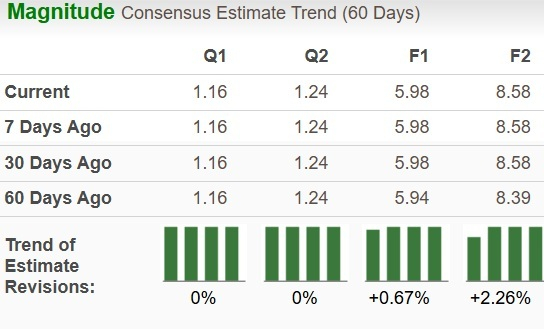
Image Source: Zacks Investment Research
Estimates have been revised 34.6% upward for ALAB’s bottom line.
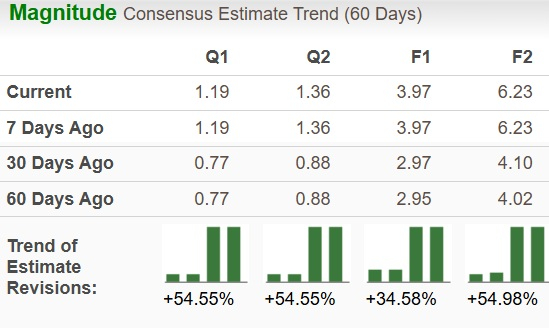
Image Source: Zacks Investment Research
CRDO or ALAB: Which Is a Better Pick?
CRDO currently carries a Zacks Rank #3 (Hold) and ALAB flaunts a Zacks Rank #1 (Strong Buy).
In terms of the Zacks Rank, ALAB appears to be a better pick at the moment.
7 Best Stocks for the Next 30 Days
Just released: Experts distill 7 elite stocks from the current list of 220 Zacks Rank #1 Strong Buys. They deem these tickers "Most Likely for Early Price Pops."
Since 1988, the full list has beaten the market more than 2X over with an average gain of +23.9% per year. So be sure to give these hand picked 7 your immediate attention.
Want the latest recommendations from Zacks Investment Research? Today, you can download 7 Best Stocks for the Next 30 Days. Click to get this free report


(0) comments
Welcome to the discussion.
Log In
Keep it Clean. Please avoid obscene, vulgar, lewd, racist or sexually-oriented language.
PLEASE TURN OFF YOUR CAPS LOCK.
Don't Threaten. Threats of harming another person will not be tolerated.
Be Truthful. Don't knowingly lie about anyone or anything.
Be Nice. No racism, sexism or any sort of -ism that is degrading to another person.
Be Proactive. Use the 'Report' link on each comment to let us know of abusive posts.
Share with Us. We'd love to hear eyewitness accounts, the history behind an article.