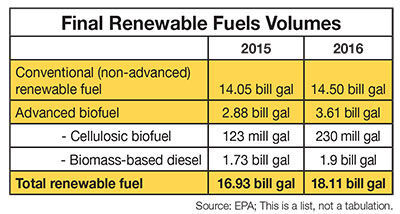
The EPA released the Renewable Volume Obligations Nov. 30 under the Renewable Fuel Standard (RFS) program for 2014, 2015 and 2016 and biomass-based diesel for 2017.
The EPA increased the total renewable fuels requirement by 630 million gallons for 2015 and 710 million gallons for 2016 from the proposed rules released in May of this year.
The amount of biodiesel increased 30 million gallons for 2015, 100 million gallons for 2016 and 2017 from the proposed rule. The national biodiesel industry had asked for volumes of 2 billion gallons in 2016 and 2.3 billion gallons in 2017.
For cellulosic ethanol, the requirements were increased by 17 million gallons for 2015 and 24 million gallons for 2016. The area of conventional renewable fuels, where corn-based ethanol counts, increased by 650 million gallons for 2015 and 500 million gallons for 2016.
In an EPA conference call announcing the numbers, Janet McCabe, acting assistant administrator for the EPA's Office of Air and Radiation, said they got 670,000 comments about the proposed rules released in May.
She said the volumes were “strong but achievable.”
The reaction from various farm and ethanol groups was mixed.
“We have seen a break in the blend wall,” said Jeff Broin, a Growth Energy co-chair, in a conference call with reporters.
He said most of the growth of ethanol blends would likely come from increased E-15 sales. The group is working with 5,000 gas stations that want to make E-15 available to their consumers.
Tom Buis, a Growth Energy co-chair, explained under the EPA ethanol volumes, the ethanol blend in the national gas supply in 2016 would be 10.4 to 10.5 percent.
“Did we get everything we wanted? No,” Buis said. “They (the final rules) are an improvement over the proposal.”
Buis and other farm and ethanol group representatives are still concerned about the EPA’s methodology, including the use of the “distribution waiver” — the argument there aren’t enough pumps available to sell higher blends of ethanol.
The American Farm Bureau, National Farmers Union, Renewable Fuels Association, Iowa Renewable Fuels Association, Iowa Farm Bureau, Missouri Corn Growers Association, Illinois Corn Growers Association, National Corn Growers Association and Iowa Corn Growers Association expressed disappointed the volumes were under what was called for when the RFS was passed by Congress in 2007.
The American Soybean Association, National Biodiesel Board, Iowa Soybean Association and Illinois Soybean Association called the rule a step forward, and said it provided some stability.
Buis didn’t rule out a future lawsuit against the EPA over its methodology to determine the volumes of the renewable fuels needed under the RFS.
Keep it Clean. Please avoid obscene, vulgar, lewd,
racist or sexually-oriented language. PLEASE TURN OFF YOUR CAPS LOCK. Don't Threaten. Threats of harming another
person will not be tolerated. Be Truthful. Don't knowingly lie about anyone
or anything. Be Nice. No racism, sexism or any sort of -ism
that is degrading to another person. Be Proactive. Use the 'Report' link on
each comment to let us know of abusive posts. Share with Us. We'd love to hear eyewitness
accounts, the history behind an article.



(0) comments
Welcome to the discussion.
Log In
Keep it Clean. Please avoid obscene, vulgar, lewd, racist or sexually-oriented language.
PLEASE TURN OFF YOUR CAPS LOCK.
Don't Threaten. Threats of harming another person will not be tolerated.
Be Truthful. Don't knowingly lie about anyone or anything.
Be Nice. No racism, sexism or any sort of -ism that is degrading to another person.
Be Proactive. Use the 'Report' link on each comment to let us know of abusive posts.
Share with Us. We'd love to hear eyewitness accounts, the history behind an article.