
IOWA CITY — In a career field typically dominated by men, women in agriculture today are proving the professional line between genders has become blurred. One area of change is in ag research and academics.
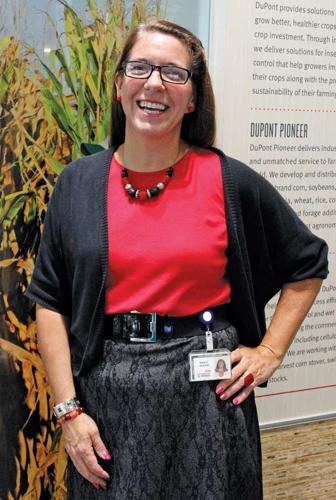
Daria Schmidt, a native of New York, grew up during a time when women were not very often seen working in agriculture, let alone in leadership positions.
But, the cultural norms did not deter her from her passion in plant breeding and genetics.
“I was always interested in genetics,” she says, referencing her high school biology course — her first introduction to traits and breeding.
She went on to get her Ph.D. in plant breeding and genetics from Iowa State University.
This year, she is celebrating her 20th anniversary at DuPont Pioneer in Johnston, Iowa, and has moved up the administrative job ladder as a director, where she oversees regulation and regulatory affairs throughout North America.
Schmidt’s work experience in agriculture began as a work-study student during her undergraduate years.
“When I first entered into the field of agriculture, even as an undergraduate work-study student, there weren’t very many women in this particular area,” she says. “Field breeding and agronomy were, at that time, not typical choices.”
She says she felt the need to prove herself to her colleagues, but decided it was ultimately her responsibility to work hard and think positively about her future in order to succeed.
“But it wasn’t without some skeptics,” she adds.
After finishing her Ph.D., she started working in private sector research in Illinois, where she was the only female plant breeder at that particular company.
One thing she remembers is proving she was capable of the same physical activity as her male colleagues, such as lifting a bag of seed to put into a planter.
“I distinctly remember this one time when the harvest crew went in to eat dinner (at a small-town restaurant) and the local person just assumed that the gentleman at the table was paying for the meal,” she adds, noting this happened in the early 1990s.
“He was my assistant’s assistant, and that certainly wasn’t the case. So when the ticket came around to me and he said ‘the boss pays for this,’ it was a shocked look on people’s faces around us (because) the boss of this crew was actually a woman.”
She says it’s important for women to show their value in the workplace and stand out as leaders in order to close the gender gap.
“It’s not going to get handed to you,” she says. “It’s about proving yourself, and you want to be able to do that anyway whether you’re a man or a woman.”
These days, Schmidt says there is more gender diversity in agriculture, which allows for a wide variety of scientific work as there are more people from different backgrounds thinking of solutions and forming ideas.
She notes the CEO of DuPont is also a woman, which helps prove those kinds of career opportunities are available to those who work hard.
“In the near future, we still have quite a ways to go,” she says, “but I think we’re getting there. It’s certainly better than 1991 when I first came into the field.”
Field of firsts
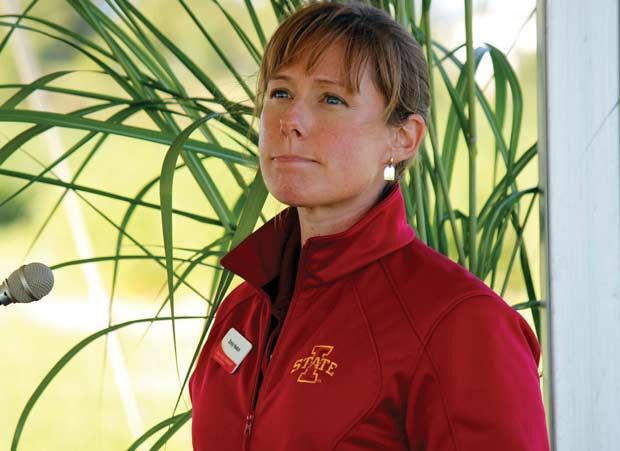
Emily Heaton works as an associate professor in the department of agronomy at Iowa State University, where she studies the physiology and management of dedicated energy crops.
“I was the first person that the ISU agronomy department hired specifically to focus on perennial bioenergy crops,” she says.
She grew up in Central Illinois and became interested in working with crops like miscanthus.
On Aug. 25, Heaton helped host a biomass fuel project field day at the University of Iowa in Iowa City to showcase their crop-related energy source research and connect with new growers in the state.
She says there are currently 350 acres of giant miscanthus planted for the university’s power plant, which will ultimately provide heat in the form of steam and electricity to the University of Iowa, which has a goal of generating 40 percent of its energy from renewable sources.
Heaton began her agricultural career path as an undergraduate and Ph.D. student in crop sciences at the University of Illinois Urbana-Champaign.
“I feel that it was very inclusive. I’ve never felt restrictions in working in agricultural science in particular,” she says.
“Of the women in ag I see coming in today, I’ve been very pleased to see they’re not being shy,” Heaton says.
“Don’t be afraid to express your interest and be passionate about agriculture. There’s certainly a place for women in agriculture professions today.”


(0) comments
Welcome to the discussion.
Log In
Keep it Clean. Please avoid obscene, vulgar, lewd, racist or sexually-oriented language.
PLEASE TURN OFF YOUR CAPS LOCK.
Don't Threaten. Threats of harming another person will not be tolerated.
Be Truthful. Don't knowingly lie about anyone or anything.
Be Nice. No racism, sexism or any sort of -ism that is degrading to another person.
Be Proactive. Use the 'Report' link on each comment to let us know of abusive posts.
Share with Us. We'd love to hear eyewitness accounts, the history behind an article.