
The artificial intelligence (AI)-driven lending landscape has gained momentum as financial institutions increasingly turn to technology to improve credit underwriting, expand borrower access and manage risk. Pagaya Technologies Ltd. PGY and Upstart Holdings, Inc. UPST are two prominent players leveraging AI and alternative data to modernize lending.
While both aim to make credit decisions more efficient and expand access to financing, their models differ. Pagaya operates an AI-powered credit network connecting lenders with institutional capital, while Upstart runs an AI lending marketplace connecting borrowers with financial institutions, thus having greater direct exposure to loan origination and the performance of its lending marketplace.
Now, as AI becomes increasingly embedded in lending, the question arises: which among PGY and UPST can deliver stronger and more sustainable growth? In order to understand this, let us dig deep into their fundamental strengths and growth prospects.
The Case for PGY
Pagaya has built an adaptable, capital-efficient business model that has evolved beyond its initial focus on personal loans. The company has expanded into auto lending and point-of-sale (POS) financing, broadening its addressable market while reducing reliance on any single loan category. This diversification helps strengthen the platform’s resilience across different economic and credit cycles.
The company has also developed a diversified funding ecosystem, with more than 170 institutional partners and a growing reliance on forward flow agreements. Under these arrangements, investors commit to purchasing loans in advance, providing Pagaya with greater funding visibility and stability, particularly during periods of market volatility. Its funding strategy is further supported by strategic asset-backed securities (ABS) issuance.
Pagaya’s limited on-balance-sheet exposure is another key advantage. Loans are generally transferred quickly to ABS vehicles or institutional investors through forward flow arrangements, with capital secured ahead of origination. This structure helps limit credit and market risk, reduces the need for loan write-downs and allows the company to maintain flexibility even in challenging market conditions.
Technology remains another important differentiator. Pagaya’s proprietary platform, including its pre-screen solution, enables lenders to offer pre-approved credit opportunities to existing customers without requiring a formal application. This allows partner institutions to expand credit access and deepen customer relationships while potentially reducing customer-acquisition and marketing costs.
Improving operating leverage and cost discipline have increasingly supported Pagaya’s earnings growth of late. In the first half of 2026, total revenues rose to $705 million from $616.4 million a year earlier, while operating expenses increased modestly to $519.2 million from $512.2 million. This widening gap between revenue and expense growth highlights the scalability of its model. Building on this momentum, management expects 2026 GAAP net income of $155-$180 million and adjusted EBITDA of $460-$490 million, signaling confidence in continued growth without a proportionate increase in costs.
The Case for UPST
Upstart was among the pioneers in applying AI to consumer lending, using proprietary models to assess borrower risk beyond traditional credit scores. It generates revenues primarily through referral and transaction fees, servicing income, and gains from loan sales and securitizations. With more than 90% of loans fully automated, the platform is designed to make lending faster and more efficient for both borrowers and lending partners.
While personal loans remain the core engine of the business, Upstart is steadily expanding into adjacent categories, including auto lending, home equity and its newer Cash Line product. The company is also working to extend its AI underwriting capabilities into additional credit markets, creating opportunities to diversify revenues over time. The recent recovery in personal lending has strengthened the economics of the core platform, giving Upstart greater capacity to invest in newer products while maintaining its focus on profitability and operating leverage.
Funding remains another important strength of Upstart’s marketplace model. The company continues to broaden its institutional capital base and use forward-flow arrangements to provide greater visibility into loan funding. In July 2026, Upstart announced a multi-year agreement with Castlelake for up to $4 billion in consumer loans over as many as 24 months, reinforcing investor confidence in the platform’s underwriting and credit performance.
Recent performance also suggests that improvements in AI underwriting and loan demand are translating into stronger operating leverage. In the second quarter of 2026, revenues reached $365 million, while adjusted EBITDA increased to roughly $77 million. Management maintained its full-year outlook of $1.4 billion in revenues and $294 million in adjusted EBITDA, while retaining its longer-term target of 35% revenue CAGR from 2025 through 2028 and a 25% adjusted EBITDA margin by 2028.
Upstart’s potential national bank charter could provide another structural advantage over the longer term. In July, the OCC granted conditional approval for Upstart Bank, although FDIC and Federal Reserve approvals and other operational conditions remain outstanding. Once fully approved, the charter is expected to reduce certain lending complexities, support nationwide product availability and potentially lower the cost of credit, while existing banks, credit unions and institutional investors are expected to remain important funding partners.
PGY & UPST: Price Performance, Valuation & Other Comparisons
In the last six months, Pagaya’s price performance has been impressive, with its shares jumping 71.2%, outperforming the S&P 500 Index’s 13% growth. In the same period, the UPST stock has lost 3.5%. Hence, in terms of investor sentiment, PGY has the edge.
6-Month Price Performance
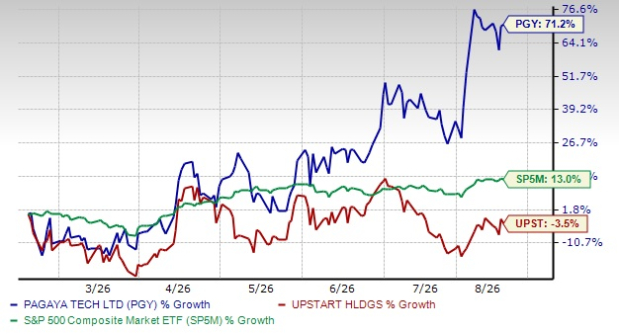
Image Source: Zacks Investment Research
From a valuation perspective, Pagaya is currently trading at a trailing 12-month price-to-book (P/B) of 2.77X, while the UPST stock is trading at a trailing 12-month P/B of 3.71X. So, in terms of valuation, PGY is inexpensive compared with Upstart.
P/B TTM

Image Source: Zacks Investment Research
Pagaya’s return on equity (ROE) of 58.14% is above Upstart’s 26.71%. This reflects that PGY is more efficient in using shareholder funds to generate profits.
ROE
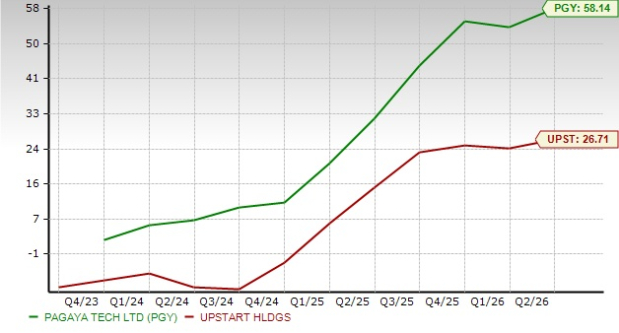
Image Source: Zacks Investment Research
Pagaya & Upstart’s Earnings & Sales Prospects
The Zacks Consensus Estimate for PGY’s 2026 and 2027 revenues indicates year-over-year growth of 13% and 15%, respectively.
The consensus estimate for PGY’s earnings suggests 12.4% and 11% year-over-year growth for 2026 and 2027, respectively.
PGY’s Earnings Growth Estimate

Image Source: Zacks Investment Research
On the contrary, the Zacks Consensus Estimate for UPST’s 2026 and 2027 revenues implies year-over-year increases of 36% and 31%, respectively.
Also, the consensus estimate for Upstart’s earnings indicates 26.4% growth for 2026 and a 47.1% rise for 2027.
UPST’s Earnings Growth Estimate

Image Source: Zacks Investment Research
PGY or UPST: Which Stock Is the Better Choice Now?
Overall, both Pagaya and Upstart offer compelling exposure to the rapidly evolving AI-driven lending industry, but their investment propositions are meaningfully different.
Consensus estimates point to substantially faster revenue and earnings expansion for UPST in 2026 and 2027. However, the company’s greater exposure to loan origination volumes, credit performance and capital-market conditions makes the business more sensitive to shifts in the economic and funding environment.
Pagaya, meanwhile, offers a more diversified and capital-efficient model, supported by its broad institutional funding network, forward-flow arrangements, limited balance-sheet exposure and expansion across personal, auto and POS lending. The company is already demonstrating improving profitability and operating leverage, while its lower P/B multiple and substantially higher ROE provide an attractive valuation and efficiency advantage over Upstart. Although PGY’s projected revenue and earnings growth is more moderate, its business model may offer greater resilience across credit cycles and less dependence on a single lending category or funding channel.
Thus, Pagaya appears better-positioned for risk-adjusted long-term growth, particularly at its current valuation. Currently, PGY sports a Zacks Rank #1 (Strong Buy), whereas Upstart has a Zacks Rank #4 (Sell).
Zacks' Research Chief Names "Stock Most Likely to Double"
Our team of experts has just released the 5 stocks with the greatest probability of gaining +100% or more in the coming months. Of those 5, Director of Research Sheraz Mian highlights the one stock set to climb highest.
This top pick is a little-known satellite-based communications firm. Space is projected to become a trillion dollar industry, and this company's customer base is growing fast. Analysts have forecasted a major revenue breakout in 2025. Of course, all our elite picks aren't winners but this one could far surpass earlier Zacks' Stocks Set to Double like Hims & Hers Health, which shot up +209%.
Want the latest recommendations from Zacks Investment Research? Today, you can download 7 Best Stocks for the Next 30 Days. Click to get this free report


(0) comments
Welcome to the discussion.
Log In
Keep it Clean. Please avoid obscene, vulgar, lewd, racist or sexually-oriented language.
PLEASE TURN OFF YOUR CAPS LOCK.
Don't Threaten. Threats of harming another person will not be tolerated.
Be Truthful. Don't knowingly lie about anyone or anything.
Be Nice. No racism, sexism or any sort of -ism that is degrading to another person.
Be Proactive. Use the 'Report' link on each comment to let us know of abusive posts.
Share with Us. We'd love to hear eyewitness accounts, the history behind an article.