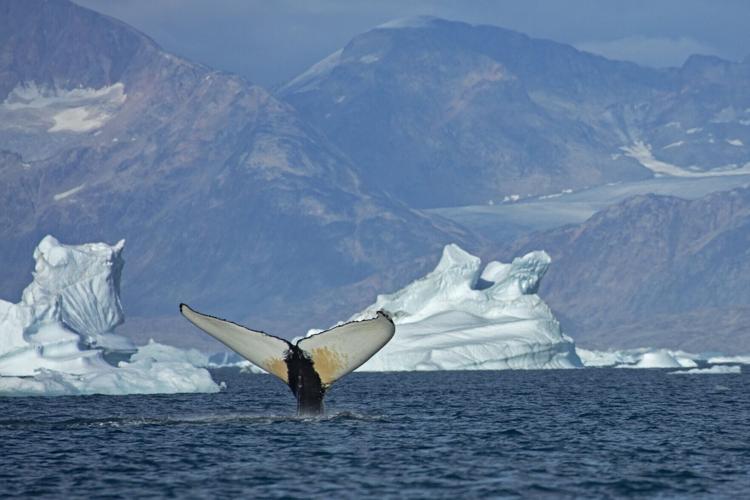
Fin whale in Greenland Sea. (Fernando Ugarte via SWNS)
By Talker
By Stephen Beech
Whales are being drawn to "feeding frenzies" within the Arctic Circle by warming waters, reveals new research.
Baleen whales are taking advantage of a newly opened-up fish "bonanza" in the Greenland Sea — reaching to the Arctic Circle and beyond, according to the study.
Scientists say their findings, published in the journal Frontiers in Marine Science, show that while most species suffer from the effects of global warming, there are a few lucky winners.
Mads Peter Heide-Jørgensen, from the Greenland Institute of Natural Resources, said: "We show that rising ocean temperatures and declining sea-ice cover have facilitated the widespread occurrence of baleen whales along the East Greenland coast, as far north as 70°N.
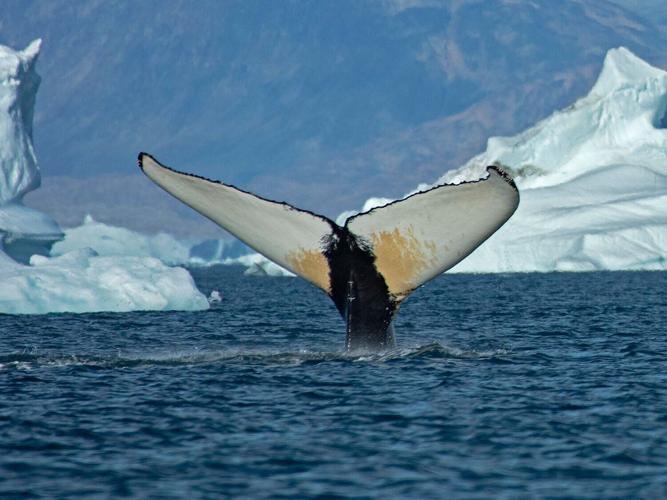
Humpback whale in Greenland Sea. (Fernando Ugarte via SWNS)
By Talker
"This has led to regular mixed 'feeding frenzies' of fin whales, humpback whales, and common minke whales — species which historically were only rarely observed in coastal East Greenland."
Heide-Jørgensen along with colleagues in Greenland, Denmark and Iceland have documented the latest spectacle of the natural world.
But they say it could spell major changes up and down the local food chain.
The Arctic and North Atlantic — apart from a "cold blob" south of Greenland — are some of the fastest warming regions on Earth.
For example, sea surface temperatures east of Greenland have risen by about 2°C since the 1990s.
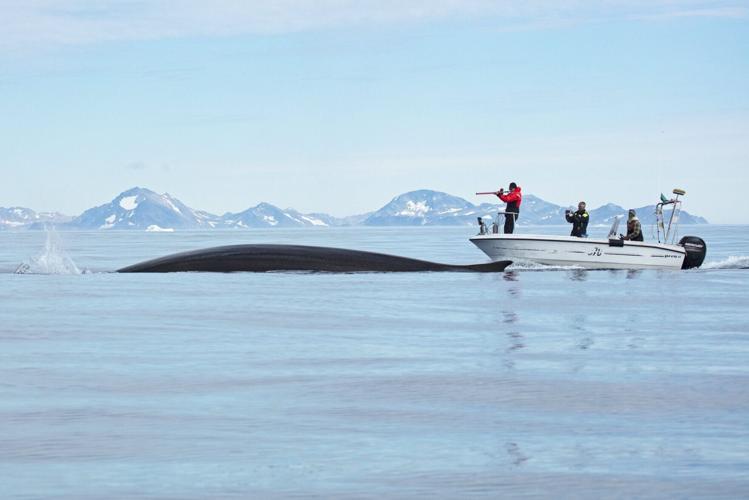
Satellite tagging a fin whale. (Fernando Ugarte via SWNS)
By Talker
The ice edge in summer retracted far to the north after the mid-2000s, dramatically reducing the extent of pack ice along Greenland's east coast.
The research team conducted the first systematic survey by plane of baleen whales up to 30 miles off the East Greenland coast in August 2015 and in 2024.
They added further airborne observations in the summer of 2022, testimonies from Inuit hunters between 2023 and 2025, and records from ships taking part in North Atlantic Sighting Surveys from 1987 on.
They also analyzed tracks from 15 satellite-tagged baleen whales taken at intervals between 2019 and 2025.
Fin whale in Greenland Sea. (Fernando Ugarte via SWNS)
By Talker
The team then built a mathematical model to find patterns within this sea of data, using historical measurements from key factors such as sea-surface temperature, salinity and icepack concentration to explain the variation.
They say the combination of data give a "unique record" of changes in the abundance of baleen whales in the Greenland Sea over the past three decades.
The picture was uniform: between 1987 and 2024, there has been a marked change in the occurrence of baleen whales along the East Greenland coast north of 60 °N and west of 29 °W.
For example, ship-based surveys didn't observe any humpback whales until 2006, while seven sightings were recorded in 2007, 26 by 2015 and more than 150 by 2024.
Similarly, sightings of minke whales from the survey vessels were few until 1995, but between 10 and 20 were encountered year-on-year after 2001.
Humpback whale in Greenland Sea. (Fernando Ugarte via SWNS)
By Talker
Ship-based sightings of fin whales also increased sharply from 1987 to the present day.
In August 2025, a ship's crew reported meeting "exceptionally large" aggregations — of up to 50 individuals simultaneously — of baleen whales along the east coast about 69 °N, north of the Arctic Circle.
Likewise, the systematic airborne surveys documented an almost continuous distribution of all three species at the same time between 60°N and 70°N in 2015 and 2024.
Heide-Jørgensen and his colleagues estimate that altogether, no fewer than 4,000 humpback whales, 6,000 fin whales and 6,000 minke whales visited the Greenland Sea in the summer of 2024.
He said: "There is little doubt that the three baleen whale species summering in East Greenland coastal waters do so primarily to feed."
Fin whale in Greenland Sea. (Fernando Ugarte via SWNS)
By Talker
The team found that the trio of species visit the region mainly to hunt for capelin — a cold-loving fish and known to be one of their most important prey farther south.
Capelin have recently been shown to have shifted their feeding grounds since the mid-2000s from the relatively warmer waters north of Iceland toward the Greenland Sea.
The research team concluded that baleen whales have caught up with the shift and "moved in for the kill."
They said there have never been any commercial capelin fisheries in the region, so competition with humans doesn't seem likely for now.
Heide-Jørgensen said: "East Greenland is undergoing a major ecological regime shift.
"Ice-associated species such as narwhals are increasingly sharing their habitat with, or being displaced by, temperate baleen whales that generally avoid ice-covered waters."
He added: "This marked change in species composition demonstrates how climate-driven changes are reorganizing the East Greenland marine ecosystem, potentially with long-lasting consequences."
Keep it Clean. Please avoid obscene, vulgar, lewd,
racist or sexually-oriented language. PLEASE TURN OFF YOUR CAPS LOCK. Don't Threaten. Threats of harming another
person will not be tolerated. Be Truthful. Don't knowingly lie about anyone
or anything. Be Nice. No racism, sexism or any sort of -ism
that is degrading to another person. Be Proactive. Use the 'Report' link on
each comment to let us know of abusive posts. Share with Us. We'd love to hear eyewitness
accounts, the history behind an article.







(0) comments
Welcome to the discussion.
Log In
Keep it Clean. Please avoid obscene, vulgar, lewd, racist or sexually-oriented language.
PLEASE TURN OFF YOUR CAPS LOCK.
Don't Threaten. Threats of harming another person will not be tolerated.
Be Truthful. Don't knowingly lie about anyone or anything.
Be Nice. No racism, sexism or any sort of -ism that is degrading to another person.
Be Proactive. Use the 'Report' link on each comment to let us know of abusive posts.
Share with Us. We'd love to hear eyewitness accounts, the history behind an article.