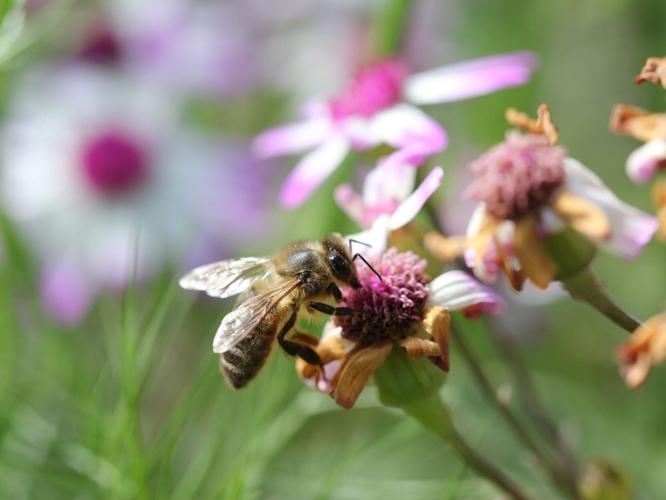
Honeybee foraging on a flower. (Marta Rossi via SWNS)
By Talker
By Stephen Beech
Letting weeds grow now could help honeybees as they struggle to gather nectar in late summer, according to new research.
The study showed that the pollinators find it hardest to forage for nectar at this time of year, particularly in August.
The University of Sussex research is the first to use a new method of directly measuring seasonal changes in the energy honeybees expend and gain from foraging.
The study, published in the journal Functional Ecology, was conducted in green spaces in and around Brighton and Edinburgh.
The findings showed that food shortages were most acute in late July and August, suggesting that bees found it the most challenging to gather nectar in those months.
The research team suggests that this is likely due to fewer flowers in bloom in late summer and a higher number of active pollinators competing for those flowers.
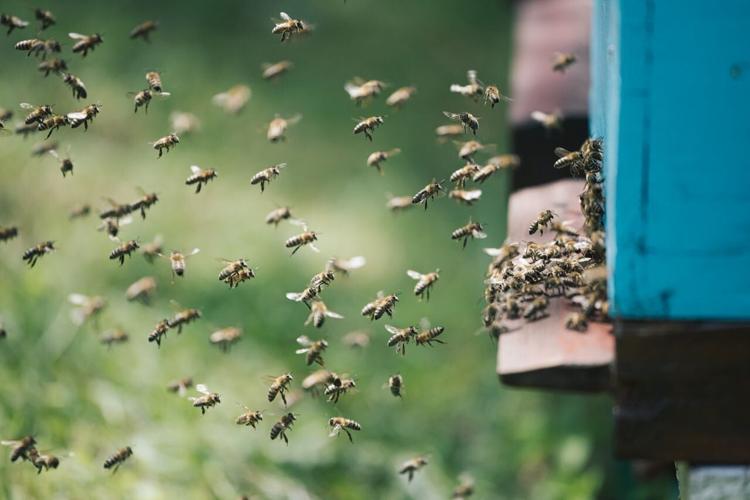
(Photo by Ben Chanas via Pexels)
By Talker
The findings contrasted with spring when honeybee foraging efficiency was at its highest, a time when most insect-pollinated trees — such as horse chestnut, willow and cherry — are in bloom.
Study co-author Nicholas Balfour said: "Our findings add to a growing body of literature indicating that late-summer is a particularly challenging season for pollinators.
"This is incredibly important, as this period of the year is when the vast majority of pollinator species are active and require forage to provision for their offspring."
Co-author Ciaran Harris said: "Encouraging flowers that bloom in late summer when bees find it more challenging to gather nectar or pollen will be more valuable for helping them.
"This could be achieved by planting late-summer blooming flowers, adjusting when lawns are mown, or being more tolerant of summer-blooming 'weeds' like thistle, ragwort, and knapweed."
He said that refraining from removing late summer-blooming weeds could be especially important in years like 2026 when heat waves are reducing nectar availability in flowers and disrupting flowering times.
(Photo by Amel Uzunovic via SWNS)
Harris says the study findings have implications for other pollinators too.
"This means that they're a good indicator of overall availability of nectar in the landscape."
The researchers directly observed honeybees foraging at sites across Brighton and Edinburgh, including Arthur's Seat, The Royal Botanic Gardens Edinburgh and Falmer village from April to October.
To determine foraging success of honeybees at different times of year, the team compared energy expended during foraging — calculated by the amount of time spent flying and walking in a 60-second period — with energy received from foraging, calculated by the number and species of flowers visited and the quantities of nectar.
Over the course of the study, the researchers collected foraging data from 1,217 honeybees and nectar data from 1,426 flowers.
They found "similar" patterns in Brighton and Edinburgh, despite the cities being more than 370 miles apart, suggesting that late summer might be a challenging period for bees to gather food in many areas of Britain.
(Photo by Markus Spiske via Pexels)
By Talker
Study co-author Francis Ratnieks said: "What is particularly satisfying about this project is that it directly measures the energetic profitability of nectar foraging across the active foraging season.
"The results confirm the pattern that had emerged from a wide range of indirect studies done in our lab, which included decoding bee dances to see how far they had to fly to forage month by month.
"These studies all point to late summer being the most challenging season for gathering nectar, and in doing so simplify the task of 'helping the bees.'"
The researchers said that a drawback of only examining green spaces in two locations was that they were unable to examine how factors such as land use influence nectar supply throughout the year.
Harris added: "Follow up studies looking at land use will be important.
"Other recent work suggests that certain land-use types, such as gardens, may be good at 'plugging' gaps in nectar supply during certain times of the year.
"Similarly, farmland under agri-environment schemes could have more weeds in late summer, helping to even out fluctuating nectar supplies across the year."
Keep it Clean. Please avoid obscene, vulgar, lewd,
racist or sexually-oriented language. PLEASE TURN OFF YOUR CAPS LOCK. Don't Threaten. Threats of harming another
person will not be tolerated. Be Truthful. Don't knowingly lie about anyone
or anything. Be Nice. No racism, sexism or any sort of -ism
that is degrading to another person. Be Proactive. Use the 'Report' link on
each comment to let us know of abusive posts. Share with Us. We'd love to hear eyewitness
accounts, the history behind an article.




(0) comments
Welcome to the discussion.
Log In
Keep it Clean. Please avoid obscene, vulgar, lewd, racist or sexually-oriented language.
PLEASE TURN OFF YOUR CAPS LOCK.
Don't Threaten. Threats of harming another person will not be tolerated.
Be Truthful. Don't knowingly lie about anyone or anything.
Be Nice. No racism, sexism or any sort of -ism that is degrading to another person.
Be Proactive. Use the 'Report' link on each comment to let us know of abusive posts.
Share with Us. We'd love to hear eyewitness accounts, the history behind an article.