States with the biggest mental health care deserts

Okrasiuk // Shutterstock

Originally published on adhdadvisor.org, part of the BLOX Digital Content Exchange.

Mental health stigma is largely on the decline in the United States, allowing more people than ever before to pursue care. Yet other barriers—including a shortage of mental health professionals—present ongoing problems for those who would otherwise seek help. More than 1 in 10 Americans lack adequate access to mental health care, according to the Department of Health and Human Services.
ADHD Advisor used data from the Health Resources & Services Administration to map and analyze mental health provider shortages across the United States. An area is considered underserved if it has fewer than 1 provider for every 30,000 people or a ratio of 1 to 20,000 for high-need communities.
Lack of access to mental health care can have long-term effects in regions across the U.S., including the lack of a proper diagnosis or an individual turning to drugs or alcohol to self-medicate. For those who do get diagnosed, including those with ADHD, insufficient mental health care access may prevent people from seeking help or managing their medications properly. This is particularly true in rural counties, where existing, limited access to care—including long wait times and far distances to travel for care—was further disrupted by the COVID-19 pandemic.

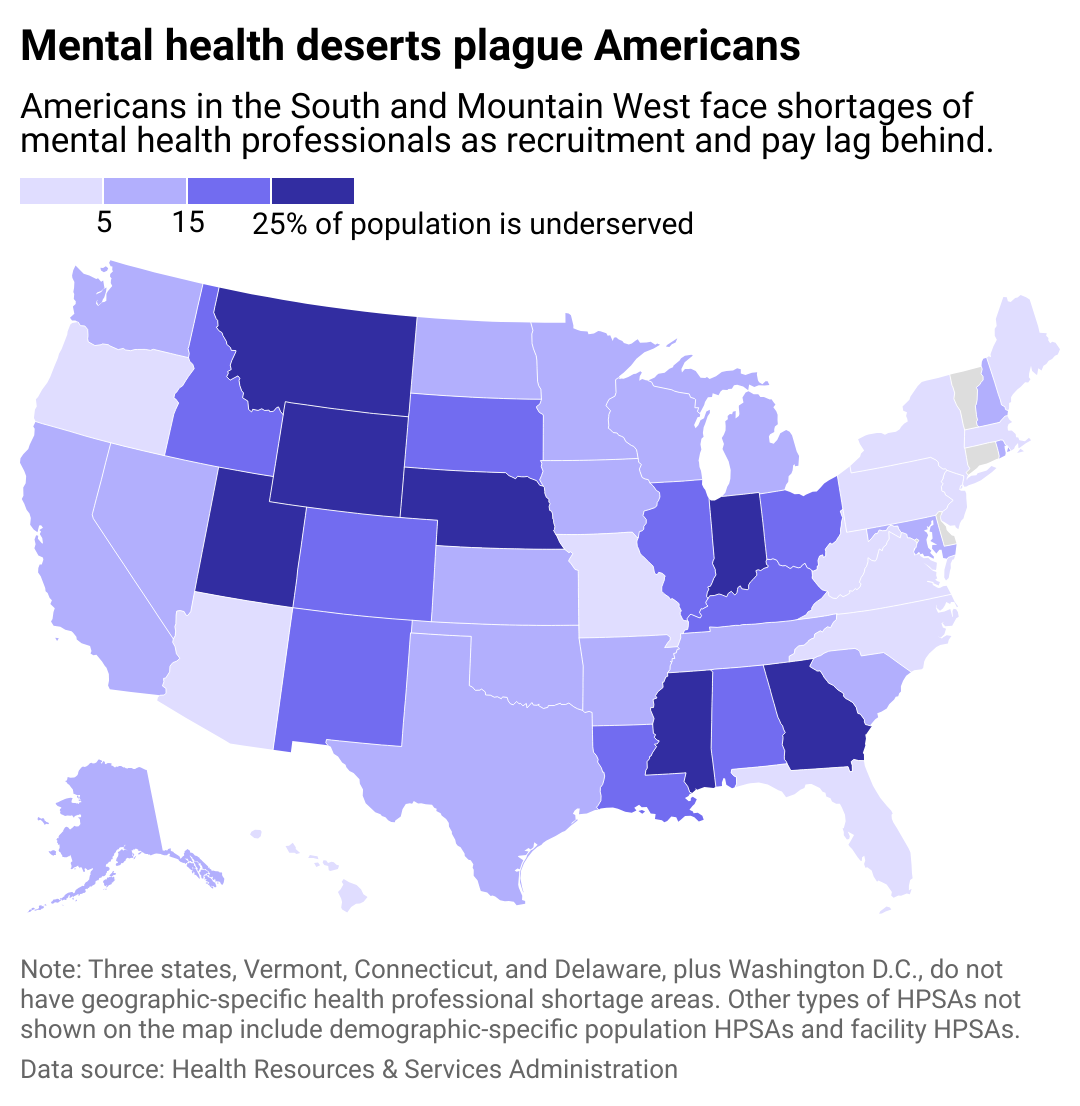
The mental health provider shortage impacts people in communities throughout the U.S., with Utah, Wyoming, Mississippi, Nebraska, Georgia, Montana, and Indiana facing the most severe shortages.
It's an ongoing cycle: Provider shortages mean doctors and clinicians are in charge of expansive caseloads, which can lead to burnout and increased retirements. In New Mexico, for example, the Centers for Disease Control and Prevention estimates the state needs at least 61 mental health professionals to ease the burden—but low pay makes it difficult to recruit people from out of state.
Lawmakers have come together at the local and federal levels to remedy this.
The Biden administration has poured billions of dollars into increasing access to care, including grants to increase the pipeline of mental health professionals in high-need areas. States are also taking an active role by offering monetary incentives, including student loan reimbursement. Apprenticeship programs can also help stem some of the shortage in high-need areas. In Alabama, for example, students getting their master's degree in social work at the University of Alabama can get real-world experience while getting paid.
While there's no one-size-fits-all approach to remedying the mental health crisis, its impacts are being felt across the country. In 2020, Americans spent about $280.5 billion on mental health and substance abuse treatments, with about a quarter coming from Medicaid spending alone.
Story editing by Nicole Caldwell. Copy editing by Tim Bruns.
This story originally appeared on ADHD Advisor and was produced and distributed in partnership with Stacker Studio.
Originally published on adhdadvisor.org, part of the BLOX Digital Content Exchange.
Please disable your ad blocker, whitelist our site, or purchase a subscription


Sorry, an error occurred.
Already Subscribed!
Cancel anytime
Thank you .
Your account has been registered, and you are now logged in.
Check your email for details.
Submitting this form below will send a message to your email with a link to change your password.
An email message containing instructions on how to reset your password has been sent to the email address listed on your account.
No promotional rates found.
Secure & Encrypted
Thank you.
Your gift purchase was successful! Your purchase was successful, and you are now logged in.
| Rate: | |
| Begins: | |
| Transaction ID: |
A receipt was sent to your email.
(0) comments
Welcome to the discussion.
Log In
Keep it Clean. Please avoid obscene, vulgar, lewd, racist or sexually-oriented language.
PLEASE TURN OFF YOUR CAPS LOCK.
Don't Threaten. Threats of harming another person will not be tolerated.
Be Truthful. Don't knowingly lie about anyone or anything.
Be Nice. No racism, sexism or any sort of -ism that is degrading to another person.
Be Proactive. Use the 'Report' link on each comment to let us know of abusive posts.
Share with Us. We'd love to hear eyewitness accounts, the history behind an article.