The K-1 fiancé visa occupies a unique place in the U.S. immigration system. It is a nonimmigrant visa, though it functions as a direct pathway to permanent residence, allowing foreign nationals engaged to U.S. citizens to enter the country for the purpose of marriage before applying for lawful permanent residence. Unlike most family-based immigration pathways, the K-1 process begins before the couple is married and requires coordination between U.S. Citizenship and Immigration Services (USCIS), the Department of State, and overseas U.S. embassies and consulates. Once the visa is issued, a K-1 visa holder must marry their U.S. citizen petitioner within 90 days of arriving in the United States.
Beyond its role in family reunification, the K-1 visa program has broader implications for communities and the U.S. economy. International marriages contribute to population growth, labor force participation, consumer spending, and demand for housing, education, healthcare, and other local services as new families establish themselves across the country. At the same time, changes in petition processing, visa issuance, and government backlogs can shape when, or whether, couples are able to begin their lives together, creating ripple effects that extend well beyond the immigration system itself. Because the program involves multiple federal agencies and overseas consular operations, shifts in administrative capacity, policy implementation, or global events can influence processing outcomes and wait times.
In this analysis, researchers at Manifest Law, a modern immigration law firm specializing in immigration visas, examine the latest available data from U.S. Citizenship and Immigration Services (USCIS), the U.S. Department of State, and the U.S. Department of Homeland Security (DHS) to identify trends in fiancé visa petition approvals, processing times, visa issuances, countries of origin, and state-level destinations, providing a comprehensive look at how the K-1 visa program has evolved in recent years.
Here are the key takeaways from the analysis:
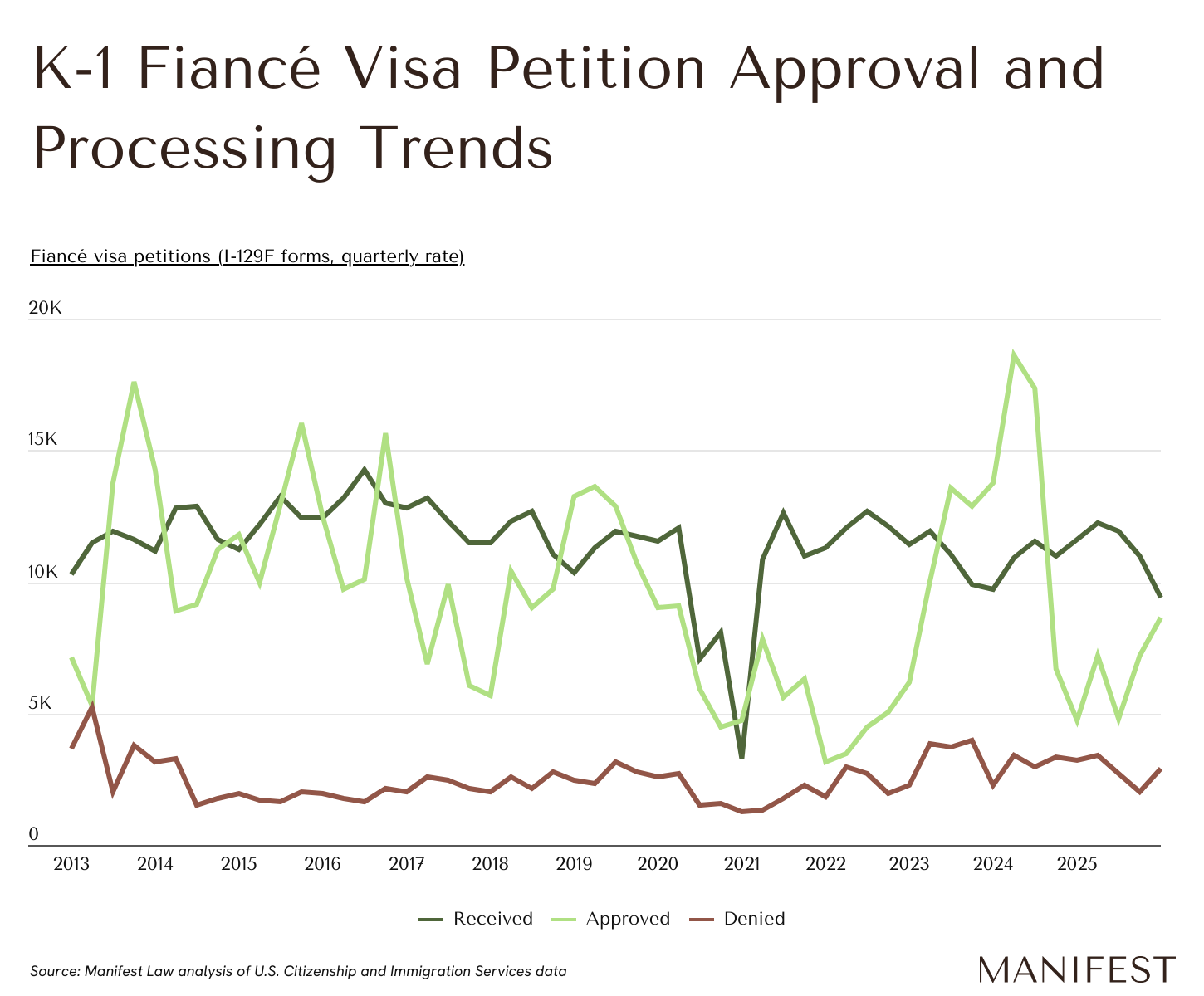
- The post-pandemic backlog reduction of fiancé visa petitions has slowed. After substantially increasing fiancé petition approvals (Form I-129F) throughout 2023 and the first half of 2024, USCIS approvals fell below new petition receipts beginning in late 2024, signaling a slowdown in backlog reduction efforts.
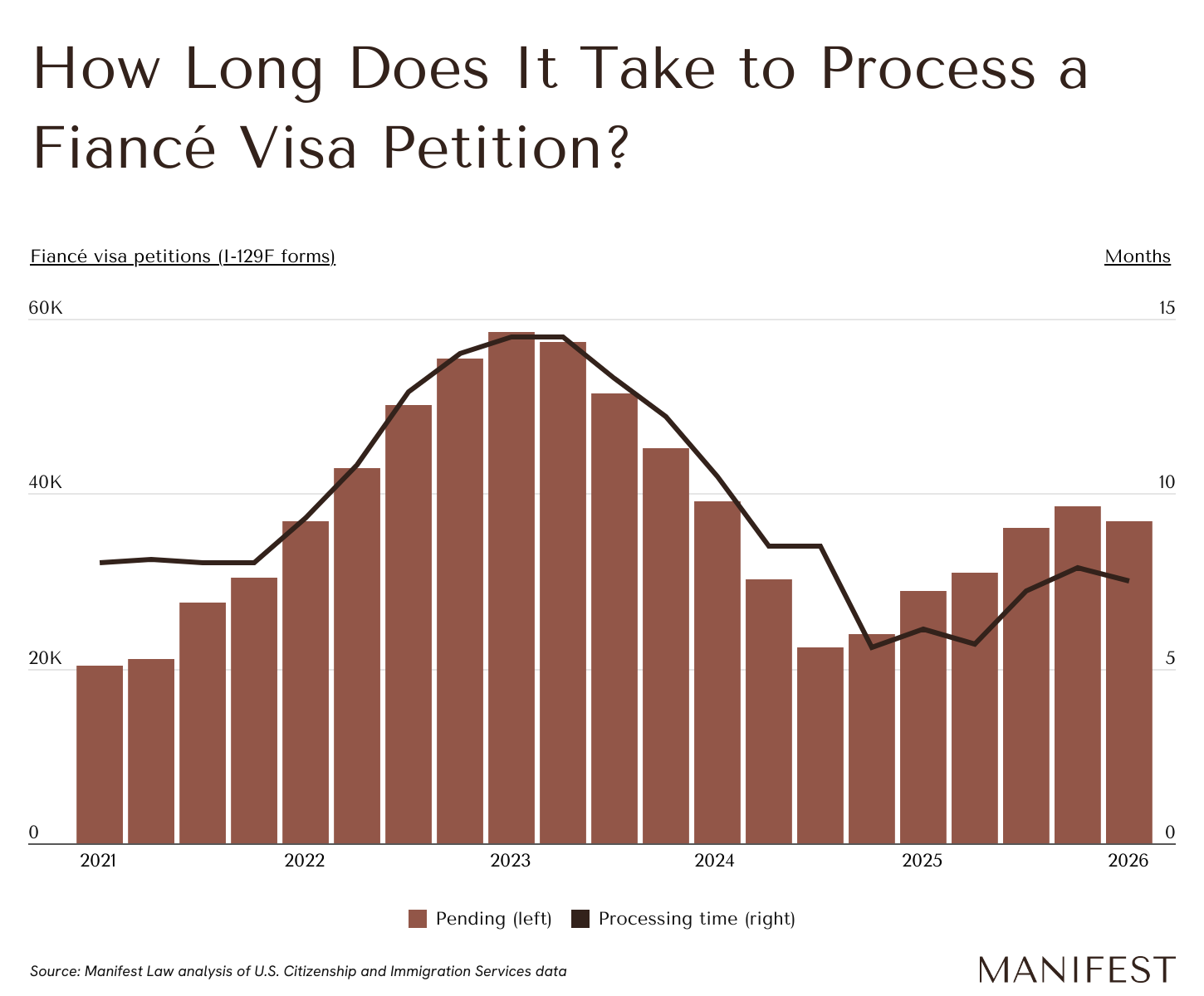
- Processing times are rising again after reaching a post-pandemic low. Median Form I-129F processing times fell to 5.6 months in late 2024 as pending caseloads declined, but both pending petitions and processing times have since increased.
- K-1 visa issuances reached their highest level in more than a decade. The U.S. Department of State issued 47,579 K-1 fiancé visas in 2024, surpassing the previous peak recorded in 2016 as overseas consular operations continued recovering from pandemic-related backlogs.
- The Philippines remains the dominant source of K-1 fiancé visas. More than 10,000 K-1 visas were issued to Filipino nationals in 2024—more than the next four leading countries combined—reflecting the country's longstanding immigration ties with the United States.
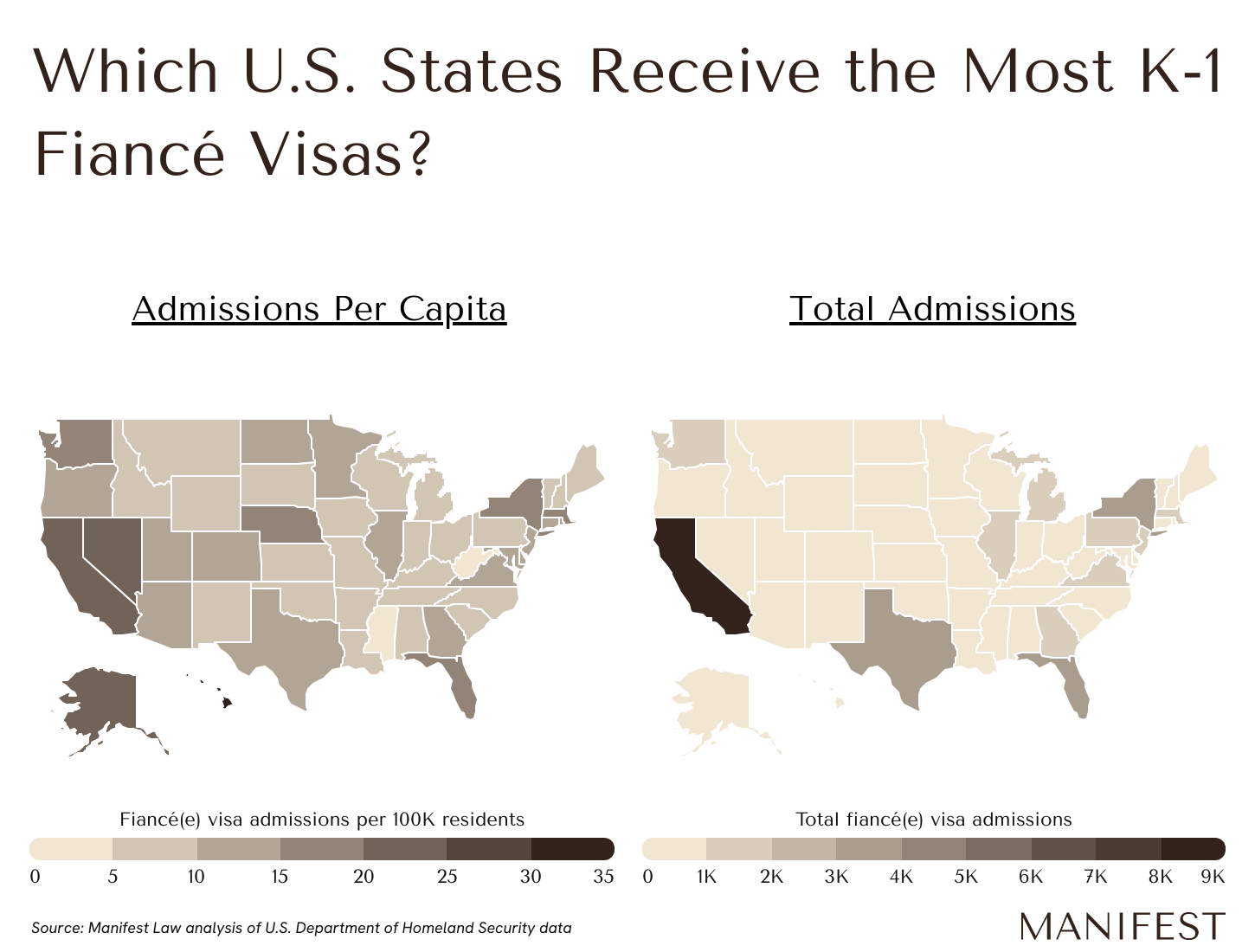
- California receives the most K-1 visa arrivals, while Hawaii leads on a per capita basis. California welcomed more K-1 visa holders than any other state in 2024, while Hawaii recorded the nation's highest rate of fiancé visa arrivals relative to its population.
K-1 Fiancé Visa Petition Approval and Processing Trends
Foreign fiancé petition approvals are well below peak 2024 levels
Source: Manifest Law analysis of U.S. Citizenship and Immigration Services data
After pandemic-era disruptions reduced adjudications and contributed to growing backlogs, USCIS substantially increased K-1 fiancé petition approvals throughout 2023 and the first half of 2024. During several quarters, the agency approved considerably more petitions than it received, indicating that it was working through previously accumulated pending cases rather than simply keeping pace with new demand. That effort culminated in 18,586 approvals in the second quarter of 2024, the highest quarterly total in USCIS's published I-129F data.
The pattern shifted sharply beginning in the fourth quarter of 2024. Quarterly approvals fell below new petition receipts and have generally remained there through early 2026. With receipts continuing at roughly 9,000 to 12,000 petitions per quarter while approvals remained substantially lower, USCIS is no longer reducing its backlog at the pace seen during 2023 and early 2024.
How Long Does It Take to Process a Fiancé Visa Petition?
After improving significantly in 2024, processing times and pending fiancé visa petitions are on the rise
Source: Manifest Law analysis of U.S. Citizenship and Immigration Services data
The slowdown in fiancé petition adjudications is beginning to affect the broader K-1 visa system. As USCIS approved more petitions than it received throughout much of 2023 and early 2024, the agency steadily reduced its pending caseload while processing times fell. Pending I-129F petitions declined from a peak of 58,479 in the first quarter of 2023 to just 22,328 by the third quarter of 2024, a reduction of more than 60%. Over the same period, median processing times fell from 14.5 months to 8.5 months before reaching a low of 5.6 months in the fourth quarter of 2024.
Those improvements, however, have begun to reverse. As petition approvals dropped below new filings beginning in late 2024, pending caseloads started climbing again, increasing from 22,328 petitions in the third quarter of 2024 to 36,875 by the first quarter of 2026. Processing times have also moved upward, rising from the 5.6-month low to 7.5 months over the same period. The relationship between these trends is consistent with how USCIS case backlogs typically develop: when the agency adjudicates fewer petitions than it receives, pending inventories grow, increasing the amount of work awaiting review and placing upward pressure on processing times.
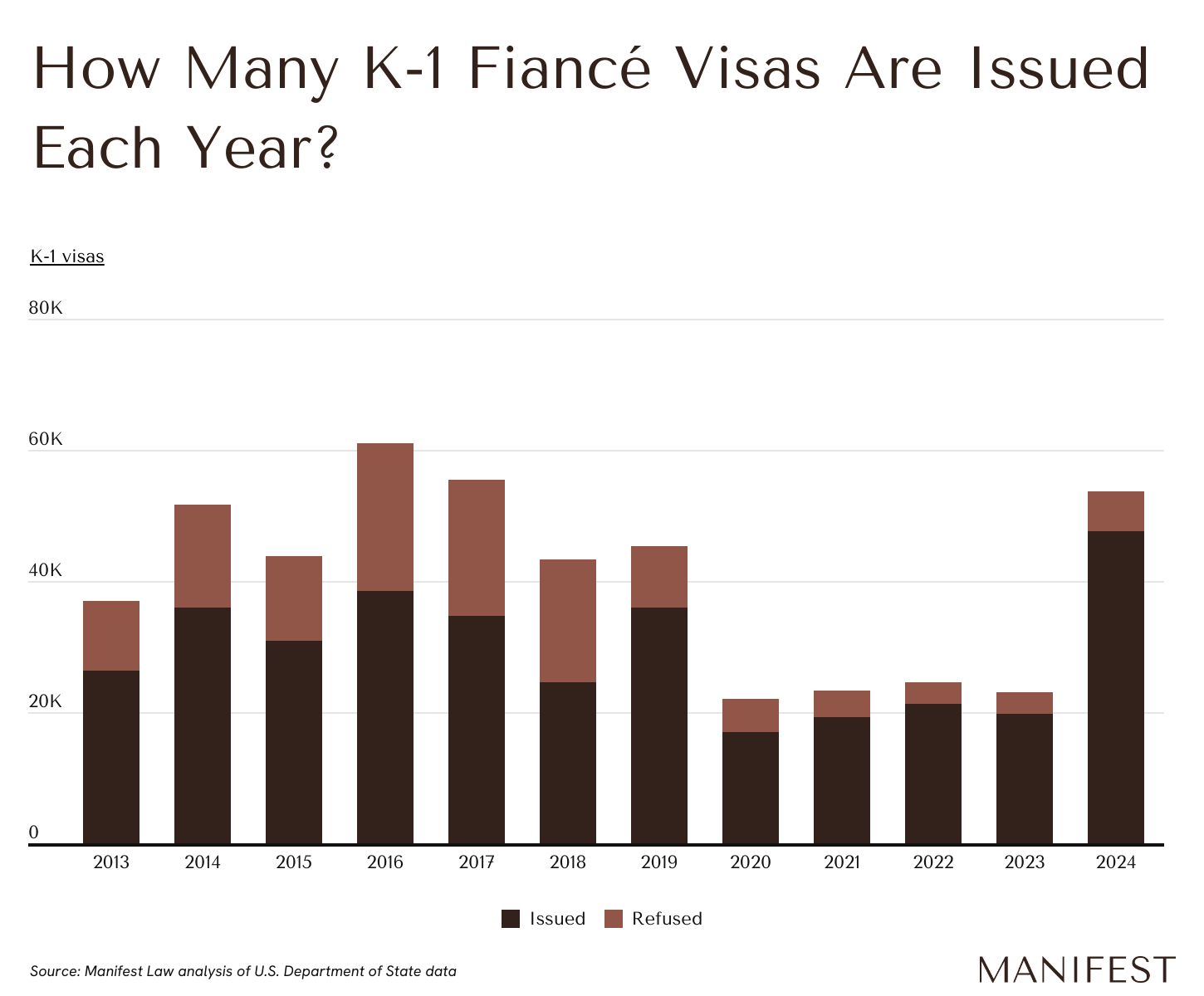
How Many K-1 Fiancé Visas Are Issued Each Year?
Following years of increasing backlogs after COVID, fiancé visa issuances surged to a 12-year high in 2024
Source: Manifest Law analysis of U.S. Department of State data
Although USCIS petition approvals determine whether a couple may continue through the immigration process, a K-1 visa is not issued until the foreign fiancé completes consular processing with the U.S. Department of State. As a result, annual visa issuances often lag changes in petition adjudications and can reflect both current processing capacity and the resolution of cases that accumulated during previous years.
Annual K-1 visa issuances fell from 35,881 in FY2019 to just 16,849 in FY2020 as consular operations around the world were disrupted. Issuances recovered partially to 19,218 in FY2021 and 21,351 in FY2022, then slipped to 19,825 in FY2023, remaining well below pre-pandemic levels despite USCIS increasing petition approvals during that period. In FY2024, however, visa issuances surged to 47,579, the highest annual total in the Department of State's published series, which begins in 2013, and nearly 24% higher than the previous peak of 38,403 in FY2016.
The surge in visa issuances coincided with a broader State Department effort to reduce visa backlogs that accumulated during the COVID-19 pandemic. Throughout 2023 and 2024, the Department reported recovering visa processing capacity more quickly than anticipated by assigning additional consular officers overseas, introducing new technology to streamline adjudications, reducing administrative processing times, and implementing other operational efficiencies aimed at increasing visa throughput. Refusals also rose, from 3,276 in FY2023 to 6,130 in FY2024.
Total adjudications more than doubled over that period, while the refusal rate fell from roughly 14% to 11%, so consular posts were both working through far more cases and issuing a somewhat larger share of them. Department of State refusal counts include INA 221(g) administrative processing refusals that are later overcome, so they are not a clean measure of final denials.
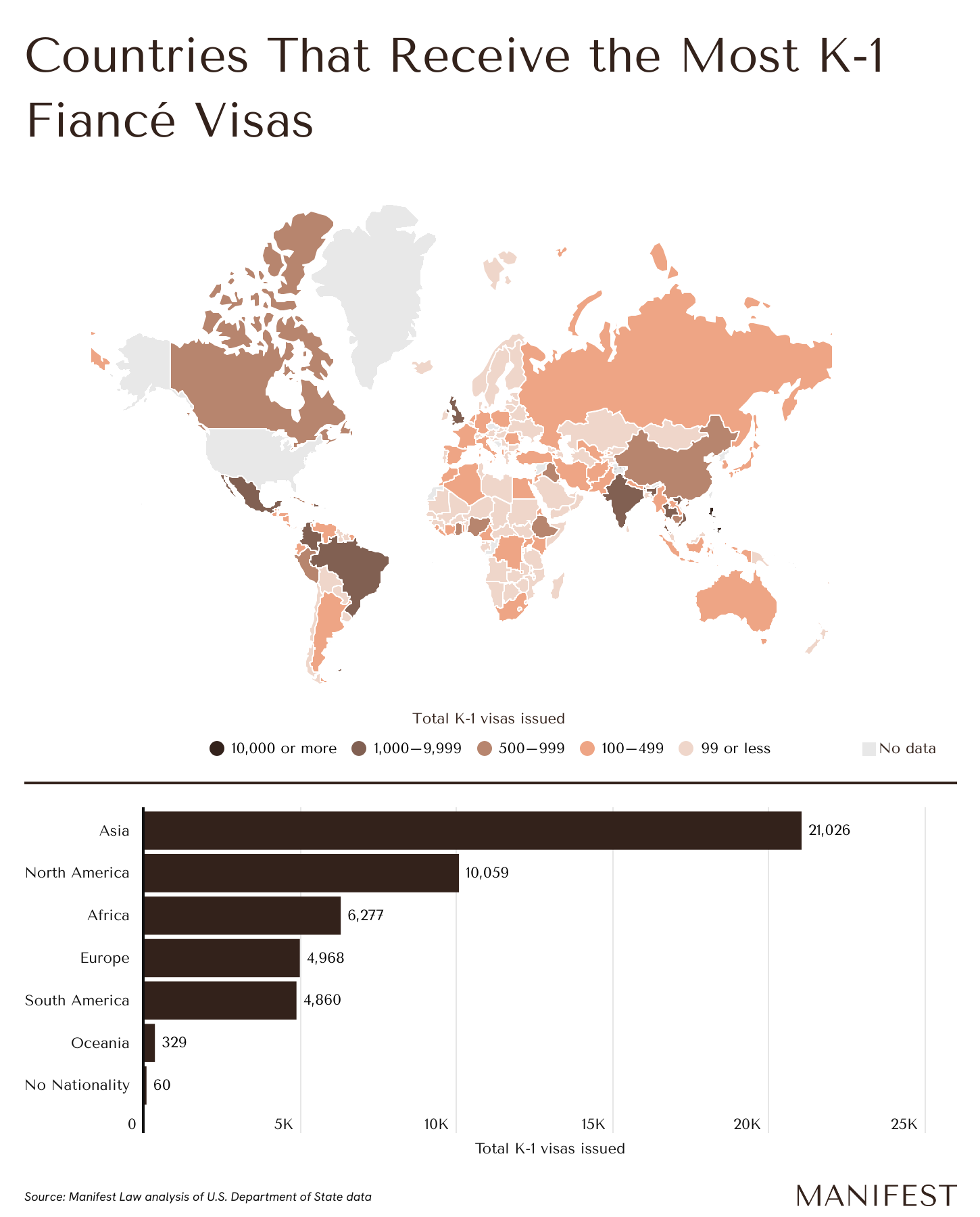
Countries That Receive the Most K-1 Fiancé Visas
The Philippines leads globally in fiancé visa issuances, more than the next four leading countries combined
Source: Manifest Law analysis of U.S. Department of State data
As visa issuances reached their highest level in more than a decade, the geographic distribution of K-1 visas continued to reflect longstanding patterns in global migration to the United States. Asia received 21,026 K-1 visas in FY2024, more than double the total for North America (10,059) and substantially more than Africa (6,277), Europe (4,968), and South America (4,860). The concentration of issuances in Asia reflects the region's deep family, economic, and migration ties with the United States, many of which have developed over several decades.
The Philippines remained by far the largest recipient of K-1 fiancé visas, with 10,228 visas issued in FY2024, more than one in five of all K-1 visas issued worldwide and roughly 2.4 times the total for Mexico. Mexico ranked second with 4,180 visas, followed by Vietnam (2,208), the Dominican Republic (1,969), and Colombia (1,863). The Philippines' longstanding lead reflects a combination of historical and demographic factors rather than a recent shift in migration patterns.
The United States and the Philippines have maintained close political, military, and economic ties for more than a century, while decades of migration have created one of the largest Filipino diaspora communities in the United States. Combined with widespread English proficiency and extensive family and social networks spanning both countries, those ties have consistently made the Philippines the leading source of K-1 fiancé visas.
Which U.S. States Receive the Most K-1 Fiancé Visas?
California by far sees the highest total fiancé visa arrivals while Hawaii leads the nation in per capita admissions
Source: Manifest Law analysis of U.S. Department of Homeland Security data
Where K-1 visa holders ultimately settle often mirrors broader immigration patterns, with the largest numbers arriving in states that have sizable populations and well-established immigrant communities. California received 8,180 fiancé visa arrivals in FY2024, more than Florida (3,940) and Texas (3,870) combined, the next two highest-ranking states. New York (3,200), Illinois (1,840), Washington (1,450), New Jersey (1,400), and Georgia (1,310) also ranked among the leading destinations, reflecting their large populations and longstanding roles as major gateways for new immigrants.
Adjusting for population presents a different picture. Hawaii recorded 34.6 fiancé visa arrivals per 100,000 residents in FY2024, well ahead of California (20.7), Alaska (20.3), Nevada (20.2), Washington (18.2), and Massachusetts (17.9). Hawaii's unusually high rate likely reflects its unique geographic position in the Pacific and longstanding historical, cultural, and economic ties with Asia.
Here is a summary of the data for Alabama:
- Fiancé(e) visa admissions per 100K residents: 5.6
- Total fiancé(e) visa admissions: 290
- Total children of fiancé(e)s visa admissions: 40
- Share of all fiancé(e) visa admissions: 0.7%
- Total nonimmigrant visa admissions: 172,170
For reference, here are the statistics for the entire United States:
- Fiancé(e) visa admissions per 100K residents: 13.1
- Total fiancé(e) visa admissions: 44,430
- Total children of fiancé(e)s visa admissions: 6,850
- Share of all fiancé(e) visa admissions: 100.0%
- Total nonimmigrant visa admissions: 77,646,290



(0) comments
Welcome to the discussion.
Log In
Keep it Clean. Please avoid obscene, vulgar, lewd, racist or sexually-oriented language.
PLEASE TURN OFF YOUR CAPS LOCK.
Don't Threaten. Threats of harming another person will not be tolerated.
Be Truthful. Don't knowingly lie about anyone or anything.
Be Nice. No racism, sexism or any sort of -ism that is degrading to another person.
Be Proactive. Use the 'Report' link on each comment to let us know of abusive posts.
Share with Us. We'd love to hear eyewitness accounts, the history behind an article.