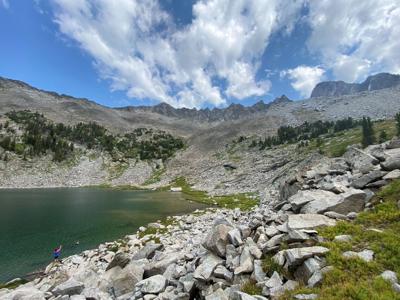
Cottonwood Lake is in the Custer Gallatin National Forest, which stands to be impacted by the proposal to rescind the Roadless Rule.
Courtesy London Bernier/Greater Yellowstone Coalition
The Trump administration has filed a proposed rule to rescind the 2001 Roadless Rule, a regulation that restricts road construction, road reconstruction and timber harvesting on roughly 45 million acres of National Forest System land across the country, including approximately 6.4 million acres in Montana.
Since the U.S. Department of Agriculture first announced its intention to rescind the rule in June 2025, the topic has been at the center of debate among conservation groups, politicians, tradesmen and outdoor recreationists.
In a USDA press release, Forest Service Chief Tom Schultz said rescinding the Roadless Rule would allow local forest managers to “address watershed, economic, and wildfire-risk conditions within the sideboards of existing laws, regulations, and policy.”
In rescinding the 2001 Roadless Rule, the USDA aims to “restore authority” to local forest managers who “know the land best” to determine how forests and grasslands are managed for recreation, resource extraction and wildfire mitigation, according to the Department of Agriculture’s Aug. 18 press release.
“(This) long overdue decision will empower states like Montana to pursue proper forest management on federal lands with local communities in mind,” Governor Greg Gianforte said in the release.
The press release characterizes the “failed” 2001 Roadless Rule as “a one-size-fits-all restriction that has frustrated land managers and served as a barrier to wildfire risk reduction work.”
By contrast, conservationists like Hilary Eisen, the Federal Policy Director for conservation group Wild Montana are strongly opposed to the proposal.
“It’s a pretty nakedly political decision; it’s not a decision based on sound forest management or common sense, fiscal responsibility, or public interest,” Eisen said.
Opposite Eisen, Gianforte and USDA official Stephen Vaden refer to the proposal as a “common sense” decision.
In terms of wildfire management, defenders of the Roadless Rule argue that opening inventoried roadless areas to additional development would increase fire risk rather than diminish it.
“Anyone who actually does this work on wildland fires could tell you that repealing the Roadless Rule within an agency that's got a multi-billion dollar backlog of road maintenance work is not going to do a whole lot of good for fighting fires,” said Sam Forstag, a Montana smoke jumper and Democratic candidate for U.S. House in the upcoming midterm election.
The Chronicle reached out to Aaron Flint, Forstag’s Republican opponent in the race for Congress, but did not hear back by press time.
With a staff that’s been significantly diminished during the second Trump administration, Forstag said the U.S. Forest Service simply does not have the manpower to staff trail and fire crews, much less build and maintain new roads.
“We have more acres burning than in a typical summer and fewer people than ever to actually fight the fires. Anyone on the ground could tell you the agency is radically under-resourced just to do the basic work right now,” Forstag said. “We don’t have the resources to go into the wilderness to clear out roads, even if it was a good policy and it doesn't seem like it is.”
The proposed rule states that “budget, conservation objectives and physical resource limits are expected to constrain new permanent road construction” on formerly inventoried roadless areas, even if the Roadless Rule is rescinded.
The proposed rule also states that rescinding the Roadless Rule “could result in an estimated 5 to 10 percent increase in total annual National Forest System sawtimber harvest,” amounting to “$4.6 to $10.6 million per year in revenue to the timber industry.”
Forstag disagrees strongly with this economic rationale.
“The notion that opening up a road so you can go 20 miles back into the wilderness is going to create any sort of profitable timber ventures is just absurdity, and it shows exactly what the problem is,” he said. “We got a lot of people running the show here who don’t know what the work actually looks like on the ground.”
For the Montana Logging Association, the proposed action to repeal the Roadless Rule is a positive development.
“This will allow our partners in the Forest Service a lot more flexibility; it will give the people on the local forests more control over what’s going on,” said Tim McEntire, the northwest region representative of the Montana Logging Association.
In the 25 years since the Roadless Rule was established, McEntire said a lot has changed in the nation’s forests.
“They’ve gotten a lot drier, we’re seeing a lot more insects and disease and this (decision) will allow local management in some areas that really need management,” McEntire said. “To get in there and get some science-driven, proactive, good forest management is going to be great for our communities.”
If the Roadless Rule is rescinded, local forest supervisors would manage the National Forest System under existing or revised land management plans, according to the USDA rulemaking documents.
Any future timber harvesting or road construction proposals within inventoried roadless areas would have to comply with these land management plans, National Environmental Policy Act regulations and other applicable laws, per the proposed rule.
“It’s very far from a free-for-all; we’re not going to go in and cut every tree,” McEntire said.
The presence of roads in currently inventoried roadless areas could help facilitate fuel reduction efforts and decrease response times to forest and other emergencies, McEntire said.
“We’re not going to be putting roads and punching holes in the whole thing; we just need to get the access in there,” McEntire said.
Wildfires are more frequently ignited in areas with roads than areas without, according to a Wilderness Society analysis of national data collected from 1992 through 2024.
From Forstag’s perspective as a firefighter, the policy shift creates more opportunities for fires to be sparked in peak fire season in areas where managers don’t currently have the resources to fight fires.
The USDA proposed rule asserts that the Roadless Rule limits mechanical thinning options and fire control tactics in inventoried roadless areas covering “substantial acreage” with "relatively high likelihood of burning under high intensity conditions.” Rescinding the rule would “increase opportunities for hazardous fuel treatments in the wildland-urban interface” by returning management decisions to local authorities, per the proposal.
“Fires started and acres burned are two different things,” McEntire said. “There’s no doubt it’s human nature: We start fires. That’s where (rescinding) the Roadless Rule really shines. We can get to the fires started just off the road quickly. A lot of times in those big mega-fires, the access is limiting our firefighting capacity.”
A polarizing topic
After the USDA announced its intention to rescind the rule, the Trump administration followed with a notice of intent in August 2025. This opened the first round of public comment on the proposal from Aug. 29, 2025 to Sept. 19, 2025. Under the National Environmental Policy Act, federal agencies must provide public comment opportunities when proposing federal public land management changes.
During this period, the Forest Service received more than 600,000 comments, including form letters and other submissions. A Center for Western Priorities analysis of a subset of approximately 224,000 comments found that the vast majority opposed rescinding the Roadless Rule.
Despite this finding, Eisen of Wild Montana said the administration’s recent proposed decision to move forward with rescinding the rule did not come as a surprise.
“This was the decision we were expecting,” Eisen said. “It clearly shows they didn’t take public comment into account; they didn’t listen to anybody, and now they’re charging ahead with what they were planning all along.”
In addition to potential implications for fire prevalence and logging, rescinding the Roadless Rule could also impact recreation and tourism activities, according to the proposed rule.
“This expansion could increase road-based recreation and accessibility improvements but would result in tradeoffs with opportunities for quiet, remote and self-reliant recreation and may increase user conflict and result in lost economic benefits," the proposed rule reads.
Estimated national losses in economic benefit to recreationists could amount to $6.1 million annually, according to the USDA proposed rule. NEPA mandates that government agencies conduct environmental impact assessments and disclose any environmental and economic impacts proposed actions may have.
“The outdoor economy is now at risk. Protected roadless areas offer world-class outdoor recreation opportunities like hunting, fishing, camping and hiking,” said Emilie Ritter, director of communications and marketing at the Greater Yellowstone Coalition.
Nearly 5% of Montana’s gross domestic product, amounting to $3.8 billion, was generated from outdoor recreation in 2024, according to the U.S. Department of Commerce.
Developing inventoried roadless areas could also lead to depreciation of Montana’s water sources, Ritter said.
“The more roads you have, the more pollution that would seep into our water supply,” Ritter said. “The Roadless Rule protects these headwaters, and it’s vital for maintaining clean drinking water across the country.”
The USDA will be receiving public comment on the proposed rule and draft EIS through Sept. 21 at 11:59 p.m. Eastern time.
Comments in support or opposition to the proposal can be submitted through the Federal eRulemaking Portal at regulations.gov or by mail to 201 14th St. SW, Mailstop 1108, Washington, D.C. 20250-1124. All comments must be identified by docket number FS-2025-0001 or RIN 0596-AD66.
Keep it Clean. Please avoid obscene, vulgar, lewd,
racist or sexually-oriented language. PLEASE TURN OFF YOUR CAPS LOCK. Don't Threaten. Threats of harming another
person will not be tolerated. Be Truthful. Don't knowingly lie about anyone
or anything. Be Nice. No racism, sexism or any sort of -ism
that is degrading to another person. Be Proactive. Use the 'Report' link on
each comment to let us know of abusive posts. Share with Us. We'd love to hear eyewitness
accounts, the history behind an article.



(0) comments
Welcome to the discussion.
Log In
Keep it Clean. Please avoid obscene, vulgar, lewd, racist or sexually-oriented language.
PLEASE TURN OFF YOUR CAPS LOCK.
Don't Threaten. Threats of harming another person will not be tolerated.
Be Truthful. Don't knowingly lie about anyone or anything.
Be Nice. No racism, sexism or any sort of -ism that is degrading to another person.
Be Proactive. Use the 'Report' link on each comment to let us know of abusive posts.
Share with Us. We'd love to hear eyewitness accounts, the history behind an article.