Four text messages the superintendent of Yellowstone National Park sent to the governor of Montana in 2023 regarding a new bison plan show a decision had already been made, a Montana Department of Livestock attorney has argued.
Therefore, the texts should be added to the administrative record in the state’s lawsuit against the federal agency, attorney Lindsey Simon wrote in the brief she filed in U.S. District Court in Billings on July 2. She is one of three state attorneys listed as working on the case.
Montana sued Yellowstone and the Department of Interior on Dec. 31, 2024, challenging the creation of the park’s new Bison Management Plan.
A Montana attorney has submitted a brief to U.S. District Court in Billings to add seven exhibits to the administrative record in the state's lawsuit against Yellowstone National Park.
7 exhibits proposed
The texts were just one of seven exhibits the state is seeking to add. The state is also requesting that two memos from the Interagency Bison Management Plan facilitator, Bozeman resident Scott Bischke, be permitted, along with decision notices issued by state agencies when bison tolerance zones were created outside the park.
Another exhibit contains the 2010 draft environmental impact statement issued by the Park Service regarding remote vaccination of bison for brucellosis.
The seventh exhibit is a 2008 Park Service monitoring plan to “evaluate the likely effects and effectiveness of a variety of management activities.” Updated in 2011, the plan identifies “desired conditions,” including a bison population averaging 3,000 to 3,500.
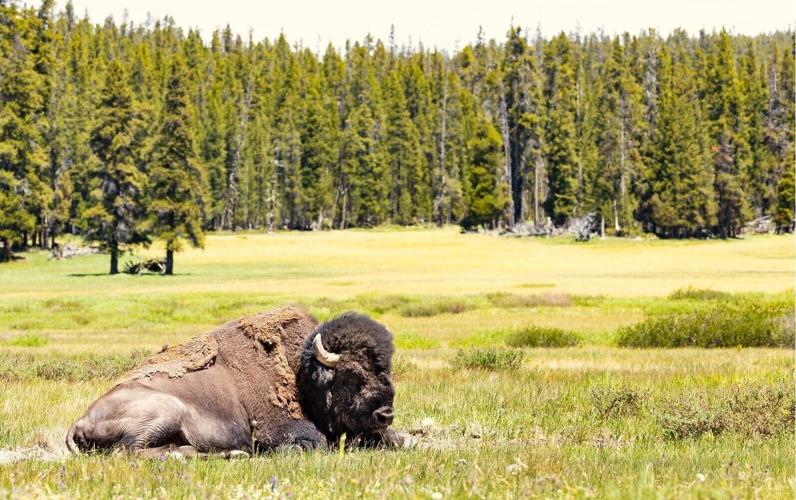
A Yellowstone National Park bison bull rests in a wallow.
JACOB W. FRANK, NPS
2024 lawsuit
The text messages were sent on May 6, 2023, between 8:47 p.m. and 9:29 p.m. by park Superintendent Cam Sholly to Gov. Greg Gianforte prior to a May 17 meeting between park and state officials. The planning process had begun more than a year earlier.
“I see you’ve invited quite a few people to the meeting on the 17th,” Sholly wrote. “I think it’s important that this doesn’t become a meeting about our differences. I’m here to support you and think you’re doing a great job on many fronts.”
Although starting out praising Gianforte, Sholly then questioned a letter the state sent to the Interior secretary.
“So pardon my frankness about the advice you’re getting on this issue,” Sholly said. “I look at the letter you sent the secretary and wonder who the hell wrote that for you?”
What letter Sholly referenced is uncertain, but three 2022 letters to the Interior secretary written by Gianforte’s office, the Department of Livestock and the Department of Fish, Wildlife & Parks all challenged how the bison plan was being developed. Gianforte also consistently advocated throughout the process for a bison herd limited to 3,000 animals.
Sholly texted Gianforte that a bison population of 3,000 is a “bs number we haven’t been at for a long time.”
He pointed to the new management plan calling for “population parameters we’ve been at over the past decade,” 3,500 to 6,000. Although he referred to the park’s carrying capacity as 8,000 to 10,000 bison in summer, based on park studies, “Obviously there isn’t habitat for that many in the winter outside the park.”
In harsh winters, bison are more likely to migrate out of the park into Montana where they can be hunted. The Park Service also traps, culls, slaughters and enters some disease-free bison into a quarantine program for eventual transfer. So far, Yellowstone has transferred 625 bison to 29 tribes in 13 states, as well as Canada.
A group of bison gather along Alum Creek in Yellowstone National Park.
Jacob W. Frank, NPS
Montana vs. bison
Montana filed its lawsuit just before the Interior Department would transition from the guidance of the Democratic Biden administration to the Republican Trump regime. Gianforte is a Republican.
Under the administration of current Interior Secretary and billionaire Trump appointee Doug Burgum, Gianforte already scored a bison win earlier this year. This spring Burgum personally oversaw the Bureau of Land Management’s rescission of grazing permits for the nonprofit conservation group American Prairie’s bison herd on federal lands in Eastern Montana.
American Prairie has challenged the decision and is also suing the Montana Land Board, which Gianforte chairs, over its rewriting of rules regarding bison grazing on state school trust lands.
Although Montana’s stated concern with American Prairie is that their bison aren’t considered production livestock under the 1934 Taylor Grazing Act, echoing the BLM’s wording and the Montana Stockgrowers former attorney, Yellowstone bison are opposed for a different reason. An estimated 40% 60% of the park’s bison have been exposed to the disease brucellosis, which can cause pregnant ungulates, including cattle, to abort.
The disease is passed through contact with birthing material. So far, the Department of Livestock has traced the 14 incidents of livestock exposure to brucellosis in Montana to elk, which can also carry the disease. However, Montana has argued that bison pose a greater threat to livestock because of their higher exposure to the disease.
Montana’s latest filing
In its latest filing, Montana has argued the new Yellowstone bison plan was based on “inaccurate and false assumptions,” failed to consider a reduction in Montana’s bison tolerance zones outside the park and argued that the plan’s “no action” alternative of maintaining a herd of 3,500 to 5,000 bison, without vaccinating against brucellosis, was in conflict with previous management objectives.
The state also alleged the text shows Sholly had already decided on what alternative to pursue, “rendering the process meaningless,” in addition to saying Yellowstone failed to cooperate with Montana as required and that increasing bison population levels will degrade the park’s habitat.
In one text to Gianforte, Sholly said he would “commit to continuing to work with the state to reduce risk of brucellosis, no bison into paradise valley (sic), etc." The Paradise Valley is north of the park, one of the areas where bison tolerance has been expanded to allow hunting and to provide more room for bison to roam in the winter.
“We’re not blowing the doors off this thing,” Sholly texted. “Basically saying we’re keeping the same population parameters we’ve been at over the past decade and working together to achieve them in the future.”
He also said the new bison plan would be “solidifying” the current situation.
Sholly noted that Gianforte had refused to consider raising the park’s bison population objective to 8,000 animals, as some conservationists had sought, and he was unwilling to drop to 3,000. Sholly referred to the low figure as a “political compromise” after the state sued Yellowstone over bison management in 1995.
Montana’s concerns ignored
Montana argued in its court brief that the text messages from Sholly proved he “disregarded Montana’s concerns” regarding National Environmental Policy Act analysis. The act requires federal agencies to determine if their proposed actions will have significant environmental effects, according to the Environmental Protection Agency.
Allowing more bison to graze in the park violates the National Park Service Organic Act and Yellowstone National Park Protection Act, the state argued, by allowing the range to be degraded.
The Park Service’s own multi-year analysis has found Yellowstone can accommodate 10,000 head on its summer range, a figure that’s been challenged by some range scientists.
Litigation is ‘lose lose’
In concluding the text chain, Sholly suggested he and the governor work through their differences.
“I don’t want to argue with you in front of a cast of thousands,” he said.
The Park Service was alerted as early as 2022 that Montana was getting ready to litigate if the agency didn’t heed the Gianforte administration’s recommendations.
“Litigation is a lose lose for you and me,” Sholly wrote. “Good chance you lose. If you win, congrats, you get a court order to take the population down to a level it hasn’t been since 2001. Court order protects me from the public and tribes but it’s going to be unnecessarily bad for the state. Even if I agreed with you, and put out alternatives to go back to 3,000, I’d immediately get litigated by multiple environmental groups and get my own science and 20+ years of decision making (including State decision making) used against me.”
The next deadline in the legal proceedings is Aug. 31 when Yellowstone’s cross-motion for summary judgment and response to Montana’s motion for summary judgment are due.
Two Montana-based conservation groups have also sued Yellowstone National Park over its 2024 bison plan. The lawsuit was combined with the Montana case before Chief District Judge Brian Morris for judicial efficiency. Both cases are challenging the same federal actions, albeit for different reasons.
In April the Department of the Interior announced it would write a supplemental environmental impact statement for its Bison Management Plan citing concerns about the unpredictability of winter bison migrations.
The decision followed a mild winter, with the herd reduced by 113 animals whereas the park was aiming for a reduction closer to 700 animals.
Keep it Clean. Please avoid obscene, vulgar, lewd,
racist or sexually-oriented language. PLEASE TURN OFF YOUR CAPS LOCK. Don't Threaten. Threats of harming another
person will not be tolerated. Be Truthful. Don't knowingly lie about anyone
or anything. Be Nice. No racism, sexism or any sort of -ism
that is degrading to another person. Be Proactive. Use the 'Report' link on
each comment to let us know of abusive posts. Share with Us. We'd love to hear eyewitness
accounts, the history behind an article.



(0) comments
Welcome to the discussion.
Log In
Keep it Clean. Please avoid obscene, vulgar, lewd, racist or sexually-oriented language.
PLEASE TURN OFF YOUR CAPS LOCK.
Don't Threaten. Threats of harming another person will not be tolerated.
Be Truthful. Don't knowingly lie about anyone or anything.
Be Nice. No racism, sexism or any sort of -ism that is degrading to another person.
Be Proactive. Use the 'Report' link on each comment to let us know of abusive posts.
Share with Us. We'd love to hear eyewitness accounts, the history behind an article.