A move by the Trump administration to prioritize livestock use on previously vacant federal grazing allotments – including tens of thousands of forest acres along Montana’s Rocky Mountain Front, Little Belt, Gallatin and Bitterroot mountains – was challenged in Oregon District Court on Thursday.
The Center for Biological Diversity filed a complaint asking the court to halt implementation of the Forest Service and Bureau of Land Management’s Grazing Action Plan and associated memorandum of understanding.
The group is seeking an order requiring the agencies to consult with the U.S. Fish and Wildlife Service and National Marine Fisheries Service as required under the Endangered Species Act. At risk, the group contended, are threatened and endangered wildlife and their habitat across 24 million acres, only 10% of all federal grazing allotments.
“The Trump administration is again putting America’s wildlife and public lands at risk by catering to the livestock industry, so we’re suing to make sure our nation’s most vulnerable wildlife don’t pay the price,” Andrea Zaccardi, carnivore conservation legal director at the center, said in a statement.
The Center for Biological Diversity sued the Trump administration Thursday over its approval of a new expanded livestock grazing plan.
Plan launched in March
The Grazing Action Plan was announced in a joint statement on March 31 by Agriculture Secretary Brooke Rollins and Secretary of Interior Doug Burgum. The secretaries said the plan would boost the supply of “American born, raised and harvested beef by supporting American ranchers.”
An estimated 20,000 ranchers in 28 states utilize federal grazing allotments. The goal of the MOU, in part, was to make grazing management “more efficient, transparent and responsive” by cutting the time it takes to issue grazing permits, according to the federal agencies. The MOU stated the plan would remain in effect for five years.
The federal action also promoted using targeted grazing to reduce wildfire risk and guaranteeing “no net loss of Animal Unit Months within allotments.”
Between the Forest Service and BLM, more than 23,000 grazing permits and leases are already being utilized on 29,000 allotments. Yet the number of cattle grazed on these federal lands amounts to only 3% of the nation’s cows.
The complaint pointed to agency letters and statements from officials noting the goal to expedite implementation, including a statement by Karen Budd-Falen, an Interior Department official, Wyoming rancher and attorney, who said that 1,300 vacant BLM allotments would be filled by the end of the year.
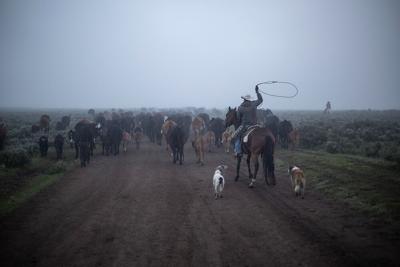
A cowboy drives cattle toward summer grazing pasture on U.S. Forest Service land along the Green River near Cora, Wyoming, in June.
RYAN DORGAN, CASPER STAR-TRIBUNE
Consultation skipped
The Center for Biological Diversity argued in its 50-page court filing that the federal agencies should have consulted with the U.S. Fish and Wildlife Service and National Marine Fisheries Service before implementing the plan. Failure to do so violated the Endangered Species Act’s protection of several species, including wolves and Gunnison sage grouse, as well as their habitat.
The BLM has already moved to revise grazing regulations to “restrict the role of the public in public lands grazing decisions,” the complaint said, including eliminating “site specific evaluations that currently identify grazing impacts to streams, wildlife habitat, and endangered species.”
The BLM has also rewritten rules to restrict grazing permits to production-oriented livestock, excluding native species such as bison owned by the conservation group American Prairie in northeastern Montana.
Trouble for grizzlies, fish?
Restocking parcels in known grizzly and wolf habitat is bound to cause problems, the center noted.
“Expanding grazing on federal public lands risks harming important carnivores like grizzly bears and wolves who are too often killed because of conflicts with livestock,” the group said.
In July, Burgum announced the Department of Interior would grant states greater freedom to manage grizzly bears as a first step to delisting the animals. The Rocky Mountain Front contains one of the largest populations of grizzlies in the lower 48 states.
The Center for Biological Diversity also pointed to possible harms to streams across the West that sustain bull trout and steelhead, fish that have already seen their traditional habitats greatly reduced.
“There are more than a dozen vacant Forest Service and BLM allotments in Idaho, Montana, Oregon, and Washington that contain or are directly adjacent to streams that are designated critical habitat for bull trout,” the complaint stated.
Keep it Clean. Please avoid obscene, vulgar, lewd,
racist or sexually-oriented language. PLEASE TURN OFF YOUR CAPS LOCK. Don't Threaten. Threats of harming another
person will not be tolerated. Be Truthful. Don't knowingly lie about anyone
or anything. Be Nice. No racism, sexism or any sort of -ism
that is degrading to another person. Be Proactive. Use the 'Report' link on
each comment to let us know of abusive posts. Share with Us. We'd love to hear eyewitness
accounts, the history behind an article.



(0) comments
Welcome to the discussion.
Log In
Keep it Clean. Please avoid obscene, vulgar, lewd, racist or sexually-oriented language.
PLEASE TURN OFF YOUR CAPS LOCK.
Don't Threaten. Threats of harming another person will not be tolerated.
Be Truthful. Don't knowingly lie about anyone or anything.
Be Nice. No racism, sexism or any sort of -ism that is degrading to another person.
Be Proactive. Use the 'Report' link on each comment to let us know of abusive posts.
Share with Us. We'd love to hear eyewitness accounts, the history behind an article.