Members of the public told the Public Service Commission Thursday they wanted the current four-person body to refute NorthWestern Energy’s power plan that almost exclusively focuses on building out Montana’s generation through gas plants over the next 20 years. Many state residents expressed concerns about the environmental impacts and the cost of the plan.
“This plan is like pouring gas on a burning building,” Missoula resident Abby Huseth told commissioners. “Locking us into decades more of fossil fuel infrastructure is just so deeply irresponsible. It makes a warped kind of sense in a world where you're only concerned with shareholder returns from one quarter to the next. But in a world where a good future for my kids, for your kids, our grandkids, where that future requires a habitable planet, it's just absolute insanity to propose a plan like this.”
NorthWestern’s 2026 Integrated Resource Plan envisions several futures where gas plants are added in the coming years to meet an assessed increase of electricity demand of more than 30% in the region. Only a couple modeled scenarios envision adding some wind and or solar in that mix, always less than the amount that would be added through other forms of power generation like gas and nuclear. Nearly all scenarios envision several hundred megawatts of nuclear energy replacing power from a retired Colstrip coal plant in 2043.
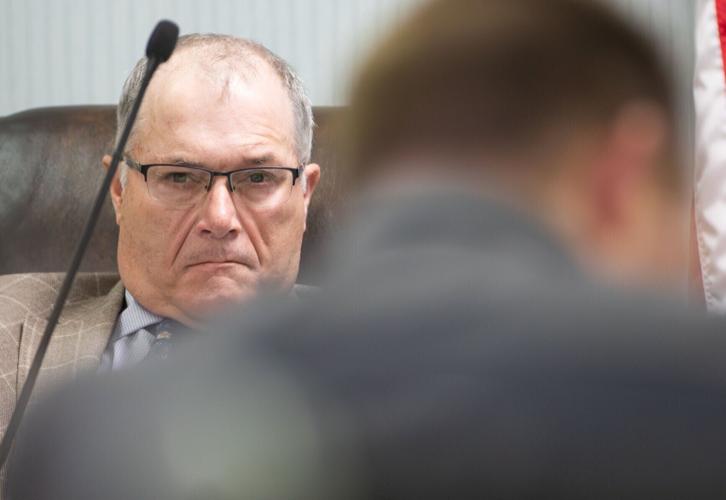
Montana Public Service Commission President Jeff Welborn listens to public statements during a hearing inside the Bollinger Room on May 12 in Helena.
SONNY TAPIA, Independent Record
“Montana customers have depended on unpredictable energy markets for supply, mostly from out of state, to meet peak energy demand for too long,” the utility said in a past press release describing the company's energy portfolio as it acquired a majority share in Colstrip.
In its finalized 382-page plan, NorthWestern stated that “dependable firm generation additions are lagging” in Montana. Recently, large energy developments in Montana have included the addition of wind, solar and batteries, but NorthWestern’s main addition to the grid in recent years has been the Yellowstone County Generating Station, a 175-megawatt gas plant near Laurel considered necessary at the time by the company to meet capacity needs.
NorthWestern currently estimates capacity needs arising again in winter 2027-28 because a 100-megawatt contract is expiring.
This year, NorthWestern just acquired an extra 592 megawatts of Colstrip’s coal plan. Currently, 370 megawatts is considered separate from ratepayers and instead can be sold to retail customers like data centers, leaving them with a rare abundance of power that can be used to meet future demand, the company has previously noted. Still, no plan by NorthWestern envisioned a continuation of the coal plant in the long term.
At the PSC hearing, citizens questioned why NorthWestern would need the additions of several hundred megawatts and worried about associated costs of the projects.
“Since 2023 alone, NorthWestern has received approval for significant rate increases, and today the average residential electric bill is approximately $131 per month, compared to about $91 just four years ago — an increase of roughly 44%,” Great Falls resident and legislative candidate Valynda Holland said. “While those increases stem from multiple factors, the reality for Montana families is the same: electricity has become increasingly unaffordable... Every major investment approved by this commission should answer one simple question: How does this directly benefit Montana ratepayers? ”
Development of most renewable energy is now cheaper than fossil fuels, but NorthWestern questioned the reliability of such power, noting "reliability risks” with recent fossil-fueled generator retirements in the region. Other contracts for clean power with NorthWestern are ending in the coming years too, but they could be extended.
“It is very clear to me, after spending several days going through the document, that NorthWestern has misrepresented and concealed the true costs and reliability of potential power sources in order to favor expensive coal, gas and nuclear generation,” Bozeman resident Jennifer Swearingen told commissioners. “In addition, it is eliminating, without explanation, clean and expensive power contracts from its existing portfolio.”
Montana Public Service Commission staff attorney Pamela Snyder-Varns reads documents on May 12 in Helena inside the Bollinger Room during a hearing.
SONNY TAPIA, Independent Record
Bozeman resident Karin Kirk, a director with Montanans for Affordable Energy, described to the commissioners how NorthWestern built its plan around peak demand, resulting in potential extra costs.
“Power needs to be there during our hottest days and coldest nights, and that is all well and good,” Kirk said. “In the Western grid, peak demand occurs for only around 90 hours a year. The whole system is built around 90 hours, just 1% of the time. When Northwestern plans for growth in electricity, they take that peak and they just shift it upward, and that gives them justification to build new power plants to serve just those 90 hours per year. And I can't imagine a more expensive and wasteful solution.”
She said other utilities have learned to smooth out peaks in electricity, often through managing electricity use during high demand. No demand response programs were included in the 2026 plan.
This isn’t the first time NorthWestern’s power plan has drawn consternation from members of the public, with a common concern being the company’s prioritization of gas power.
A 2020 report commissioned by the Public Service Commission and produced by Synapse Energy Economic described that costs assigned to solar in a 2019 power plan were “much higher” than industry benchmarks. Further, solar and wind were strongly discredited in the models than was standard, leaving only room for new gas resources in the past model. The technical report described NorthWestern’s approach back then as “flawed.”
“So, it's not much of a stretch to imagine that this latest plan, similarly biased against affordable wind, solar, and energy storage options will very likely result in more rate hikes to come,” Sierra Club of Montana member Caitlin Piserchia said. “We know, as has been mentioned, renewable energy is accessible and affordable, and Montana is falling behind despite its strong wind potential.”
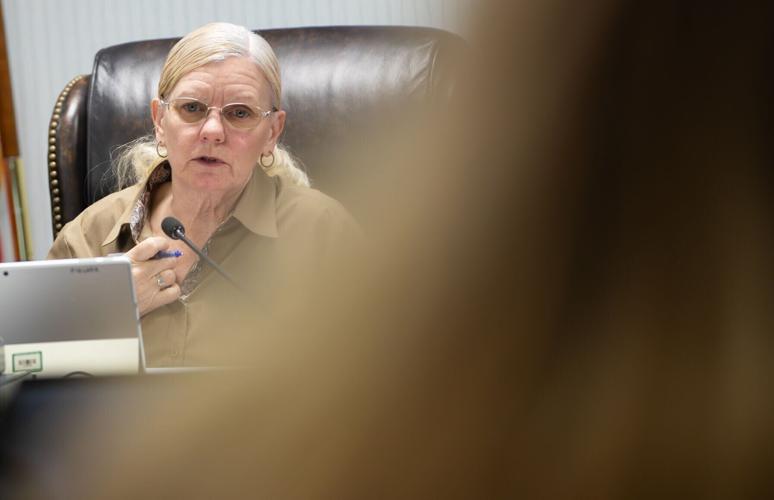
Montana Public Service Commission Vice President Jennifer Fielder speaks during a hearing inside the Bollinger Room on May 12 in Helena.
SONNY TAPIA, Independent Record
The Missoula resident said NorthWestern continues to refuse to analyze in good faith and is “flouting” the authority of the PSC.
“We all deserve better,” Piserchia told commissioners.
A written comment period on the power plan concludes on July 28, and can be emailed to pschelp@mt.gov. After that the regulatory body must review the plan and consider public comment over 120 days. The body can’t rule on the plan’s substance, but can determine whether it meets minimum filing requirements and provide general feedback.
No one provided positive feedback about NorthWestern’s plan to the PSC during its two Helena public hearings.
Keep it Clean. Please avoid obscene, vulgar, lewd,
racist or sexually-oriented language. PLEASE TURN OFF YOUR CAPS LOCK. Don't Threaten. Threats of harming another
person will not be tolerated. Be Truthful. Don't knowingly lie about anyone
or anything. Be Nice. No racism, sexism or any sort of -ism
that is degrading to another person. Be Proactive. Use the 'Report' link on
each comment to let us know of abusive posts. Share with Us. We'd love to hear eyewitness
accounts, the history behind an article.




(0) comments
Welcome to the discussion.
Log In
Keep it Clean. Please avoid obscene, vulgar, lewd, racist or sexually-oriented language.
PLEASE TURN OFF YOUR CAPS LOCK.
Don't Threaten. Threats of harming another person will not be tolerated.
Be Truthful. Don't knowingly lie about anyone or anything.
Be Nice. No racism, sexism or any sort of -ism that is degrading to another person.
Be Proactive. Use the 'Report' link on each comment to let us know of abusive posts.
Share with Us. We'd love to hear eyewitness accounts, the history behind an article.