Ruth DiPietro leans on a sign outside a planning commission meeting regarding data centers on Thursday, June 11, 2026, in Nashville, Tenn. (AP Photo/George Walker IV)
Artificial intelligence and its machines need electricity—a lot of electricity.
Data centers accounted for 4.4% of American electricity consumption in 2024, according to the U.S. Department of Energy.
The surge in new, more energy-intensive data centers to power artificial intelligence and its machine learning waves is poised to potentially triple electricity consumption by 2028, according to Penn State University's Institute of Energy and the Environment.
A recent analysis by Bloomberg projects U.S. data centers will consume as much as 20% of total electricity production by 2035.
“The usage is definitely significant and it's growing,” said Kim Lundgren, CEO of Kim Lundgren Associates (KLA), a Boston-based sustainability consulting firm that works with local governments on data centers and other development issues.
Kim Lundgren
Sandra Costello
The United Nations (UN) and International Energy Agency (IEA) said AI and its data centers already use more power than many countries and project that by 2030 their global energy demand will exceed all but five countries.
IEA estimates AI/data centers could use 945 terawatts of electricity by 2030, double their current consumption. That could mean AI and its data centers will consume more power than countries (and big economies) such as Japan, Brazil, Germany and France.
Lundgren said AI's energy use raises concerns about power grids and utility rates, and is a top consideration for local communities weighing data center projects across the U.S.
'SPEED TO POWER'
AI data centers need significantly more power and bandwidth to fuel computing power and machine learning. That includes powering servers and other systems and cooling systems to keep them from overheating.
Andrew Denis, chief scientist and co-founder at ZON, a Delaware-based energy technology company that works with data center developers and users, described AI’s power needs as “large and compounding.”
“Average rack densities roughly doubled from 2021 to 2024, AI racks now routinely exceed 50 kilowatts, and next-generation systems are pushing toward 200 kilowatts per rack — with a further fourfold jump expected by 2027,” Denis told Adams MultiMedia (AMM).
“Every watt of compute demands cooling on top of it, and training runs swing hundreds of megawatts up and down in seconds,” he said.
AI’s thirst for power entails a basic prompt requiring as much as 10 to 15 times the power of a traditional Google search and larger machine learning tasks needing even more electricity, according to the UN and other groups.
Britt Burt, senior vice president of power industry research at Industrial Info Resources (a Texas-based research and consulting firm), said power needs top the list of where new data centers are being proposed and planned.
“They are such a huge electricity user,” Burt said. “The old mantra of location, location and location has really given way to speed to power.”
Denis agrees.
“It is now the defining constraint — not chips, not land, not capital. Roughly half of the data center projects slated to come online in 2026 face delays attributable to power availability,” he said.
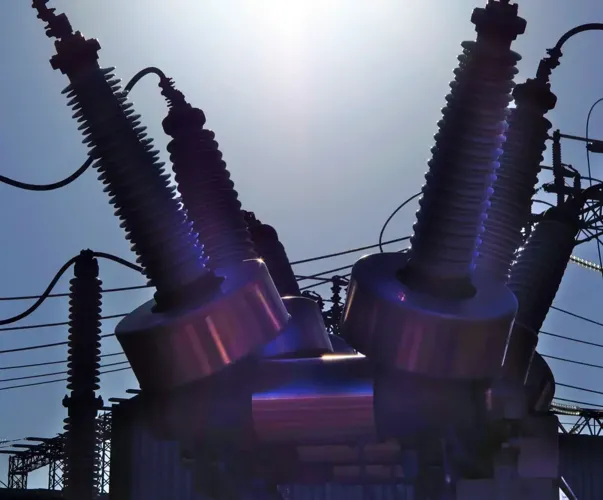
High-voltage transmission lines provide electricity to data centers in Ashburn in Loudoun County, Virginia. (AP Photo/Ted Shaffrey, File)
Ted Shaffrey
CONCENTRATED SURGES
Burt said an estimated $6 trillion is eyed for investment in new data centers globally, with much of it targeted in the U.S. “About $4 trillion of that is in the U.S.,” Burt said.
Increases in data centers’ electricity usage could be even more pronounced in U.S. states where new data centers are landing.
Virginia, which is already the top hub for data centers, could see energy use by technology facilities increase from approximately 25% to as much as 57% by 2030, according to Energy Power Research Institute (EPRI).
The California-based group projects several other states could see big increases in the amount of power used by data centers.
Wyoming and Iowa could see data centers’ power use triple to approximately 30% of total electricity consumption, respectively, by 2030, according to EPRI.
Ohio, Texas and New Mexico could see data centers’ electricity usage go from single digits to 20% or more, respectively, by 2030.
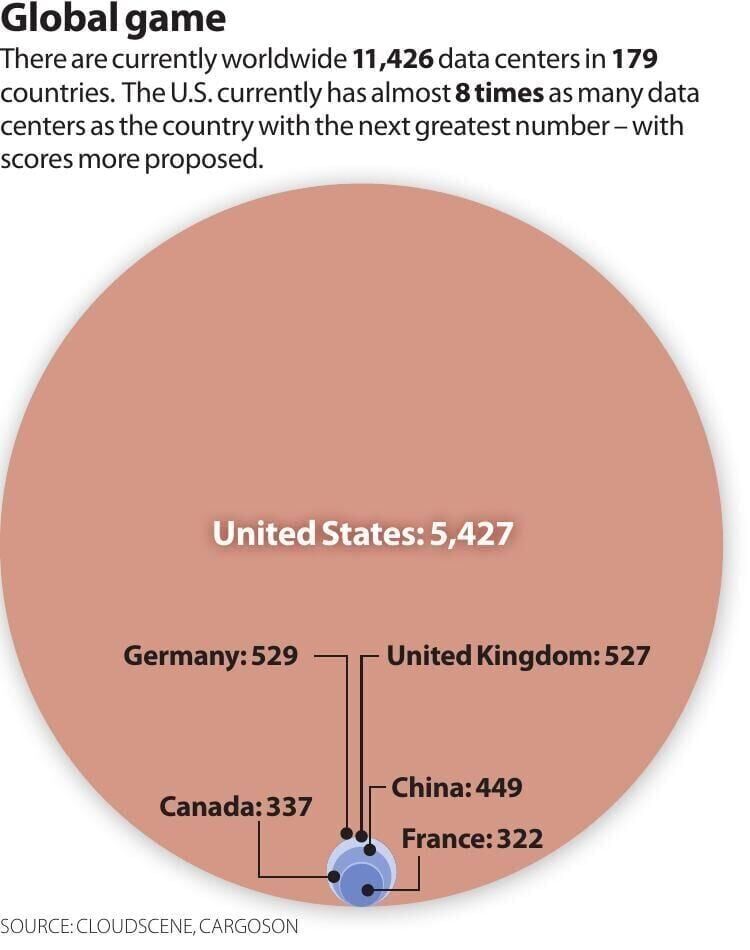
A map depicting U.S. data center infrastructure.
Chris Moore / AMM
HIGHER RATES?
Some worry whether the increased demands could result in high utility bills for residential and other business ratepayers.
Cardinal rules of market economies dictate that increased demand and/or gobbled-up supplies usually result in higher prices.
“Communities near major clusters in Virginia, Texas, and Georgia have reportedly seen electricity rates rise 8 to 15%,” Denis said. “In the (Mid-Atlantic) region, data centers were blamed for over $9 billion in added capacity costs as auction prices hit records; in Ireland, data centers already consume more than 20% of national electricity.”
Several states, including Florida, Tennessee and Oregon, have passed new laws restricting utilities from passing on increased rates from data centers to other ratepayers.
Other states are considering similar moves.
Oregon’s law includes a tariff and rate hike on big data center developers and hyperscalers aimed at counteracting higher utility bills for residential and other users.
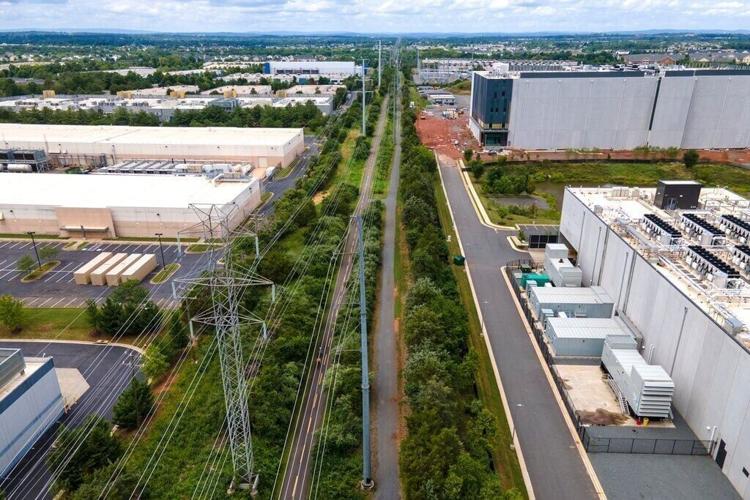
AI data centers require large amounts of electricity and energy infrastructure.
Wikimedia Commons / Magnolia677
POWER PLAYS
The AI surge also creates concerns over whether power grids can handle the added AI-driven loads.
Power infrastructure in rural areas and small towns, in particular, may need upgrades and new equipment.
“Much of our energy grid across the United States is 40 years old or older,” Burt said.
Some AI data center developers and large hyperscalers are paying for upgrades to local and regional power grids or linking to older coal-fired, nuclear or energy plants.
Ruth DiPietro leans on a sign outside a planning commission meeting regarding data centers on Thursday, June 11, 2026, in Nashville, Tenn. (AP Photo/George Walker IV)
George Walker IV
“In a lot of cases they are footing the bill for upfront help for upfront infrastructure, for transmission lines and substations,” Burt said.
Speed to market and the need for power are combining to compel developers and hyperscalers to build their own off-meter power plants and develop their own energy sources.
U.S. President Donald Trump has pushed for easing regulations and allowing new data centers to build and rely on their own power plants.
Trump says that will help the U.S. in the global AI race and ensure data center power demands don’t have downstream impacts on other ratepayers.
But going off-meter has its own challenges, including financing, supply chain backlogs, inflation and regulatory approvals.
“Going off grid is not as easy as it might seem,” said Parag Nathaney, a Washington-based energy and electricity markets analyst.
Nathaney said the energy equation requires cooperation between data center builders and utilities on power supplies, supply chain snafus and connectivity challenges.
Chris Moore / AMM
“Data center load growth will be limited by how much new grid supply can be added,” he said.
“Utilities also need to be nudged by regulators in sharing locations where there is large capacity on the grid available to integrate new load relatively quickly. This should allow for greater integration of data center load without straining the existing grid and raising rates for consumers.
Speed-to-market needs have hyperscalers and AI data center builders scrambling for energy options.
Where are they turning? That’s next in our series. For more on this series, including digital discussions and coverage from across the country check out http://datacenterdiscord.adamsmultimedia.com/.
Keep it Clean. Please avoid obscene, vulgar, lewd,
racist or sexually-oriented language. PLEASE TURN OFF YOUR CAPS LOCK. Don't Threaten. Threats of harming another
person will not be tolerated. Be Truthful. Don't knowingly lie about anyone
or anything. Be Nice. No racism, sexism or any sort of -ism
that is degrading to another person. Be Proactive. Use the 'Report' link on
each comment to let us know of abusive posts. Share with Us. We'd love to hear eyewitness
accounts, the history behind an article.









(0) comments
Welcome to the discussion.
Log In
Keep it Clean. Please avoid obscene, vulgar, lewd, racist or sexually-oriented language.
PLEASE TURN OFF YOUR CAPS LOCK.
Don't Threaten. Threats of harming another person will not be tolerated.
Be Truthful. Don't knowingly lie about anyone or anything.
Be Nice. No racism, sexism or any sort of -ism that is degrading to another person.
Be Proactive. Use the 'Report' link on each comment to let us know of abusive posts.
Share with Us. We'd love to hear eyewitness accounts, the history behind an article.