
The telecom industry is evolving beyond traditional wireless connectivity. The rapid adoption of cloud computing, AI and other data-intensive applications is propelling demand for faster networks, greater fiber capacity and robust infrastructure. Network operators are prioritizing investments in broadband, 5G and network modernization to support rising traffic and changing customer requirements.
Verizon Communications, Inc. VZ and Nokia Corporation NOK both operate at different ends of the broader telecom ecosystem. Verizon boasts a comprehensive wireless, broadband and fiber infrastructure that delivers connectivity services to consumers, businesses and hyperscalers. Nokia is a network technology and infrastructure provider. It supplies optical, IP, fixed and mobile-network technologies.
Growing AI adoption has created new drivers across the telecom ecosystem. Let’s analyze in depth the competitive strengths and weaknesses of the companies to understand which of Nokia or Verizon is in a better position to maximize gains from the emerging opportunities.
The Case for Verizon
AI infrastructure expansion and hyperscale connectivity requirements have become one of the biggest emerging growth vectors for Verizon. Google has signed an agreement worth more than $1 billion to use Verizon’s dark-fiber routes to connect its data centers. The telecom giant is reportedly in talks with other hyperscalers and is expected to announce new deals.
One of the biggest structural changes in the industry is the convergence of telecom and data-center infrastructure. As AI clusters become larger, the connectivity required between data centers is becoming increasingly important. Verizon boasts an extensive metro fiber network that can offer low-latency and resilient connectivity needed to link data centers. This could become a multi-billion-dollar revenue-generating opportunity for Verizon over the next few years.
Verizon has acquired 82 AWS-3 spectrum licenses for approximately $3.2 billion. The company has revealed that the spectrum is complementary to its existing infrastructure and can be deployed without additional capital investment. Verizon’s strategy combines improvements in network performance and AI-enabled network management. The spectrum deployments, in addition to these factors, will strengthen its network proposition and support customer acquisition.
The company’s core business continues to perform well. Postpaid wireless customer addition remains strong. Its strategy of lowering churn through a convergence strategy is paying off well.
Verizon continues to strengthen its financial profile through disciplined execution, boosting customer economics and cost optimization. Free cash flow increased 24.4% year over year during the quarter, allowing Verizon to raise 2026 adjusted EPS growth guidance to 6-7%, increase free cash flow growth guidance to 9-10%, and expand its share repurchase target to as much as $4.5 billion. Management also reaffirmed that its multi-year transformation program remains on track to deliver at least $9 billion in operating and capital expenditure savings.
Despite market saturation and growing competition in the telecom space, Verizon’s prudent strategy of lowering churn rate, expanding into new emerging markets, focusing on improving cash flow and generating greater returns for shareholders is a major positive.
The Case for Nokia
Nokia is increasingly positioning itself as an infrastructure provider for the AI data-center buildout. The optical networks remain its biggest growth engine, backed by strong order intake from AI & Cloud customers. During the second quarter, Nokia reported a book-to-bill ratio well above one, indicating that orders are running ahead of sales. IP Networks business is also growing, backed by AI adoption.
Nokia is also building a longer-term growth opportunity around AI-RAN (Radio Access Network). AI RAN aims to bring AI capabilities into the radio access network. This will allow network infrastructure to support both traditional wireless connectivity and AI-related workloads. The opportunity is in an early stage, but Nokia is already building customer traction.
However, it is to be noted that AI-related revenue remains a smaller part of Nokia’s revenue base. Mobile Infrastructure remains an important contributor to Nokia's revenue. While the segment's sales increased 7% year over year, its gross margin declined 70 basis points to 49.3%, while operating margin fell 60 basis points to 11.6%. This indicates that revenue growth is not translating into comparable profit growth.
The company faces stiff competition in each of its served markets. It competes with Ericsson ERIC across mobile network infrastructure, radio access networks (RAN), core networks and 5G deployments. Ericsson boasts a comprehensive portfolio of 60,000 granted patents. Around 50% of the world’s mobile 5G traffic runs on Ericsson’s radio networks. In the AI networking space, which is the company’s fastest-growing vertical, it faces strong competition from Arista, HPE and Cisco.
Nokia recorded €390 million of restructuring and associated charges in the second quarter of 2026. It is to be noted that Nokia now expects €800 million of restructuring charges in 2026 and €700-800 million of restructuring-related cash outflows. The restructuring should improve efficiency in the long run; this remains a major drag for near-term profitability. The company’s payout rate as of the second quarter of 2026 is 26.2%, significantly lower than Verizon.
How Do Zacks Estimates Compare for VZ & NOK?
The Zacks Consensus Estimate for Verizon’s 2026 sales and EPS implies year-over-year growth of 2.1% and 6.79%, respectively. The EPS estimates for 2026 have moved northward over the past 60 days.

Image Source: Zacks Investment Research
The Zacks Consensus Estimate for NOK’s 2026 sales implies year-over-year growth of 5.57%, while that for EPS suggests an increase of 18.18%. The EPS estimate for 2026 has declined over the past 60 days.

Image Source: Zacks Investment Research
Price Performance & Valuation of VZ & NOK
Over the past year, VZ has gained 10.9% compared to NOK’s growth of 155.7%.

Image Source: Zacks Investment Research
Verizon looks more attractive than Nokia from a valuation standpoint. Going by the price/earnings ratio, NOK’s shares currently trade at 23.12 forward earnings, significantly higher than 9.29 for VZ.
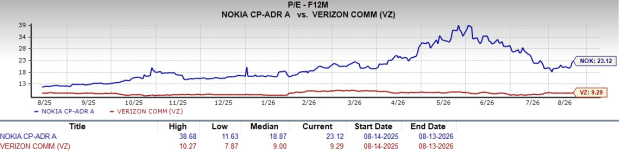
Image Source: Zacks Investment Research
VZ or NOK: Which is a Better Pick?
Verizon and Nokia carry a Zacks Rank #3 (Hold) each. You can see the complete list of today’s Zacks #1 Rank (Strong Buy) stocks here.
Both companies are taking several steps to strengthen their prospects in the AI-driven telecom ecosystem. Nokia is expanding its AI networking portfolio, while Verizon is enhancing its network assets to cater to AI data center networking demand. However, Verizon’s established cash return profile, improving financial profile through disciplined execution, improving customer economics and cost transformation initiatives are lucrative for investors. Owing to these factors and with a better valuation, Verizon is a better investment option at present.
7 Best Stocks for the Next 30 Days
Just released: Experts distill 7 elite stocks from the current list of 220 Zacks Rank #1 Strong Buys. They deem these tickers "Most Likely for Early Price Pops."
Since 1988, the full list has beaten the market more than 2X over with an average gain of +23.9% per year. So be sure to give these hand picked 7 your immediate attention.
Want the latest recommendations from Zacks Investment Research? Today, you can download 7 Best Stocks for the Next 30 Days. Click to get this free report


(0) comments
Welcome to the discussion.
Log In
Keep it Clean. Please avoid obscene, vulgar, lewd, racist or sexually-oriented language.
PLEASE TURN OFF YOUR CAPS LOCK.
Don't Threaten. Threats of harming another person will not be tolerated.
Be Truthful. Don't knowingly lie about anyone or anything.
Be Nice. No racism, sexism or any sort of -ism that is degrading to another person.
Be Proactive. Use the 'Report' link on each comment to let us know of abusive posts.
Share with Us. We'd love to hear eyewitness accounts, the history behind an article.