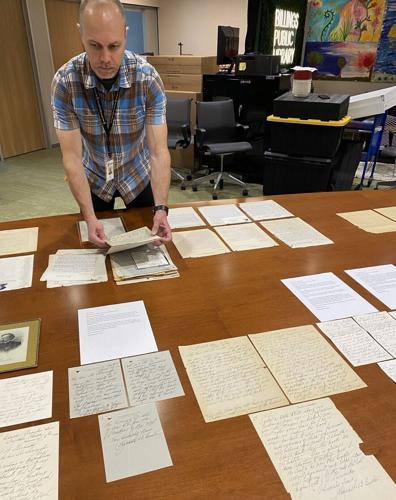
Joe Lanning, the Montana Room Librarian for the Billings Public Library, displays the variety of correspondence in the library's archives relating to the 1926 commemoration of the Battle of the Little Bighorn.
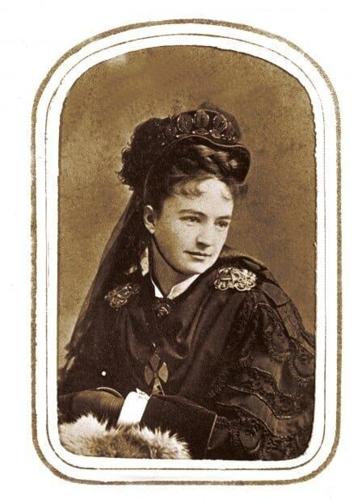
Elizabeth "Libbie" Custer advocated for her husband long after his death, including as a member of the committee marking the 50th anniversary of the Battle of the Little Bighorn.
Joe Lanning, the Montana Room Librarian for the Billings Public Library, displays the variety of correspondence in the library's archives relating to the 1926 commemoration of the Battle of the Little Bighorn.
“Don’t forget to keep a weather eye open for that prince of fakers, Alfred Chapman, the long-haired liar who claims he was Custer’s chief guide, and witnessed the massacre thru a spyglass from a hill a mile away.”
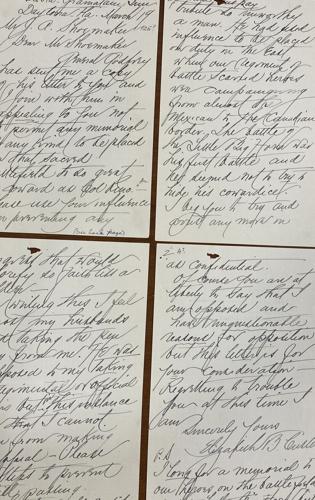
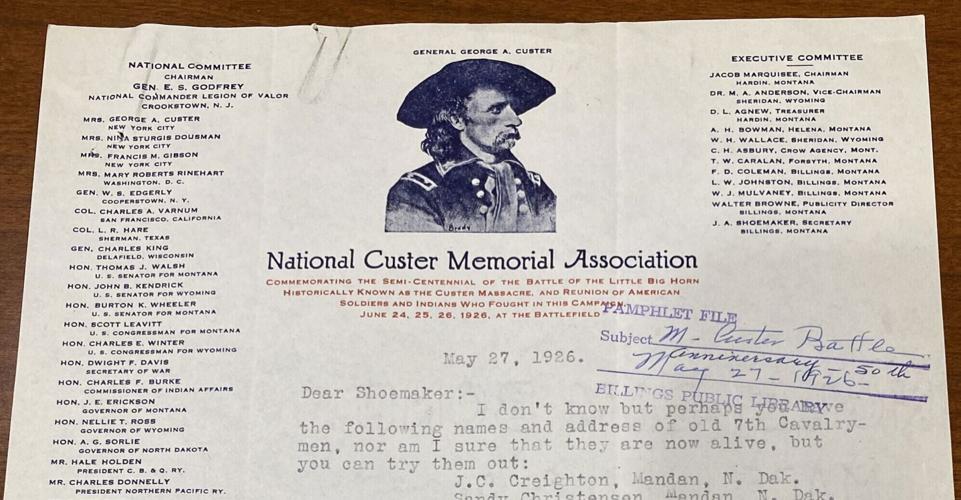
This passage, close to the top of a June 1, 1926, letter written by cowboy poet Earl Alonzo Brininstool, was an admonishment to J.A. Shoemaker, secretary of the National Custer Memorial Association.
Shoemaker was helping coordinate the 50th anniversary commemoration of the Battle of the Little Bighorn, known to victorious Native American tribes as the Battle of the Greasy Grass. Their defeat of the 7th Cavalry on June 25-26, 1876, was being observed with great fanfare organized by a national committee led by Gen. E.S. Godfrey, National Commander Legion of Valor.
Custer commemoration
Elizabeth "Libbie" Custer advocated for her husband long after his death, including as a member of the committee marking the 50th anniversary of the Battle of the Little Bighorn.
At the top of the committee’s letterhead, just below Godfrey, was Mrs. George A. Custer, wife of Lt. Col. George Custer, who was killed while leading the 7th Regiment of the U.S. Cavalry against the Lakota Sioux, Cheyenne and Arapaho tribes camped along the Little Bighorn River in southeast Montana.
The letters, along with other documents that include 12 signed handwritten messages from Elizabeth Custer, are among artifacts contained in the Billings Public Library’s archives. Included are two letters from Elizabeth Custer to the librarian at the time, Elizabeth Garber, offering to send her books.
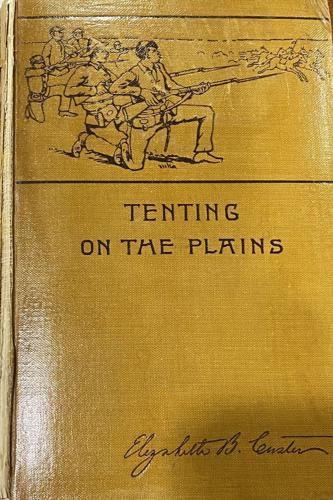
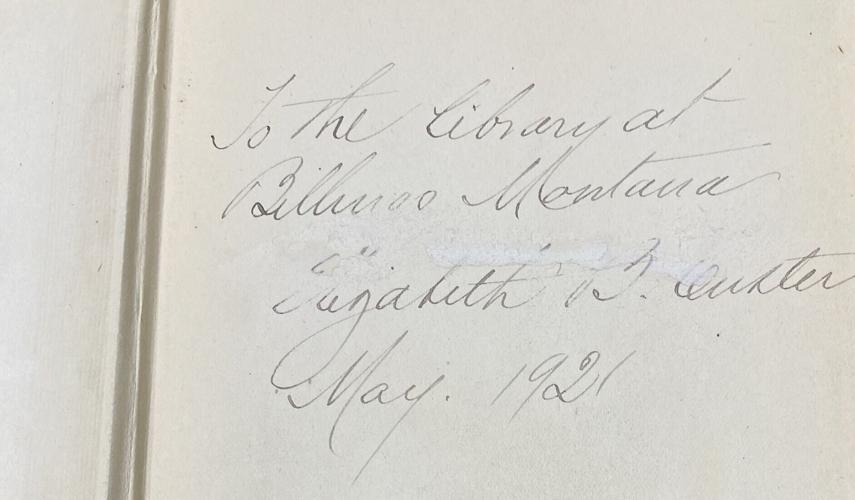
Elizabeth Custer wrote three books, two of which she signed when donating them to Billings and one of which has disappeared and was replaced by a donation.
“This could have very well been on the shelf for decades, and it just evaporated in the wind,” said Joe Lanning, Montana Room Librarian.
Where the correspondence and other documents came from is unknown.
“That’s a mystery, because provenance for most of it was a handshake,” Lanning said.
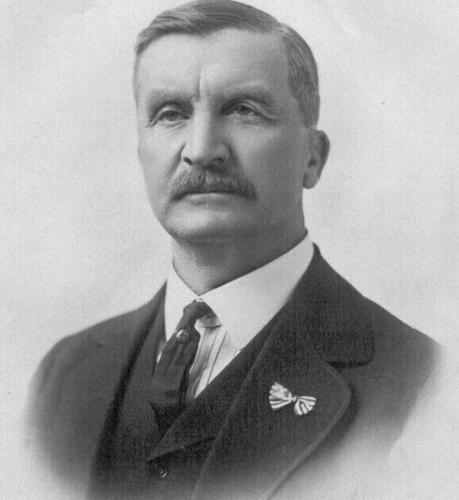
I.E. O'Donnell was a prominent Billings pioneer who helped organize the 50th anniversary commemoration of the Battle of the Little Bighorn.
Montana Cowboy Hall of Fame
But Lanning suspects they may have been donated by one of the library’s original board members, Ignatius Daniel “I.D.” O’Donnell, a family friend and employee of Parmly Billings.
“Parmly was former president of the Northern Pacific and the largest private landowner in newly established Yellowstone County,” according to the Montana Cowboy Hall of Fame’s website, which inducted O’Donnell in 2018. “Parmly placed his various Yellowstone agricultural interests under I.D.’s supervision.”
This 1926 letter from Earl Alonzo Brininstool is written on the National Custer Memorial Association's letterhead.
BRETT FRENCH
french@billingsgazette.com
Links to history
Lanning alerted the Billings Gazette to the artifacts after reading that Jim and Virginia Court were donating a 1927 letter from Elizabeth Custer they had acquired to the Big Horn County Museum. The donation took place as the 150th anniversary of the battle approached last month.
“There was correspondence between a lot of old members of different regiments here and there, really asking (O’Donnell), and kind of like making their case of, like, 'Hey, I was an important element of such and such unit,' maybe an invitation to come out, and 'I think maybe footing the bill for me traveling would be in order,'” Lanning said.
O’Donnell and Shoemaker were overwhelmed with such pleas and liked the idea of the “old timers” gathering but could only afford so much based on the event’s limited funds. Shoemaker’s handwritten list of invitees numbered into the 50s.
When finally launched, the 50th anniversary drew the “Greatest crowd in Montana history” to the battlefield, proclaimed the Kremlin (Montana) Chancellor newspaper in its July 9, 1926, edition.
“The fiftieth anniversary afforded a unique opportunity for a reunion of the aging combatants,” according to the Natural History Museum’s post quoting historian Douglas McChristian. “Promoters of the semi-centennial realized that the ranks of Little Bighorn survivors, both red and white, were thinning with each passing year. For the veterans, time had tempered some of the old animosities. It seemed a good time to reflect and symbolically ‘bury the hatchet’ while there was still time.”
In addition to Custer’s death, the battle resulted in the killing of 260 soldiers and an estimated 60 to 100 warriors.
Custer’s last charge
The Billings Public Library has about a dozen letters from Elizabeth Custer.
BRETT FRENCH
french@billingsgazette.com
At age 84, Elizabeth Custer remained her husband’s greatest promoter, evidenced by her position on the 1926 committee.
“She was the number one supporter and salvager of Custer's image after the battle, right?” Lanning said. “She's the one that did the most work making sure that he was remembered as, like, a Western hero and not a failure, because there were plenty of people out there at the time that thought, well, maybe it's the latter, right?”
Elizabeth Custer wrote to Shoemaker requesting help with housing friends, praised those taking part in organizing the events and, in one instance, criticizing Major Marcus Reno for his actions in the battle.
Calling him “so great a coward,” she appealed to Shoemaker to ensure Reno wasn’t paid any tribute or “memorial of any kind to be placed on the sacred battlefield.”
“I beg you to try and avert any more in Congress that would glorify so faithless a soldier,” she wrote in the letter. “In writing this I feel almost my husband’s hand taking this pen away from me.”
In 1876, Reno led three companies across the Little Bighorn River toward the camp that contained an estimated 1,500 to 2,000 warriors. His troops were immediately attacked. Upon retreat, some soldiers were left behind, leading Reno to request a Court of Inquiry in hopes of exonerating his actions.
Propagating themes
Elizabeth Custer sent three of her signed books to the Billings Public Library in 1921.
BRETT FRENCH
french@billingsgazette.com
Lanning said in transcribing Elizabeth Custer’s letters, she hits on the same themes over and over again, which he called “some of the more interesting bits.” Those same themes — the ideology that United States settlers were destined by God to expand to the West — are in her books as well, he added.
“The language is very clear,” he said. “She is a believer in that cause.”
One letter Custer wrote noted her sorrow at not being able to attend the 50th anniversary and added how the West, so desolate before Euro-American arrival, was now “teeming with life.”
“In 2026 that's a rather controversial statement,” Lanning said. “I find powerful statements like that in every single letter I've looked through so far. I really think that that's the great part of these letters.”
Elizabeth Custer signed the books she wrote and donated.
BRETT FRENCH
french@billingsgazette.com
Odd bits
The library’s holdings also include a 1911 letter from John Burkman to Elizabeth Custer. Burkman, who as Custer’s orderly saddled the Lt. Col.’s horse on the day of the battle, wrote about his recollections of the day.
Burkman recounts Custer’s decision to attack, rather than wait for supporting troops, after the soldiers had been spotted by Native American scouts. He also complains about his deteriorating sight.
At age 86, nearly blind and in ill health, Burkman shot himself while living in Billings.
A Nov. 8, 1925, article in the New York Times noted his death.
“He was at one time caretaker of Custer's horses and blooded dogs,” the article said.
A 1916 handwritten letter in the library’s collection from Frederick Bond stated the writer could attest to the fact that the Lt. Col. did not have long hair at the time of the battle. While another letter writer claims to have arrived in the territory via steamboat and was the scout who sent dispatches about the location of Chief Sitting Bull’s camp on the Little Bighorn.
Are all the claims real? Lanning queried historians about one letter from a man saying he took messages from Gen. Alfred Terry to Reno during the battle calling for medical aid and reinforcements.
“When I first came upon it, I thought this seems like it might be a pretty big deal,” Lanning said, but after querying other historians, “Nothing else really backs it up.”
Native participants
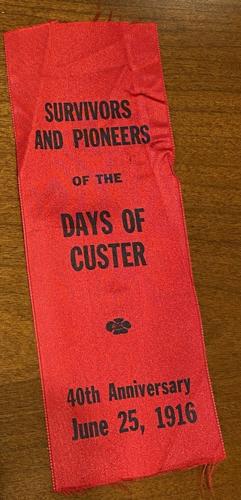
Ribbons like this were printed for the 40th anniversary.
BRETT FRENCH
french@billingsgazette.com
Correspondence from 1926 in the library's possession from South Dakota provides a list of 40 Native American Greasy Grass combatants — including Puts on His Shoes, Did Not Go Home and Full Stomach — as now living on the reservation.
The reservation’s superintendent goes on to note that because of the “extreme age of these old braves, I believe that at least three of them will eliminate themselves by the time it is necessary” to commemorate the battle’s 50th anniversary.
One letter to O’Donnell sent by Nashua, Montana, resident Charles C. Sargent is typed on letterhead paper, the back of which contains advertisements. In the note, Sargent claims to “know about as much as anyone living about the affairs” of the battle, having talked to “nearly every one of the head mean of the Indians.”
According to his obituary, Sargent enlisted in the Union Army at the age of 15 and served for three years, six weeks of which was as a prisoner of war. “He enlisted again in January 1866, and came to Montana as a soldier to assist in building Fort Buford.”
He later settled on land that would become the Nashua townsite near the confluence of the Milk and Missouri rivers in northeastern Montana.
Fort Buford was built near the confluence of the Missouri and Yellowstone rivers, near present-day Williston, North Dakota, serving as a supply depot for western military actions. Sioux leader Sitting Bull surrendered at the fort in 1881 after avoiding U.S. Army capture for years by seeking refuge in Canada.
Digital future
Lanning plans on digitizing the letters and uploading them to the Montana History Portal so the public and researchers can easily access them.
The native southern Californian is a historian by training, with a graduate degree from Utah State University and undergrad at California State University, Fullerton. Lanning was hired to the library staff about eight years ago, working his way up to his current position, which he’s held almost five years.
“I'm just ridiculously lucky to have this position,” he said, calling the archives a “historian’s playground.”
Many of the library’s historic photos have already been uploaded to the Montana History Portal.
“Our photograph collection is phenomenal,” he said.
One last look back
In addition to warning organizers of the 50th Battle of the Little Bighorn commemoration to beware of “that prince of fakers,” Brininstool, in his letter from Los Angeles, also suggests who to include. He concluded by saying he hoped to make it to the event.
“Been in bed practically three weeks with flu or grip, and am just getting on my feet again, feeling rather wobbly,” he wrote.
Born in 1870, just six years before the battle, Brininstool was a “prolific author of books and articles on the Indian Wars,” according to the Nebraska State Historical Society. The society is home to a collection of his correspondence, manuscripts and articles between 1923 and 1935.
Interestingly, the author wrote a comment about a letter he published that was written by a U.S. Army colonel who vindicated Major Reno.
Keep it Clean. Please avoid obscene, vulgar, lewd,
racist or sexually-oriented language. PLEASE TURN OFF YOUR CAPS LOCK. Don't Threaten. Threats of harming another
person will not be tolerated. Be Truthful. Don't knowingly lie about anyone
or anything. Be Nice. No racism, sexism or any sort of -ism
that is degrading to another person. Be Proactive. Use the 'Report' link on
each comment to let us know of abusive posts. Share with Us. We'd love to hear eyewitness
accounts, the history behind an article.



(0) comments
Welcome to the discussion.
Log In
Keep it Clean. Please avoid obscene, vulgar, lewd, racist or sexually-oriented language.
PLEASE TURN OFF YOUR CAPS LOCK.
Don't Threaten. Threats of harming another person will not be tolerated.
Be Truthful. Don't knowingly lie about anyone or anything.
Be Nice. No racism, sexism or any sort of -ism that is degrading to another person.
Be Proactive. Use the 'Report' link on each comment to let us know of abusive posts.
Share with Us. We'd love to hear eyewitness accounts, the history behind an article.