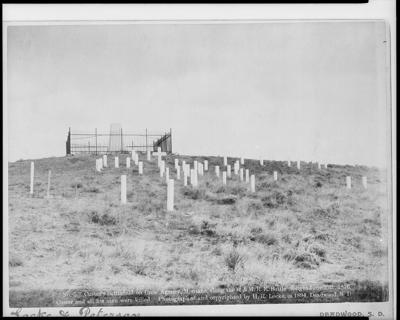
Lt. Col. George Armstrong Custer's decision to attack a large encampment of Lakota and Cheyenne along the Little Bighorn River resulted in a now famous battle.
This is the last page of a four-page letter penned by Elizabeth Custer on Aug. 7, 1927, one year after the 50th anniversary of the Battle of the Little Bighorn.
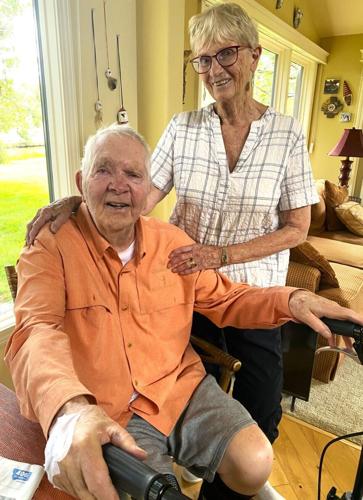
Billings residents Jim and Virginia Court have been involved in the history of the Little Bighorn Battlefield since Jim was appointed superintendent of the national monument in 1978.
Crow tribal members ride bareback during the Real Bird family’s annual Battle of the Little Bighorn Reenactment near Garryowen, Montana, on June 20, 2025. The riders reenact scenes from the 1876 battle, preserving a tradition of horsemanship passed down through generations.
The cursive writing, with its large overlapping loops, can be difficult to read in places, but that’s to be expected. The author, Elizabeth Bacon Custer, was 85 years old when she wrote it.
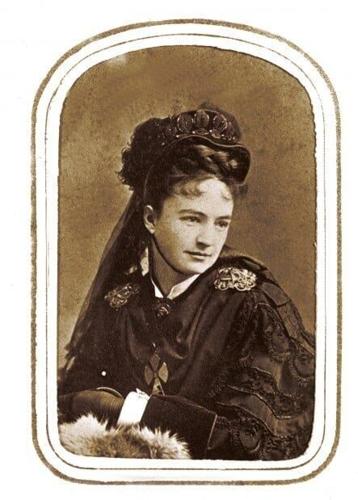
Elizabeth "Libbie" Custer lived almost to age 92, dedicating the years after her husband's death to keeping his memory alive.
The long-widowed wife of Lt. Col. George Armstrong Custer was penning a four-page missive to Ruth Renrick Gregory. Dated Aug. 7, 1927, Custer thanked Gregory for inviting her to the 50th anniversary commemoration of the Battle of the Little Bighorn the previous year.
“My dear Mrs. Gregory,” Custer began, “This last year has been such an eventful one for the loyal West has been paying tribute to my husband who opened the way and died for them and their struggles to make a safe place for those who came from the crowded East.”
‘Greatest crowd’
Lt. Col. George Armstrong Custer's decision to attack a large encampment of Lakota and Cheyenne along the Little Bighorn River resulted in a now famous battle.
National Park Service
The 50th anniversary drew the “Greatest crowd in Montana history” to the battlefield, proclaimed the Kremlin (Montana) Chancellor newspaper in its July 9, 1926, edition.
The ceremony included veterans from both sides of the battle, “mingling arm and arm on the battle field where 50 years ago the Sioux and Cheyenne annihilated Gen. Custer’s immediate command,” wrote the Sioux City Journal on June 25, 1926.
The battle, known to the victorious tribes as the Battle of the Greasy Grass and to others as Custer’s Last Stand, was such a decisive defeat that then-president Ulysses Grant posthumously charged Custer with disobeying orders.
The Civil War veteran’s brash decision to attack the encampment of an estimated 7,000 Lakota, Cheyenne, Dakota and Arapahos resulted in the deaths of 260 soldiers and an estimated 60 to 100 warriors.
A circuitous route
Virginia Court received the four-page letter in the mail about six years ago encased in an embossed album.
BRETT FRENCH
french@billingsgazette.com
Now, as the 150th anniversary of the June 25-26, 1876, battle approaches — along with the 250th anniversary of the Declaration of Independence — Elizabeth Custer’s 100-year-old letter has resurfaced and will be donated to the Big Horn County Historical Museum.
“I was so anxious to have the West know that tho I had not the courage to visit these harrowed scenes, my heart responded to everything done — on the anniversary of the Battle of the Little Bighorn — June 25th 1925,” Elizabeth Custer wrote to Ruth Gregory.
The letter’s route back to Bighorn County touches on many fateful incidents.
In about 2000, Gregory’s daughter-in-law, Jean Gregory, approached Virginia Court with a letter she had found while going through Ruth’s belongings.
At the time, Jean was a member of the Custer Battlefield Museum Association’s board and Court’s husband, Jim, was superintendent of the Little Bighorn Battlefield National Monument.
Ruth Gregory died in 1991 at the age of 104, having lived on a ranch with her husband, Frank Gregory, on upper Rotten Grass Creek near Lodge Grass since 1928.
Court read the letter Jean Gregory had discovered and was amazed.
“It's incredible to think back in those years you could write a letter to Elizabeth Custer, and she would respond to you,” she said.
Most of Elizabeth Custer’s letters are about her trips abroad, or the love letters she exchanged with her husband. Many aren't dated or even signed.
“There are very few letters in existence written by Elizabeth Custer where she addresses her husband and how she felt about him,” Court added.
The museum board decided to auction the letter as a way to raise money for the preservation committee which wanted to buy and preserve land around the battlefield, Court said.
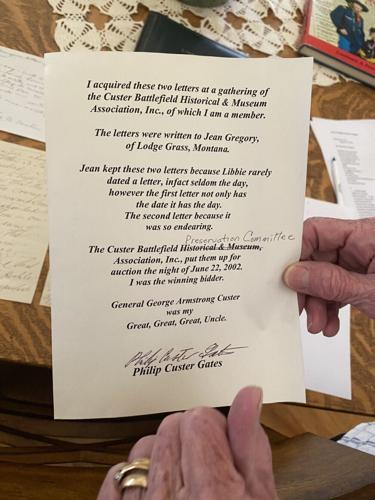
Philip Gates bought the Custer letter at auction in 2002, as this signed letter of provenance notes.
BRETT FRENCH
french@billingsgazette.com
On June 22, 2002, when the letter was being auctioned, Court attempted to buy it, hoping to donate the faded pages back to the museum. However, there was another bidder, a Floridian citrus grower with deep pockets — Philip Custer Gates.
After the bid hit $2,000, Court bowed out.
“That was a lot of money back then, you know,” she said.
A friend in need
Billings residents Jim and Virginia Court have been involved in the history of the Little Bighorn Battlefield since Jim was appointed superintendent of the national monument in 1978.
BRETT FRENCH
french@billingsgazette.com
Given their shared interest in history, the Courts and Gates became friends, taking several steamboat trips together. After Gates died in 2007 at age 83, Court asked his widow, Barbara, if she would consider giving her Elizabeth Custer’s letter for donation to the Big Horn County Historical Museum. The museum is located in Hardin, about 17 miles northwest of the battlefield.
About five years ago, a box arrived at Court’s Billings home. The package contained a green leather-bound album embossed in gold lettering that said: LIBBIE’S LETTERS on the top line. MRS. GEORGE A. CUSTER across the bottom.
Inside, held in place by plastic sleeves, was the four-page letter along with a signed letter of provenance which included Gates stating George Custer was his great-great-great-uncle — hence his middle name and interest in the letter.
In all the travels the Gates had taken with the Courts, this fact was never revealed, Virginia said.
After the box’s surprise arrival, life got in the way.
“This is terrible, but things have happened in our lives that I kind of forgot about it,” said the 81-year-old Court in a recent interview. “And then, you know, there's been such a to-do about the anniversary coming up, and I thought, ‘Hmm, why don't we do this. Why don't we give some publicity to the Big Horn County Museum?’”
She has made plans to turn over the letters this week.
“We are just so excited to get it,” said Beth Mehling, a longtime member of the museum’s board. “For us to receive that letter is such an honor.”
She also praised the Courts for their generosity not just with the donation, but all of their previous work on the museum, battlefield and preservation of 2,800 acres of land surrounding the site, for which Jim Court raised $6 million.
150th anniversary
This is the last page of a four-page letter penned by Elizabeth Custer on Aug. 7, 1927, one year after the 50th anniversary of the Battle of the Little Bighorn.
BRETT FRENCH
french@billingsgazette.com
Festivities for the 150th anniversary of the battle begin on Thursday, June 25, when the gates to the national monument open at 7 a.m. followed by programs at 9:30 a.m. No entrance fee will be charged.
“With up to 10,000 visitors expected to attend the commemoration per day, be sure to plan ahead to ensure a safe and enjoyable experience,” the National Park Service advised on its website.
Tribal nations, descendants, historians, elected officials, authors, military representatives, and cultural organizations have activities planned, according to the agency, including a parade and fly over, opening prayer and talks. Tribal cultural demonstrations, cavalry descendant presentations and traditional drum groups are just some of the activities.
Unfortunately, the new visitor center, which has been under construction, will not be completed in time for the event. A tribally owned construction company is building the $14 million, 9,000-square-foot facility.
Custer lives on
This news article in the Sioux City Journal describes the 50th anniversary of the Battle of the Little Bighorn.
Known to her acquaintances as Libbie, Elizabeth Custer died of a heart attack at age 91 — four days shy of her birthday — on April 4, 1933, in her New York City Park Avenue apartment. She never remarried, and the couple had no children. She was buried at West Point next to her husband.
“The last link with the romantic, stirring chapter of American history was broken on Tuesday with the passing away of Mrs. Elizabeth Bacon Custer,” The Evening News in Wilkes-Barre, Pennsylvania, announced in its April 8, 1933, edition.
“Although she rarely was seen in public, she led an active life,” The Great Falls Tribune reported on April 13, 1933. “She wrote three books on her experience in camp as the wife of a soldier,” including “Boots and Saddles,” “Tenting on the Plains” and “Following the Guidon.”
In her will, Elizabeth directed an executor of her estate to give all “souvenirs of General Custer, including ‘portraits and photographs, his army accoutrements, uniforms, souvenirs of war or frontier, books and illustrations and trophies of the chase’” to the “public museum or memorial which may be erected on the battlefield of the Little Big Horn in Montana,” according to a 1933 story in The Troy (Montana) Tribune.
A portion of the battlefield was designated a national cemetery in 1879. In 1940, the battlefield was transferred from the War Department’s administration to the National Park Service. In 1991, Congress changed the name of the battlefield and a new memorial dedicated to Native American participants was authorized.
In 2011, the Park Service decided to move the Little Bighorn Battlefield National Monument’s more than 123,000 historical archives and some 26,000 historic objects, to a facility in Arizona for safekeeping as the visitor center deteriorated before being torn down.
But the Big Horn County Historical Museum houses a wealth of Custer memorabilia for visiting history buffs, including the dioramas that were originally at the battlefield, said Mehling, the museum board member.
“That little museum, honest to god, is one of the best kept secrets in Eastern Montana,” she added, noting the numerous buildings on the ground offer visitors a chance to step back in time.
Although Elizabeth Custer never made it to the site of her husband’s death in what is now Montana, she cherished those who helped keep his memory alive.
“I shall treasure your words as I try to recall more of my husband in the Civil War, as it were,” she wrote to Jean Gregory in 1926. “Continue to ‘love General Custer’ — he was worthy of your affection — Sincerely Elizabeth B. Custer”
Keep it Clean. Please avoid obscene, vulgar, lewd,
racist or sexually-oriented language. PLEASE TURN OFF YOUR CAPS LOCK. Don't Threaten. Threats of harming another
person will not be tolerated. Be Truthful. Don't knowingly lie about anyone
or anything. Be Nice. No racism, sexism or any sort of -ism
that is degrading to another person. Be Proactive. Use the 'Report' link on
each comment to let us know of abusive posts. Share with Us. We'd love to hear eyewitness
accounts, the history behind an article.







(0) comments
Welcome to the discussion.
Log In
Keep it Clean. Please avoid obscene, vulgar, lewd, racist or sexually-oriented language.
PLEASE TURN OFF YOUR CAPS LOCK.
Don't Threaten. Threats of harming another person will not be tolerated.
Be Truthful. Don't knowingly lie about anyone or anything.
Be Nice. No racism, sexism or any sort of -ism that is degrading to another person.
Be Proactive. Use the 'Report' link on each comment to let us know of abusive posts.
Share with Us. We'd love to hear eyewitness accounts, the history behind an article.