
Following the money in politics rarely leads to a sitting elected official.
A Missoula city councilor helms a political nonprofit that’s grown to a multimillion dollar operation over eight years. In 2024, that nonprofit — A Better Big Sky — distributed millions through other groups that spent on mailers, TV ads and canvassers to help influence elections across Montana.
Tax returns from the Internal Revenue Service show the nonprofit raised roughly $100,000 in revenue in 2018. By 2024, the group's annual revenue spiked to $7.7 million, and roughly $2 million went directly toward political action committees.
Data from 2025 has yet to be released by the IRS, but state finance reports showed A Better Big Sky has recently continued advocacy work. The group spent $500,000 for paid signature-gatherers for a ballot initiative supporting non-partisan judges in March 2026.
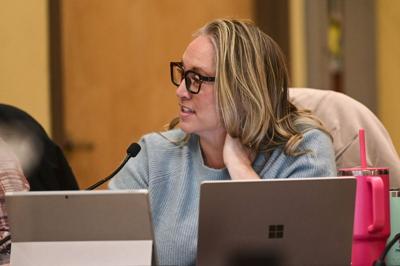
Ward 5 Missoula City Councilor Stacie Anderson has served as a councilor since 2017, and in 2018 launched A Better Big Sky as its executive director.
The group has been successful in securing donors to fund other state and regional political nonprofits, such as Forward Montana, Montana Conservation Voters and Western Native Vote.
While Anderson has stood by her work as an advocacy effort, political analysts point to an unusual quandary where an elected official is atop a major player in Montana politics that, in effect, picks winners and losers in state-level elections.
A Better Big Sky is a nonprofit advocacy group for several issues like public education and the environment that largely funds other political nonprofits, but, as a 501(c)(4) organization, its donors are not publicly listed on tax returns.
Political experts refer to these as "dark money" organizations; they can’t contribute directly to candidates or coordinate with campaigns, but they can spend vast amounts in elections on materials like mailers, TV ads and doorknockers, without revealing who their donors are.
A review by the Missoulian found money from A Better Big Sky passed through multiple political action committees before reaching campaign consultants, advertisers and the payroll for canvassing companies.
Anderson told the Missoulian in a prepared statement that she is incredibly proud of A Better Big Sky's work.
"Our mission is to support and fund nonprofit organizations that educate and engage Montanans on key public issues, including education, public lands, individual freedoms, and economic and environmental well-being," Anderson said in the statement. "We focus on setting strategy, building partnerships and directing resources to ensure our mission and our values are protected in Montana."
Anderson did not answer additional questions posed by the Missoulian and declined to sit for an in-person interview.
Money in politics continues to grow across headline races, from Montana's U.S. Senate race to more local-level contests like the Montana Legislature.
Through the 2026 primaries, conservative and progressive groups have already spent millions to tip the scales for candidates in Montana. Both Democrats and Republicans have historically injected money to win elections.
Anderson is the chair of the city’s health, safety and operations committee. She’s long advocated for proper funding for the city’s police and fire departments. Before joining City Council, she worked on several congressional campaigns, the Missoulian previously reported.
She ran unopposed for reelection in 2025, the only candidate on city council who did not face an opponent.
Two political scientists told the Missoulian that 501(c)(4) nonprofits are an emerging tool amid an increase of spending in elections across the country, but generally those groups are managed by insider political strategists, not elected officials.
Federal law prohibits the nonprofit from spending more than half of its revenue on electioneering, but A Better Big Sky can donate to other organizations that can donate directly to campaigns.
In 2024, data from the IRS and the state of Montana show millions of dollars flowing to political organizations across the Treasure State for election spending.
Following the money
A Better Big Sky's 2024 revenue flowed to 15 organizations located mainly in Montana, with the largest recipient being Missoula-based Montana Values Action Fund, which received $1.9 million, according to tax returns from the IRS.
Montana Values Action Fund is a political committee registered with the Montana Commissioner of Political Practices. The group's treasurer, Mary Stranahan, also served as the board chair for A Better Big Sky in 2024.
On Aug. 8, 2024, A Better Big Sky contributed $935,000 to Montana Values Action Fund, according to campaign finance reports.
From there, Montana Values Action Fund gave:
- Montana Rural Voter Action Fund: $100,000: In an Oct. 24, 2024, report, the rural action voter fund spent money advocating for several candidates. The group spent more than $100,000 to support Montana Supreme Court candidate Jeremiah Lynch, as well as Independent and Democratic state legislative candidates in eastern Montana. The group also spent $3,450 to support 11 Democratic state legislative candidates through Facebook and Instagram ads, according to the finance report.
- Montana Senior Vote Action Fund, $350,000: In total, Montana Values Action Fund gave the group $657,000 for the entirety of 2024, according to a finance report filed on Oct. 30, 2024. In the same filing, the Montana Senior Vote Action Fund spent $362,049 for mailers and digital ads supporting Democratic candidates in dozens of state Legislature races, as well as funding 2024 Democrat gubernatorial candidate Ryan Busse.
- Wild Montana Voter Fund, $50,000: In an Oct. 30, 2026, report, the group spent money for mailers and canvassers for several state Legislature races. The group spent more than $3,000 on payroll for canvassers for House District 89 candidate Mark Thane, a Democrat who represents a portion of Anderson's City Council ward at the base of the South Hills neighborhood. In 2024, Thane beat out Republican challenger Lyn Hellegaard, who previously represented the district in 2022. Thane and Hellegaard are set to face each other again in the November 2026 election.
Other groups funded by A Better Big Sky include MontPIRG, Middle Fork Strategies, Big Sky 55+, Montanans for Public Lands and more nonprofit groups.
‘Playing the game’
Political analysts told the Missoulian dark money groups have become a standard practice in politics. Both Democratic and Republican groups operate political nonprofits, according to Jessi Bennion, a professor of political science at Montana State University.
Bennion said since the Citizens United decision in 2010 by the U.S. Supreme Court, dark money is a part of the strategy to fund campaigning, like securing extra cash for mailers, TV ads, endorsements or issue-based advocacy.
“They are playing the game,” Bennion said in a recent interview. “It is not illegal what these groups are doing, but that does not mean people like it. The public does not like this idea of some very wealthy person swooping in and changing an election. If you ask that on a polling question, absolutely that would be out of the ballpark.”
More than $120 million was spent by outside funders on the hotly contested 2024 U.S. Senate race between Republican Tim Sheehy and Democrat Jon Tester, according to nonprofit Open Secrets.
It was the most expensive election in Montana history, but big money still courses through the veins of the state.
In the runup to this year’s June primary, two political action committees spent $5 million to influence the Democratic primary race for Montana’s open U.S. Senate seat.
One outside group flooded the zone with $3 million worth of social media advertisements and mailers. Another spent more than $1 million trying to get Alani Bankhead’s Democratic opponent, Reilly Neill, elected in the primary, even though the group was aligned with Republicans.
Americans for Prosperity, a conservative political nonprofit, has spent hundreds of millions of dollars across the country for its candidates of choice, including $6 million in the Montana 2024 Senate election, according to the Center of Media and Democracy.
“The public doesn’t like it, but how do you get attention?” Bennion questioned. “That takes money these days, and until someone comes up with an idea of how to change things, it is going to be really difficult to play in politics.”
Even the Transparent Election Initiative, a ballot initiative aimed at curtailing corporate and dark money in Montana politics, uses a 501(c)(4) nonprofit for fundraising, the Montana Free Press reported.
For races that are not on the top of the ticket, like a seat for state Legislature, that money goes farther, said Kal Munis, a professor of political science at Auburn University who grew up in and around Montana.
(Editor's note: In 2020, Munis was paid by A Better Big Sky to commission a study on split-ticket voters. He did not work directly with Anderson.)
Munis told the Missoulian in a recent interview that spending money in a state Legislature race carries more impact than a top-ticket race like governor or Senate.
The state Legislature meets once every two years and does not come with an annual salary, meaning there is less incentive to run for the office, Munis said, and therefore usually fewer dollars are spent on courting voters.
And with local newspapers drying up across the country, there is often less information for the public to weigh the candidates, Munis said.
“Any piece of electioneering material in a low information environment like that will have an outsized impact,” Munis said.
Like Bennion, Munis said both parties use dark money for campaigning. 501(c)(4)s do not disclose their donors, and have looser financial reporting requirements than super PACs. Additionally, the groups can also advocate for issues outside of the election cycle, like at the state legislature.
New York Times reporting in April showed a stunning increase in shadowy philanthropic groups raising money on behalf of candidates in elections, with a higher reliance on 501(c)(4) organizations from Democrats since 2020.
In 2024, about 17% of super PAC revenue, or about $1.5 billion, came from groups who did not disclose their donors, according to the New York Times review
Anderson told the Missoulian that A Better Big Sky is a small but important contributor to the larger nonprofit economy. She cited data from the Montana Nonprofit Association that in total, nonprofits generated $9 billion in revenue across the state and employed an estimated 11% of the Montana's workforce in 2023.
Many of these groups advocate for issues like public lands and healthcare. Bennion said consistent Democrat voters would likely approve of the funds, but Munis questioned whether it’s a conflict of interest for a nonprofit leader to also serve as an elected official.
Paying the bills
Munis said he had concerns with Anderson running one of these political groups, as she actively makes decisions on the City Council while securing political donations from unknown sources.
"This should be a broader discussion, should this be permissible?" Munis asked.
Bennion said it is common for elected officials to join political nonprofits involved in dark money after they serve, but she could not name another currently elected official who oversees a political organization.
She noted that Missoula City Council is a part-time job, and like most other state and local elected officials people have secondary jobs.
“People have to make a living, and if you are a political person and that is what you have your training and expertise in, you are going to work in that world,” Bennion said. “If you are doing a part-time thing, you need something else to do.”
Missoula City Council pays $18,000 annually. Most other city councilors have a second job. City Council President Mike Nugent is also a Realtor. Ward 1 Councilor Jennifer Savage has worked in communications for Missoula County Public Schools and the University of Montana.
None of the other councilors operate a political nonprofit. Ward 4 Councilor Amber Sherrill previously worked as the interim executive director of Five Valleys Land Trust, but that group is a 501(c)(3) organization, which is prohibited from electioneering.
Anderson told the Missoulian that like other councilors, she holds another job to pay the bills.
“I feel extremely fortunate that both of these roles are grounded in a shared commitment to strengthening Montana communities,” Anderson said in the statement.
Anderson’s salary at A Better Big Sky has swelled over the past eight years, according to IRS data. In 2018, the group paid her $21,667. By 2024, her salary reached $102,375, a 372% increase. In 2024, A Better Big Sky also employed four people for a total payroll of $148,722.
Andy Boyd, a Democratic activist who runs the Facebook page the “Montana resistance” has called out Anderson by name for operating a dark money group. Boyd’s Facebook group has more than 22,000 followers, and generally he discusses progressive politics and concerns over political spending.
He has previously called A Better Big Sky “one of the largest funding vehicles within the state’s political ecosystem” and said the group has a large network of nonprofits that strategize where, when and how to fund Montana elections.
Boyd told the Missoulian in an interview that he doesn’t think A Better Big Sky is breaking any laws, but said people should be aware of the "inconvenient truths” that large sums of dark money are being allocated to all sorts of candidates in the state.
“I vote Democrat, I donate to Democrats and I organize for Democrats, but there has to be a point where we can criticize what is going on here and do better,” Boyd told the Missoulian.


(0) comments
Welcome to the discussion.
Log In
Keep it Clean. Please avoid obscene, vulgar, lewd, racist or sexually-oriented language.
PLEASE TURN OFF YOUR CAPS LOCK.
Don't Threaten. Threats of harming another person will not be tolerated.
Be Truthful. Don't knowingly lie about anyone or anything.
Be Nice. No racism, sexism or any sort of -ism that is degrading to another person.
Be Proactive. Use the 'Report' link on each comment to let us know of abusive posts.
Share with Us. We'd love to hear eyewitness accounts, the history behind an article.