On July 22, 1961, the Post officially merged with The Montana Standard and for nearly six years, The Butte Daily Post was included on the front-page masthead.
Audience members gather to listen to the Ethiopian jazz group Hailu Mergia perform during the second day of the 2024 Montana Folk Festival at the Original Mine.
A page from the Anaconda Standard from December 17, 1899 features an illustration by John W. Trowbridge titled “A One Course Christmas Dinner for the Lonely Prospector”
Butte was not exactly brimming over with people 150 years ago.
The mining camp’s population had waned considerably before climbing once again, reaching about 1,000 people by 1876.
It was enough to convince Union veterans of the Civil War named James Mills and Harry Kessler to start a tri-weekly newspaper on June 1, 1876, and name it The Butte Miner.
Mills would later make this analogy: “In the good Centennial year, 1876, Butte was but the bud from which has sprung flower and fruitage to enrich the world.”
An image of Butte circa 1873-74.
University of Montana Mansfield Library
One hundred and fifty years later, since the first edition of Butte's news was published, The Montana Standard is looking back on its origins and the legacy of newspapers in the storied city.
The first newspaper: The Butte Miner
In a greeting to its readers, the newspaper owners explained, “The mining interest of Montana is preeminent, and with its kindred and associated interests engrosses the thoughts and labors of two-thirds of the people of Montana.”
Unlike other Montana newspapers of the day, which included The Madisonian, The Helena Semi-Weekly Herald and The Rocky Mountain Husbandman, the focus of The Miner would be mining.
Its owners believed The Miner had a “call and a mission, and that Montana will be the better of its existence.”
A sense of humor was evident on its first day, too.
The Butte Miner's first edition on June 1, 1876.
Newspapers.com
“We are the youngest. Should be it Miner or Minor?” was the question posed to readers.
Butte’s population continued to grow, and The Butte Miner would — within three years — become a daily newspaper.
Competition crops up
By 1880, more than 3,350 people would call the Mining City home, which inevitably led to some competition when The Butte Inter Mountain came to be on March 21, 1881.
“The publication of the Inter Mountain is begun, and will be continued, by an association of gentlemen who have faith in the permanency and prosperous future of Butte,” was explained in its introductory editorial.
The Butte Miner described The Inter Mountain as a “respectable Republican newspaper,” and wrote, “Without a feeling of envy or jealousy, we wish the Inter Mountain long life, unlimited prosperity and financial success.”
Damning with faint praise, The Miner also noted that in typographical appearance, The Inter Mountain was neat, and “although thrown together hastily, it is no discredit to the art.”
The Inter Mountain was owned by Republican politician Lee Mantle, who served in the Montana Territorial Legislature, was a Butte mayor, and was later elected to the U.S. Senate.
Copper King W.A. Clark, along with his brother J. Ross Clark, acquired interest in The Miner in November 1881. The copper magnate would take full advantage, using the newspaper to push his political aspirations and Democratic agenda.
By the end of the 1880s, another Democratic paper would make an appearance, and it would become a force to be reckoned with.
W.A. Clark’s rival, Copper King Marcus Daly, introduced the residents of Butte and Anaconda to The Anaconda Standard on Sept. 4, 1889.
View of the building housing the offices and printing plant of the Anaconda Standard newspaper, Anaconda, Montana.
Montana Historical Society Library and Archives
“It takes its place in the journalistic world with becoming modesty, yet it is a robust youngster and expects to make itself heard,” was The Standard’s pledge on its first publication day.
The newspaper was essentially a Butte publication, with offices in both Anaconda and Butte. Because there were already two dailies in Butte, The Anaconda Standard could only acquire Associated Press services if the paper was printed in Anaconda.
“Knowing how much the intelligent public demands of the press, it has prepared itself to meet that demand and its ambition is to rank as the best newspaper in the commonwealth” was the promise The Anaconda Standard made to its readers.
The Daly-owned newspaper made good on its commitment.
More than just writing, visuals too
In terms of content and artistry, The Miner and Inter Mountain would pale in comparison to The Anaconda Standard, which circulated all throughout Montana and even had a bureau in Washington, D.C.
The paper could also be found at newsstands in such major U.S. cities as Denver, San Francisco, Salt Lake City and Chicago.
Audrey Jaap, director of the Butte-Silver Bow Public Archives, said the Miner, Inter Mountain and Anaconda Standard all offered their own unique perspective.
Jaap said The Butte Miner was controlled by Clark's interests, The Anaconda Standard was controlled by Daly's, and unlike its competitors, The Butte Inter Mountain came out in the evening.
“Each offered the same news, but each with just a bit of a slant or bias,” said Jaap. “For researchers, this makes for a very interesting experience and tells a larger story in itself, not just the stories printed in the pages.”
Under the leadership of Editor John H. Durston, The Anaconda Standard consistently had more content than its local rivals and, by the fall of 1899, color was introduced to its readers.
A page from the Anaconda Standard from December 17, 1899 features an illustration by John W. Trowbridge titled “A One Course Christmas Dinner for the Lonely Prospector”
"MEGAN NIELSEN, Montana Standard"
For the most part, photography was still not reproducing at a printable level. Photographs tended to be too blurred and out of focus. Drawings were the preferred choice.
By recruiting artists from New York City newspapers, The Anaconda Standard illustrated the events of the day through an artist’s eye.
Thanks to the talent of such illustrators as John W. Trowbridge, Willis Thorndike, William H. Loomis, John C. Terry, George W. Long and others, readers were able to visualize what they were also reading, whether it be courtroom scenes, sporting events or feature stories.
Trowbridge was its first illustrator. His work was introduced to readers on Sept. 5, 1899.
The newspaper assured its readers that “Mr. Trowbridge’s superb work will find cordial appreciation in the Montana circles where the Standard has its patrons.”
Following the death of Marcus Daly on Nov. 12, 1900, the Anaconda Copper Mining Company took the reins of The Anaconda Standard.
An industrial plant tied to Butte's mining industry in 1900.
Library of Congress
More daily papers were to come.
Butte newspapers combine
On March 1, 1904, The Butte Evening News was introduced to the citizens of Butte.
Calling itself “the official paper of the people,” its staff believed there was “ample room for a truthful publication in the afternoon field in this city.”
Seven years later, its owners decided Butte could not sustain four daily newspapers. The publication ceased on Feb. 3, 1911, with the headline “The News Makes Its Adieux.”
The Butte Daily Post rang in the new year of 1913, replacing the Butte Inter Mountain.
“If all goes well, the Post will win the public’s favor and be a prosperous newspaper before the new year is far advanced,” was the confident forecast.
The Butte Miner and The Anaconda Standard would combine to become The Montana Standard on Sept. 12, 1928, leaving Butte with two dailies — the other being The Butte Daily Post.
On its first day of publication as The Montana Standard, it referred to itself as a consolidated form of Butte’s Anaconda Standard and The Butte Miner.
“In no sense of the word will it be a new newspaper,” was assured to its readers.
In an attempt to reinvent The Butte Miner, Copper King Clark’s son, W.A. Clark Jr., decided to delve into the newspaper business with The Montana Free Press, first published Sept. 17, 1928.
“Behold friends and fellow citizens, The Butte Miner reborn and reincarnated into The Montana Free Press” was its introduction, also promising “it will fight for the square deal for everyone in Butte and Montana, let the chips fall where they may.”
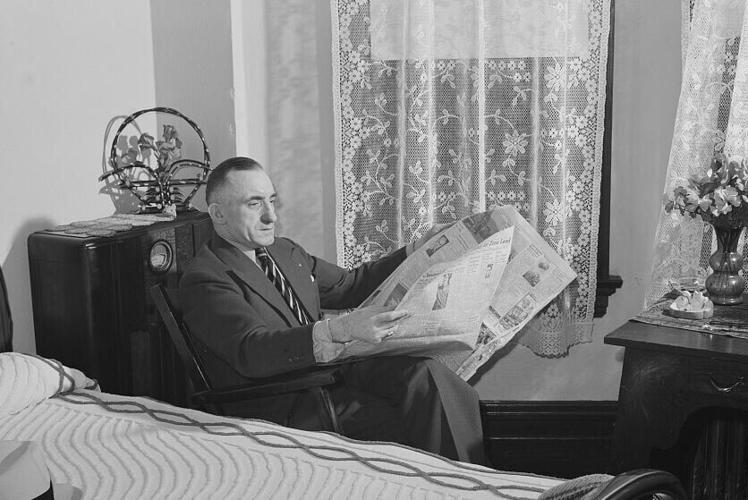
John Herlihy, a shift boss at the Mountain Con mine, reading a Butte newspaper at home in 1943.
Russell Lee/Library of Congress
The Press’ first paying customer was 93-year-old Katharine “Grandma” Ennis, a Montana pioneer, who wrote a check for $8, the cost for a year’s subscription.
Eight months later, prepaid subscribers were issued refunds. As of May 19, 1929, The Montana Free Press had closed its doors.
“My invitation to the citizens of Montana to cooperate with me did not meet with the response that I had anticipated,” wrote Clark Jr. by way of an explanation.
A press operator prints a Butte newspaper in 1942
Russell Lee/Library of Congress
The Montana Standard would continue to print editions of The Anaconda Standard for its Anaconda residents until June 20, 1970, when Anaconda would become a bureau.
Telling Butte's story
Throughout Butte’s history, Jaap said the town’s numerous newspapers gave readers a glimpse of what daily life was like.
“From coverage of major events, like the Granite Mountain Mine disaster, to obituaries of its residents, or even advertisements for goods sold in local stores, no other resource captured so much history all in one place,” said Jaap.
By 1959, the Anaconda Company sold its interests in all Montana-owned newspapers. Including The Montana Standard, to Lee Enterprises, a Midwest company that got its start in 1890.
“Butte and Anaconda, rich in natural resources, colorful in history and tradition, offer a special challenge to newspaper men. We accept that challenge eagerly,” was a statement made by the company on June 2, 1959.
The Montana Standard and The Butte Daily Post would compete for subscriptions and advertising dollars for more than three decades.
On July 22, 1961, the Post officially merged with The Montana Standard and for nearly six years, The Butte Daily Post was included on the front-page masthead. The name was discontinued on May 26, 1967.
On July 22, 1961, the Post officially merged with The Montana Standard and for nearly six years, The Butte Daily Post was included on the front-page masthead.
Newspapers.com
Since The Montana Standard became the lone daily newspaper 65 years ago, much has happened, some bad, some good.
Locally, nationally and globally, The Montana Standard has continually reported on life’s ups and downs.
The multitude of fires of the 1960s and 1970s was front-page news, as was the Columbia Gardens closure.
“Butte sheds tear as Gardens close,” was the Sept. 4, 1973 headline.
Closer to home, reporters have covered such topics as the numerous strikes, mining and otherwise.
Anaconda and Butte survived some tough announcements, including the smelter closure and the potential end of Butte mining.
“Anaconda Co. closes smelter” was the Sept. 30, 1980, Montana Standard headline. “Butte mining to stop” followed on Jan. 7, 1983.
“Butte mining to stop” reads a headline in the Jan. 7, 1983 issue of the Montana Standard.
Newspapers.com
By 1985, residents would welcome a return to mining and a 90-foot statue of the Madonna would grace the East Ridge.
“It’s Official — Butte mines sold” was the Dec. 19, 1985 headline. More good news would follow. “Lady Mission Accomplished” was The Standard’s headline two days later.
Already a tourist attraction, the Berkeley Pit continues to be the subject of ire and awe.
The 2000s brought Butte many new attractions.
Once referred to as the Mining City, Butte has become known as the Festival City. Each summer, people flock to the Montana Folk Festival and the Irish festival, An Ri Ra.
Audience members gather to listen to the Ethiopian jazz group Hailu Mergia perform during the second day of the 2024 Montana Folk Festival at the Original Mine.
JOSEPH SCHELLER The Montana Standard
Thanks to the dozens of volunteers, Stodden Park would become home to the Spirit of Columbia Gardens Carousel. Later, Ridge Waters water park would be a welcome addition to Stodden Park.
Many things have come and gone in the past 150 years, but we take pride in reporting The Montana Standard still stands and remains the oldest business in town.
From 1876 to 2026, the newspaper, like Butte, has weathered many storms. In this electronic age, we, too, have adapted to remain relevant.
News, good or bad, never dies.
Here’s to many more years.
A page from the Anaconda Standard from December 17, 1899 features an illustration by John W. Trowbridge titled “A One Course Christmas Dinner for the Lonely Prospector”
"MEGAN NIELSEN, Montana Standard"
Tracy Thornton is a reporter for the Montana Standard in Butte.
Keep it Clean. Please avoid obscene, vulgar, lewd,
racist or sexually-oriented language. PLEASE TURN OFF YOUR CAPS LOCK. Don't Threaten. Threats of harming another
person will not be tolerated. Be Truthful. Don't knowingly lie about anyone
or anything. Be Nice. No racism, sexism or any sort of -ism
that is degrading to another person. Be Proactive. Use the 'Report' link on
each comment to let us know of abusive posts. Share with Us. We'd love to hear eyewitness
accounts, the history behind an article.



(0) comments
Welcome to the discussion.
Log In
Keep it Clean. Please avoid obscene, vulgar, lewd, racist or sexually-oriented language.
PLEASE TURN OFF YOUR CAPS LOCK.
Don't Threaten. Threats of harming another person will not be tolerated.
Be Truthful. Don't knowingly lie about anyone or anything.
Be Nice. No racism, sexism or any sort of -ism that is degrading to another person.
Be Proactive. Use the 'Report' link on each comment to let us know of abusive posts.
Share with Us. We'd love to hear eyewitness accounts, the history behind an article.