

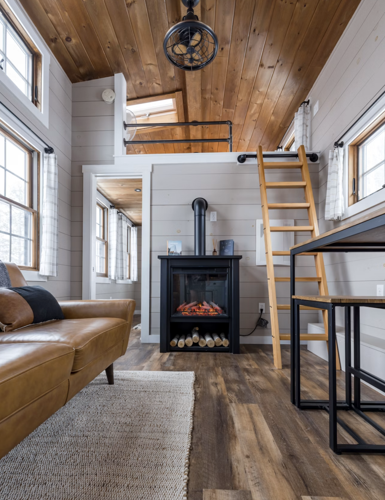
For many people, living in a tiny home is an aspiration. They want to go somewhere that feels cosy and is easy to maintain, but unfortunately, confining your life to 250 sq ft can be a bit of a hit-or-miss proposition. While it might work short-term or for Airbnb rentals, it is not the sort of thing you want to be doing long-term.
In this post, we take a look at some of the reasons why you probably shouldn't live in a tiny home and what you might want to do instead
High cost and friction
One thing you'll notice about living in a tiny home is the high cost and friction of living there. Because you don't have much space, there are a lot of things you have to move off-site and do somewhere else.
For example, let's say you have a very small utility room or kitchen. Often you won't have space for a laundry machine, so you'll have to outsource this to the local launderette or laundromat, which will charge you every week for the privilege. You might also have issues with a tiny home off-site if you have to manage waste. You may have to pony up additional money for septic tanks to deal with your wastewater. There are also issues with things like composting toilets or manually hauling grey water in freezing temperatures. Ultimately, it doesn't really work for many people long-term, especially when the weather gets bad or cold.
Extreme moisture and climate vulnerability
At the same time, living in a tiny home can often lead to extreme moisture and climate vulnerability, unless you're extremely organized. Even breathing, showering, or boiling water releases significant amounts of water vapor into the air.
In a 2,000 sq ft space, this dissipates widely and quickly evaporates back into the atmosphere and is ejected out of the home. In a 200 sq ft space, that's a significant amount of water, and it doesn't release as easily. For this reason, it's almost impossible to ventilate the space. It's a bit like trying to ventilate a small bathroom with a tiny window: eventually, moisture is going to build up, and mould is going to form.
There are also issues with insulation on tiny homes. If you have a large property constructed for you, there's much more space to place insulation. In one of these tiny homes, you don't have that sort of luxury. If you try to put in two or three feet of insulation in the roof or a foot of insulation in the walls, that's going to encroach on the available space even more and make it feel more cramped. It's also going to have a minimal effect during the summer heat or the freezing winter cold, and will make split air conditioners and heating units work much harder.
No style options
Maybe it's not quite true to say that there are no style options when you live in a tiny home, but you can't adopt the popular styles that are available when you have a full-size house.
Because of this, many people who live in these properties feel like they're at their wit's end. When they approach them, it feels more like they're walking down to the garden shed than going to somewhere that feels cosy and welcoming. There's also the psychological impact of living in a property that doesn't really feel like home. Many people like modern styling because it gives them the cosy feeling that they had when they were children.
No psychological breathing room
What happens if you live in a tiny home with somebody else? You better be comfortable with being around them all the time, no matter what they're doing or where they are.
In a regular-sized home, somebody can be in the shed and another person can be in the kitchen. Everybody has a bit of space to themselves. In a tiny home, that's not the case. The kitchen, the bedroom, and perhaps even the bathroom are in the same physical space, and everybody is reachable simply by stretching out your arm. If one person gets cold, or both people get cold, there's no space for anyone to go anywhere. If somebody has an early morning for a professional call, the other person has to wake up with them. There's also no visual privacy, meaning that even the strongest relationships can face the strain.
Depreciation
Depreciation is an issue that doesn't get mentioned much in the conversation about tiny homes, but the fact of the matter is that they lose value over time. This happens because, unlike traditional real estate, they're made of less durable materials.
For example, tiny homes are often mass-manufactured off-site and then delivered to a particular plot of land. Most have obsolescence built into them and are only designed to last between 15 and 25 years. That means that after 10 years, if you spend $80,000 on a tiny home, it might only be worth half of that a few years later.
More chores of existing
If that wasn't bad enough, there are also more chores of existence when you live in a tiny home. When you have limited space available, everything you try to do becomes a game of Tetris in order to go to bed. Do you have to fold away your desk and vice versa?
Let's say, for example, that you only have space for one table in your tiny home. Think about how many things you use a surface for. Let's say that you are somebody who works from home and needs somewhere to put their laptop in the morning. You have no choice but to use that table, but at the same time you need to clear all of your work stuff away every time somebody wants to eat a meal, unless they're okay eating in bed.
The solution, of course, is to choose a regular or large-sized home where you have more space. A tiny home can seem like a good value for money economically, but actually living in it is much more challenging than many people imagine.


(0) comments
Welcome to the discussion.
Log In
Keep it Clean. Please avoid obscene, vulgar, lewd, racist or sexually-oriented language.
PLEASE TURN OFF YOUR CAPS LOCK.
Don't Threaten. Threats of harming another person will not be tolerated.
Be Truthful. Don't knowingly lie about anyone or anything.
Be Nice. No racism, sexism or any sort of -ism that is degrading to another person.
Be Proactive. Use the 'Report' link on each comment to let us know of abusive posts.
Share with Us. We'd love to hear eyewitness accounts, the history behind an article.