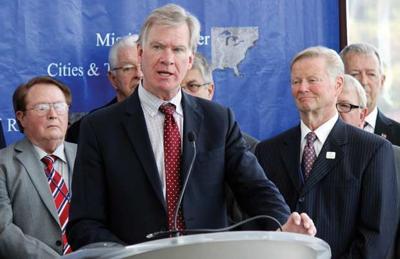
At a meeting of the Mississippi River Cities & Towns Initiative Sept. 16 in Dubuque, Chris Coleman, mayor of St. Paul, Minn., said “the Mississippi River is the most agriculturally productive zone” in the country and sustainable practices are essential to maintain it.
At a meeting of the Mississippi River Cities & Towns Initiative Sept. 16 in Dubuque, Chris Coleman, mayor of St. Paul, Minn., said “the Mississippi River is the most agriculturally productive zone” in the country and sustainable practices are essential to maintain it.
DUBUQUE — More than two dozen mayors from along the Mississippi River gathered Sept. 15-17 for a meeting to discuss how agriculture interacts with the economic impact of the waterway.
The Mississippi River Cities & Towns Initiative (MRCTI) is comprised of 68 mayors dedicated to improving water quality, habitat restoration, water conservation and creating more sustainable local economies.
“The Mississippi River is much mightier than even we realized,” Roy Buol, the mayor of Dubuque and co-chair of MRCTI, said in a news release.
“The river’s importance to our region and nation is indisputable. We must now move forward strategically and purposefully to protect this natural resource and economic force.”
During the meeting in Dubuque, Buol said for the first time there are economic profiles on the Lower and Upper Mississippi River Basin.
Studies show revenue generated by the river is $404.9 billion, which is “significantly higher than anticipated,” according to a MRCTI news release — nearly double what was expected. This revenue supports approximately 1.3 million U.S. jobs — 300,000 more jobs than expected.
During the “Supply Chain Management and Incentivizing Sustainable Agriculture” discussion, a key issue was brought up by presenters: How are farmers going to feed 9 billion people by 2050 with an eye on the environmental impact of more intensive farming?
THE MISSISSIPPI River is important for this because it impacts agriculture and water quality all over the world. It’s North America’s largest drainage system, attracting significant amounts of chemical runoff such as nitrogen and phosphorous from fertilizers.
While agricultural waste is not the only pollution factor, this runoff carries into the Gulf of Mexico and contributes to an annual “dead zone.”
St. Paul, Minn., Mayor Chris Coleman said unsustainable agricultural practices could “devastate the region.”
He said poor overall environment leads to less productive agriculture, and it’s up to farmers to take the first steps in improving conservation methods on their own properties.
Ambassador Kenneth Quinn, president of the World Food Prize Foundation, led the sustainable agriculture discussion.
“No matter what, there will be a huge increase in demand because everyone has to eat,” he said, noting it’s important to help farmers produce more surplus crops to feed more people.
But, members of the group discussed ways to do this without expanding current crop acres.
Sean McMahon of the Iowa Agricultural Water Alliance said there are ways to make land that’s already dedicated to agriculture more productive before expanding acres.
He says between now and 2050, the U.S. could lose an area of roughly “two and a half Californias” worth of natural land and habitat to allow for more farmland in the United States.
He also notes hypoxic zones are increasing in frequency and size all over the world.
“Unfortunately, there is no silver bullet in solving water-quality problems,” McMahon said, noting people tend to unfairly blame farmers for the majority of water quality issues.
HOWEVER, HE added, conservation is important for improving farmer profitability, since farms are directly impacted by land and water quality.
With the new economic information, Buol said the mayors can more effectively lead changes in their communities to improve water quality and conservation efforts.
John Dickert, mayor of Racine, Wis., said he is optimistic about MRCTI’s future impact.
“(Mayors) are a force that will be recognized,” he said.
Keep it Clean. Please avoid obscene, vulgar, lewd,
racist or sexually-oriented language. PLEASE TURN OFF YOUR CAPS LOCK. Don't Threaten. Threats of harming another
person will not be tolerated. Be Truthful. Don't knowingly lie about anyone
or anything. Be Nice. No racism, sexism or any sort of -ism
that is degrading to another person. Be Proactive. Use the 'Report' link on
each comment to let us know of abusive posts. Share with Us. We'd love to hear eyewitness
accounts, the history behind an article.



(0) comments
Welcome to the discussion.
Log In
Keep it Clean. Please avoid obscene, vulgar, lewd, racist or sexually-oriented language.
PLEASE TURN OFF YOUR CAPS LOCK.
Don't Threaten. Threats of harming another person will not be tolerated.
Be Truthful. Don't knowingly lie about anyone or anything.
Be Nice. No racism, sexism or any sort of -ism that is degrading to another person.
Be Proactive. Use the 'Report' link on each comment to let us know of abusive posts.
Share with Us. We'd love to hear eyewitness accounts, the history behind an article.