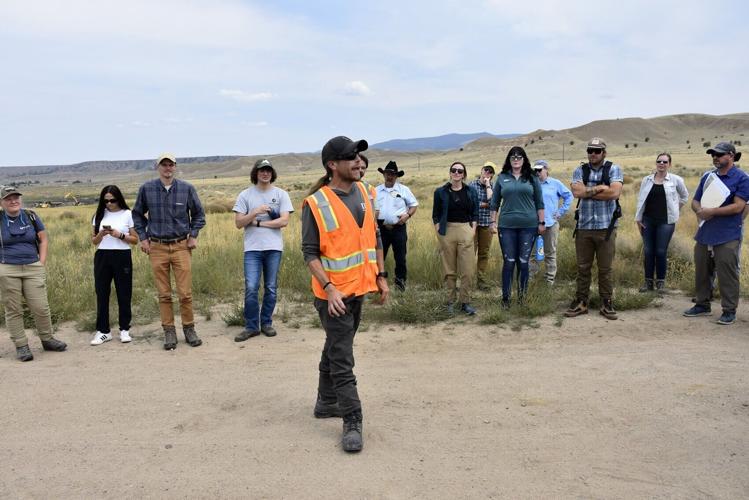
Logan Dudding, Clark Fork River project manager for the Montana Department of Environmental Quality, talks to about 40 people in August 2025 who were touring Phase 7 cleanup work of the river near Racetrack Pond.
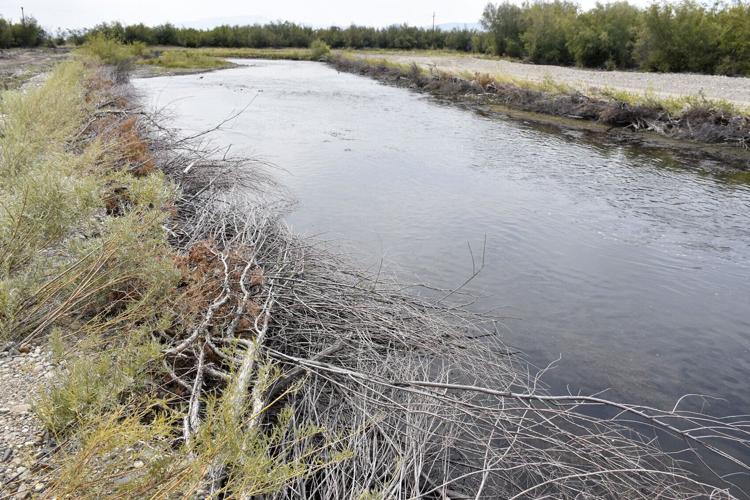
Remedial design has substituted a 'brush matrix' approach to holding streambanks and planted willow and creating habitat on the Clark Fork River for a coir log intervention. This stretch of river is near Racetrack Pond.
Contractor employees work Tuesday along the Clark Fork River near Racetrack Pond as remediation and restoration activities continue to address contamination from historic mining and smelting upstream.
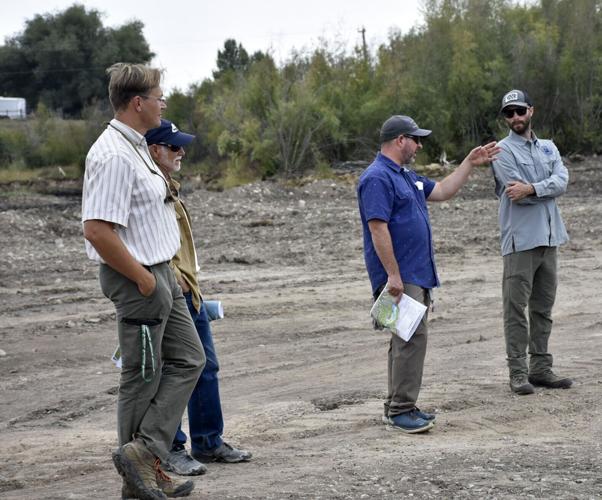
During an August 2025 tour of remediation then underway on the upper Clark Fork River, participants discussed how cleanup work has been refined to preserve more riparian vegetation and fish habitat. Tour participants included, from left: Robert Pal, Ph.D., an expert at Montana Tech in ecological restoration; Joe Griffin, a longtime Superfund watchdog; Brian Bartkowiak, an environmental science specialist for the state's Natural Resource Damage Program; and, Caleb Uerling, a fisheries biologist for Montana Fish, Wildlife & Parks. Bartkowiak described plans to create wetlands at the site.
Nathan Cook with the state Natural Resource Damage Program spoke Wednesday about the health of Montana fisheries during a meeting of the Environmental Quality Council.
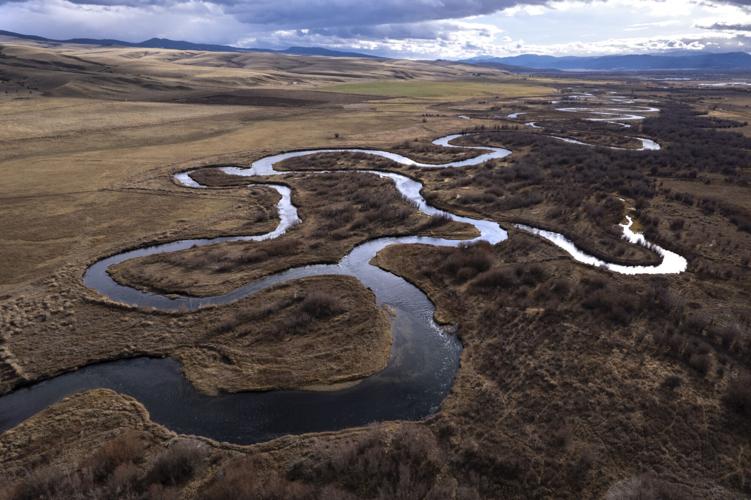
The Clark Fork River meanders through the Deer Lodge Valley. Remediation and restoration work continue for a river hammered more than a century ago by mining and smelting pollution from upstream.
Avian ecologists from the University of Montana Bird Ecology Lab demonstrate how they study the health of the songbird population along the Upper Clark Fork River near Galen, Montana.
DEER LODGE — The fieldwork in 1891 showed it does not take long to kill a river.
The bulletin from the U.S. Fish Commission painted a grim portrait of what was then called the Deer Lodge River and flows now as the Clark Fork. The researchers found a creekbed rife with a “shifting mass of fine silt” linked to mining and smelting activities upstream and believed fatal to aquatic life.
“We seined the river very thoroughly in the vicinity of Deer Lodge and did not find any fish whatsoever,” the report observed.
Logan Dudding, Clark Fork River project manager for the Montana Department of Environmental Quality, talks to about 40 people in August 2025 who were touring Phase 7 cleanup work of the river near Racetrack Pond.
Duncan Adams, The Montana Standard
It takes a whole lot longer to bring a river back.
Remediation of mining and smelting wastes long bedeviling the Clark Fork River and related restoration of natural resources began in 2010. Current projections suggest the work will continue until at least 2038 on the 47 river miles between the river’s headwaters near Warm Springs and Garrison — the reach of the Clark Fork considered most injured by historic mining and smelting pollution.
Contaminants of concern include arsenic, cadmium, copper, lead and zinc.
The latest work, described as Phase 7, began in January near Racetrack Pond upstream of Deer Lodge and is expected to continue until mid-December. Phase 7 has addressed about 1.4 river miles.
Remedial design has substituted a 'brush matrix' approach to holding streambanks and planted willow and creating habitat on the Clark Fork River for a coir log intervention. This stretch of river is near Racetrack Pond.
Duncan Adams, The Montana Standard
The Montana Department of Environmental Quality and the state’s Natural Resource Damage Program are supervising the cleanup and restoration, with EPA providing oversight.
On Tuesday afternoon, DEQ, NRDP and EPA participated in a tour of Phase 7 work to date. The Clark Fork River Technical Assistance Committee organized the outing. More than 40 people participated.
During an August 2025 tour of remediation then underway on the upper Clark Fork River, participants discussed how cleanup work has been refined to preserve more riparian vegetation and fish habitat. Tour participants included, from left: Robert Pal, Ph.D., an expert at Montana Tech in ecological restoration; Joe Griffin, a longtime Superfund watchdog; Brian Bartkowiak, an environmental science specialist for the state's Natural Resource Damage Program; and, Caleb Uerling, a fisheries biologist for Montana Fish, Wildlife & Parks. Bartkowiak described plans to create wetlands at the site.
Duncan Adams, The Montana Standard
The key phrases Tuesday were “lessons learned” and “a double-edged sword.”
DEQ had promised its approach for Phase 7 would be kinder and gentler than earlier phases that removed just about everything, including riparian vegetation providing shade and cover for fish. One wag compared the desolate result to a Walmart parking lot.
A once abundant population of brown trout in the upper river declined dramatically. Many believe the forceful approach to remediation played a role in that population slide. Related research continues.
For Phase 7, DEQ used new streambank treatments, incorporating live willows, large wood and log structures to provide better aquatic habitat.
The Clark Fork River meanders through the Deer Lodge Valley. Remediation and restoration work continue for a river hammered more than a century ago by mining and smelting pollution from upstream.
File photo, The Montana Standard
And the agency elected to leave select stands of riparian vegetation, even if they were rooted in contaminated soils, as one strategy to preserve habitat.
These approaches were among the lessons learned from previous interventions that were more aggressive.
Yet the more attenuated approach presents a few double-edged sword dilemmas, said Logan Dudding, DEQ’s Clark Fork River project manager.
For example, leaving a section of riparian vegetation and the soil in which it is rooted can perpetuate issues from an abnormally high floodplain built by the catastrophic flood in 1908 that deposited contaminated sediments there and in streambanks of the Clark Fork River.
One goal of the remediation is to restore a more natural interaction between the river and its floodplain. A high point could cause seasonal high flows to sluice and erode.
Contractor employees work Tuesday along the Clark Fork River near Racetrack Pond as remediation and restoration activities continue to address contamination from historic mining and smelting upstream.
Duncan Adams, The Montana Standard
DEQ expects to remove about 135,000 cubic yards of contaminated materials during Phase 7. One cubic yard is roughly equivalent in size to a standard washing machine. Workers for contractor Intermountain Construction Services truck the wastes to a repository in the Opportunity Ponds.
Tuesday’s tour launched from Arrowstone Park just outside Deer Lodge. The park has been controversial from the beginning because it was built by an Atlantic Richfield contractor atop contaminated mining and smelting materials treated solely with deep-tilled lime and then capped.
In recent years, contaminants have begun leaching to the surface, creating areas called “slickens” that won’t grow vegetation. Several people on the tour said they are regular users of the park.
The U.S. Fish Commission bulletin from 1891 demonstrates that the river’s pollution began years before the big flood as copper mining escalated in Butte and the smelter in Anaconda processed that ore.
Atlantic Richfield, a U.S. subsidiary of bp America, purchased the Anaconda Co. in 1977 and is responsible under Superfund law for funding cleanup and restoration.
A 2008 settlement with Atlantic Richfield provided about $94 million for remediation and roughly $27 million for restoration. Before initiation of Phase 7 the sum of remaining funds totaled about $98.4 million.
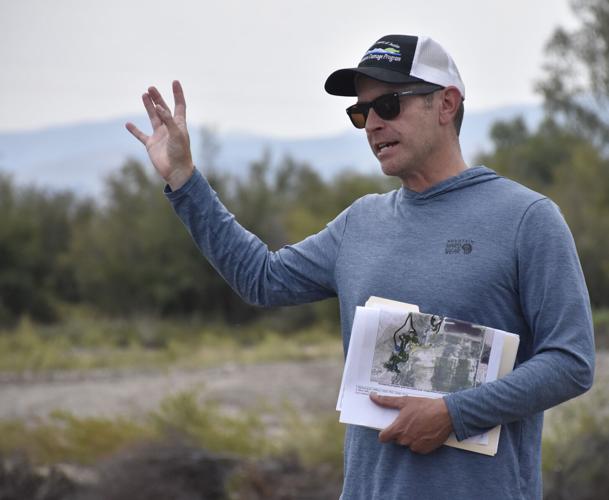
Nathan Cook with the state Natural Resource Damage Program spoke Wednesday about the health of Montana fisheries during a meeting of the Environmental Quality Council.
Duncan Adams, The Montana Standard
Observers worry the money will run out well before Garrison. If that happens, a so-called round robin process would kick in, requiring additional, alternating funding from the EPA, Montana and Atlantic Richfield.
To date, not including Phase 7, the remediation-restoration effort has completed 7.5 phases of 22.
DEQ adopted a new strategic plan in 2023 that, among other things, narrows the zone of cleanup — an approach designed to save money and destined to leave more contaminants in the floodplain. The state says it is updating the plan and the revision will include newer budget numbers.
DEQ has said it hopes to complete construction of all 22 phases stretching to Garrison by 2038 — a goal that seemed ambitious Tuesday.
Both Dudding and Jessica Banaszak of DEQ said they don’t anticipate there will be remedial/restoration construction during 2026 because of the complexities of access, landowner coordination, communicating with other stakeholders, final sampling and more. That will leave less than 12 years for 13 phases, some more complex than others.
Banaszak and Dudding said the state has not yet identified which phase will be tackled next.
Keep it Clean. Please avoid obscene, vulgar, lewd,
racist or sexually-oriented language. PLEASE TURN OFF YOUR CAPS LOCK. Don't Threaten. Threats of harming another
person will not be tolerated. Be Truthful. Don't knowingly lie about anyone
or anything. Be Nice. No racism, sexism or any sort of -ism
that is degrading to another person. Be Proactive. Use the 'Report' link on
each comment to let us know of abusive posts. Share with Us. We'd love to hear eyewitness
accounts, the history behind an article.




(0) comments
Welcome to the discussion.
Log In
Keep it Clean. Please avoid obscene, vulgar, lewd, racist or sexually-oriented language.
PLEASE TURN OFF YOUR CAPS LOCK.
Don't Threaten. Threats of harming another person will not be tolerated.
Be Truthful. Don't knowingly lie about anyone or anything.
Be Nice. No racism, sexism or any sort of -ism that is degrading to another person.
Be Proactive. Use the 'Report' link on each comment to let us know of abusive posts.
Share with Us. We'd love to hear eyewitness accounts, the history behind an article.