

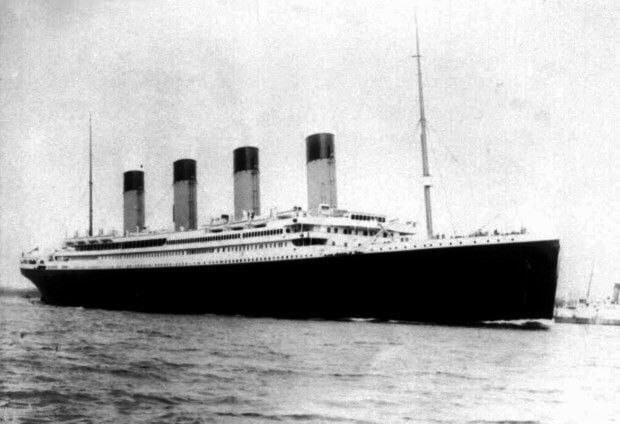

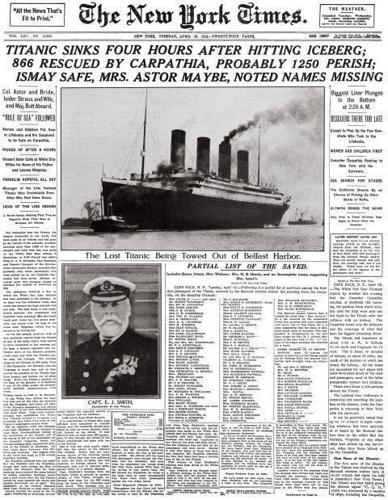
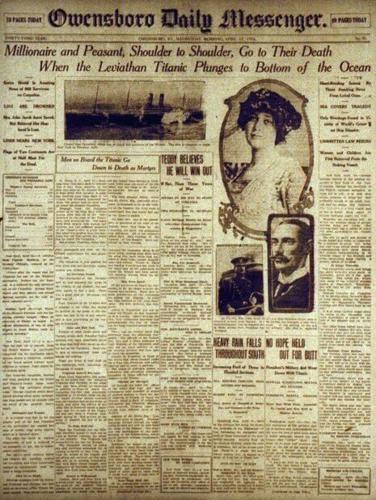




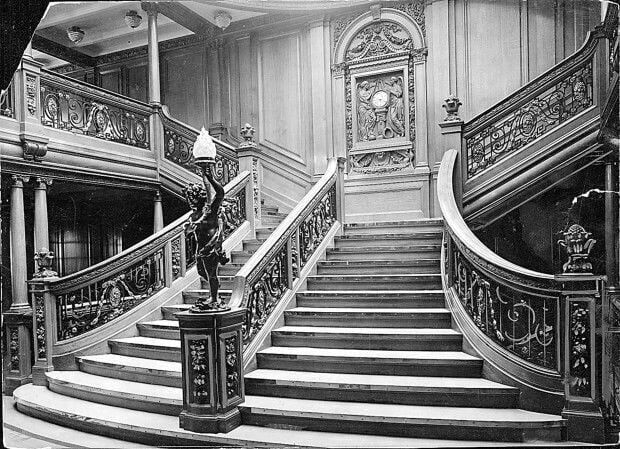
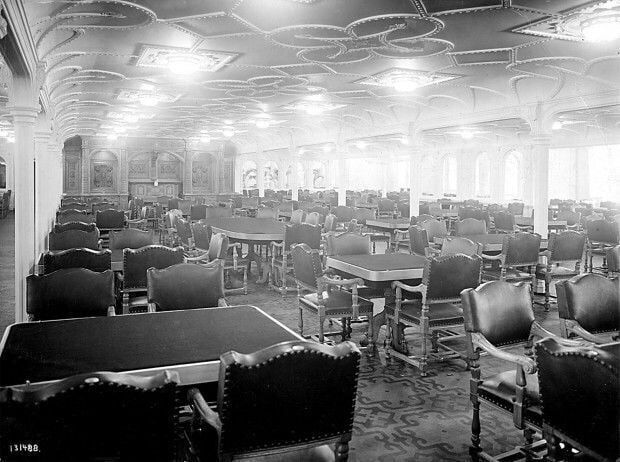


Less than 24 hours after RMS Titanic struck an iceberg in the North Atlantic, Billings residents 3,000 miles away were reading the first dispatches from Halifax, Nova Scotia, the nearest port to the scene of unimaginable tragedy.
Initial reports from the White Star Line, owner of the Titanic, appeared in the Billings Evening Journal on April 15, 1912. They only hinted at the disaster earlier that day 700 miles from the Canadian city.
“Women and Children Put into Life Boats for Safety While Steamers Rush to Rescue,” the headline read.
A dispatch from Halifax reported that “with her 1,300 passengers safely transferred to another vessel, the Titanic is this afternoon slowly approaching this port.”
It went on to detail how the Titanic passengers had been picked up by her sister ship Olympic and were removed later to the Baltic, which was steaming toward the coast.
A second report said that Titanic’s pumps were in good working order, that her water-tight compartments were holding and that she was expected to reach New York safely.
None of it was true, of course. White Star Line, which later waffled on whether the statements had officially come from its offices, already knew that Titanic carried only enough lifeboats for a third of the 2,223 people aboard and that the ship had gone down with massive loss of life. No good explanation was offered by the company for those initial reports, which came crashing down as furious families accused the company of heartlessly feeding them false hope.
By the next day, and every day for the next week, the Titanic disaster covered most of the front page of the Billings Evening Journal, an earlier version of The Billings Gazette. It only disappeared entirely from Page One on May 2, and made frequent reappearances for weeks afterward.
New technologies
The wireless radio that brought news of events at sea on the same day they happened represented a technological leap into the modern age that foreshadowed, 100 years later, instantaneous iPhone coverage of slaughter in the streets of Syria. The Marconi wireless system, only a few years old in 1912, allowed the Titanic to alert others on land and sea that she needed help.
If the Carpathia had not been summoned to the position radioed by the Titanic, many more would have succumbed to hypothermia before another steamer happened by. The gigantic ship might not have been missed until days later, after she failed to arrive in New York. Instead, the wireless brought help and helped speed news of her plight across America and Europe.
Three Montanans survived the wreck, according to stories that appeared in the aftermath. Mrs. L. Parish and a Mrs. Shelley, both of Butte, were treated for shock at Mount Sinai Hospital in New York City after they arrived on the rescue ship Carpathia on April 18.
On May 3, The Evening Journal announced “Montana Boy Saved from Titanic Wreck.” Bobby Lawton, a Dillon dry goods clerk, had been presumed lost at sea since no one had heard from him. But Lawton, who had been visiting his native Scotland, was found recovering in a New York hospital.
In its April 22 edition, The Evening Journal carried a story assuring residents that a rumor spreading about a Titanic survivor staying in Billings was false. A reporter contacted the Illinois woman in question who said she was visiting relatives here and had no idea how the gossip started.
In the days after the disaster, The Daily Journal commented on it three times on its editorial pages. The first editorial, which appeared April 17, was headlined “Lives Sacrificed to Greed” and called the disaster “murder on the high seas. It was a stupendous sacrifice of human lives to corporate greed, a toll of blood to increase the grist flowing into the plethora treasure box of the steamship company.”
The newspaper did a complete turnaround in its April 27 editorial — after more information came from a Senate inquiry — saying the primary responsibility for the tragedy rested with the traveling public in its “insatiable desire for speed.”
Deafening silence
During the first days after the ship went down, readers of the Evening Journal were riveted by news from London, Halifax, New York and Washington, D.C. But little was heard from the Carpathia as she made her way to New York. Lists of survivors were sent. Otherwise she remained silent, not even responding to requests from President Taft, who had sent the cruiser Salem to get in touch with the Cunard ocean liner.
The Salem radioed back: “Can get no information from the Carpathia of any kind, although within easy communication distance. Sometimes she acknowledges our call, but will not admit receipt of our message or make any reply to them. Cannot believe she fails to understand them.”
For Taft it was a personal matter as well as a matter of state. His friend and military aide Maj. Archibald Butt was a passenger on the Titanic. He did not survive. The president, along with friends and relatives of other passengers and crew, waited for days to learn the fate of loved ones.
Later stories charged that the Marconi wireless operators on the Carpathia had been ordered to keep strict silence so the exclusive story could be sold once the steamer arrived in New York.
Controversy raged over the radio silence. Some Marconi company officials denied that a news blackout had been ordered. Others agreed that such messages were sent, but that they were misinterpreted by The New York Herald. Marconi employees had allegedly sold its operators’ stories to The New York Times.
The issue apparently was never officially resolved, but was swept aside by larger questions associated with the Titanic debacle.
Early coverage contained few details of what happened other than the ship struck an iceberg and sank in the early morning hours of April 15. There were survivors, but many more were lost.
On April 16, reports were issued that the Carpathia had rescued 866 people, mostly women and children. The actual number was 705, but the discrepancy was not explained. In those early days numbers changed frequently.
Since few details about the sinking and rescue were available, news organizations gathered what information they could for millions of readers anxiously awaiting word about what was the greatest, almost unthinkable maritime disaster of all time.
There were reports that the $10 million luxury liner — $223 million in today’s currency — was not insured because no combination of insurance could cover the loss. Jewels brought on board by some of the richest people in the world were supposedly valued at $5 million and the loss of baggage and mail would amount to $2 million. Litigation costs were estimated at $5 million.
While the ship may not have been insured, the jewels were, reports said. One American socialite reportedly had $750,000 worth of pearls aboard, about $16.7 million in today’s dollars.
In the blackout from the Carpathia, marine experts were asked to speculate on what could have happened. One blamed the ice mountains floating in the shipping lane on an early spring that caused icebergs to calve. The Times of London questioned whether ships had gotten too big and too fast. A report from Washington noted that had the Titanic been registered in this country she would have been required to carry 48 lifeboats instead of the 20 that British standards mandated.
First indications that survivors on the Carpathia had physical and mental health problems came when White Star accepted an offer from St. Luke’s Hospital to set aside a wing for the company’s use.
It was reported that seven survivors had been “driven insane” by their ordeal and many others were seriously ill. Company officials refused to discuss conditions of the survivors.
Details come to shore
By April 19, after the Carpathia arrived in New York and delivered its passengers, details of the Titanic’s ordeal finally reached the news-starved public. An anti-immigrant bias threaded through the narrative, with stories maligning the behavior of the people in steerage, who made up the majority of Titanic’s passengers. Their actions were weighed against stories of the brave, calm and chivalrous manner displayed by the men in First Class.
One story held that four men from steerage rushed the lifeboats and were shot when they refused to leave. Another story told of male steerage passengers fighting with women in their attempts to escape. But yet another story told of how crew members tried to block steerage passengers from getting to the upper decks, which no doubt fed a growing panic.
One of the first reasonably full accounts of the disaster came from a St. Louis Dispatch reporter who happened to have been a passenger on the Carpathia. He interviewed Titanic crew members as the ship sped to New York.
They told him the collision with the iceberg was an “unbelievably mild shock.” The crew said two shots from a gun warning of imminent danger had been fired, and that the iceberg hadn’t been spotted until it was just a quarter-mile from the ship.
Another account said men started jumping overboard as the lifeboats were lowered.
“It was like sheep following a leader,” George Broden, a passenger from Los Angeles, said.
Several stories were told about how Capt. Edward John Smith went down with the ship. Broden said that after the captain was washed from the bridge, he swam to a drowning baby and carried it in his arms to a lifeboat. The captain refused to get into the boat himself and swam back toward the sinking ship. Just as he approached her, a series of explosions rocked Titanic. Broden said he saw the ship go down bow first, its lights still burning. He may also have sparked the legend of Titanic’s band playing as the ship went down.
Almost immediately the U.S. Senate called hearings to investigate. Later, authorities in London, who seemed to resent the American inquiry, scheduled hearings of their own.
One witness subpoenaed to testify before the Senate committee was Third Officer Herbert Pittman. When asked to describe what happened after Titanic disappeared below the waves, he fought tears.
“It was a continuous moan for an hour and then gradually died away,” he said. “Gentlemen, I wish you had not referred to this.”
Funeral ships went out to retrieve the bodies and news accounts made it hard to keep the numbers straight. Stories said more than 200 bodies were eventually taken to Halifax, where they were either buried or shipped to their homes. The Evening Journal said only those who had some identification on them were taken to shore. The rest were buried at sea by a chaplain aboard the ship. Some who could be identified were also buried at sea because of the condition of their bodies after several days in the water.
One story told of a plan to raise more of the bodies by blasting the Titanic as she rested on the sea floor. But the idea was pronounced impossible. Even had it been feasible, pressure of more than 5,000 lbs. per square inch at that depth “would have made them (bodies) pulp,” it said.
A report appeared in the May 9 Evening Journal that White Star had paid its first death claim for a member of Titanic’s crew. A bedroom steward’s widow and her five children received $1,500, the maximum of the company’s liability.


(0) comments
Welcome to the discussion.
Log In
Keep it Clean. Please avoid obscene, vulgar, lewd, racist or sexually-oriented language.
PLEASE TURN OFF YOUR CAPS LOCK.
Don't Threaten. Threats of harming another person will not be tolerated.
Be Truthful. Don't knowingly lie about anyone or anything.
Be Nice. No racism, sexism or any sort of -ism that is degrading to another person.
Be Proactive. Use the 'Report' link on each comment to let us know of abusive posts.
Share with Us. We'd love to hear eyewitness accounts, the history behind an article.