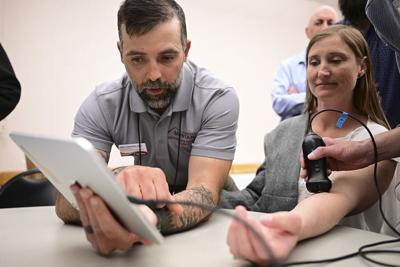
Physician assistants from around the state of Montana participate in an exercise during the Montana Academy of Physician Associates conference on the University of Montana campus on April 23, 2026. UM announced on Wednesday it will launch the only public physician associate program in the state this fall to address a major shortage of healthcare workers in rural communities.
Physician assistants from around the state of Montana participate in an exercise during the Montana Academy of Physician Associates conference on the University of Montana campus on April 23, 2026. UM announced on Wednesday it will launch the only public physician associate program in the state this fall to address a major shortage of healthcare workers in rural communities.
The University of Montana will launch the only public physician associate program in the state this fall to address a major shortage of healthcare workers in rural communities.
The program had over 600 applicants for the 24 slots, according to a University of Montana press release on Thursday. The state of Montana needs around 20 physician associates to fill positions each year to meet healthcare needs and industry growth, according to data from the Montana Department of Labor and Industry.
A master of physician associate studies degree is less costly and requires less schooling than other medical programs, but allows workers to function in similar primary care roles, according to the press release. Montana is one of six states where physician associates can practice independently from physicians after accumulating 8,000 hours of postgraduate clinical experience.
The program begins with 12 months of preclinical instruction in which students will get hands-on experience working in hospitals and other healthcare settings across Montana, including Providence St. Patrick Hospital, under professional mentorship, according to the press release. Students' clinical year consists of rotating programs that focus on family medicine, women’s health, internal medicine and pediatrics.
After their clinical experience, students have two more months of remote post-clinical education aimed at getting students settled at a job location, according to the press release. Staff involved with the program hope students from rural areas within Montana will return to serve their communities after graduating from the 26-month curriculum.
Keep it Clean. Please avoid obscene, vulgar, lewd,
racist or sexually-oriented language. PLEASE TURN OFF YOUR CAPS LOCK. Don't Threaten. Threats of harming another
person will not be tolerated. Be Truthful. Don't knowingly lie about anyone
or anything. Be Nice. No racism, sexism or any sort of -ism
that is degrading to another person. Be Proactive. Use the 'Report' link on
each comment to let us know of abusive posts. Share with Us. We'd love to hear eyewitness
accounts, the history behind an article.



(0) comments
Welcome to the discussion.
Log In
Keep it Clean. Please avoid obscene, vulgar, lewd, racist or sexually-oriented language.
PLEASE TURN OFF YOUR CAPS LOCK.
Don't Threaten. Threats of harming another person will not be tolerated.
Be Truthful. Don't knowingly lie about anyone or anything.
Be Nice. No racism, sexism or any sort of -ism that is degrading to another person.
Be Proactive. Use the 'Report' link on each comment to let us know of abusive posts.
Share with Us. We'd love to hear eyewitness accounts, the history behind an article.